

SAMA says Aramco IPO not causing liquidity issues for banks

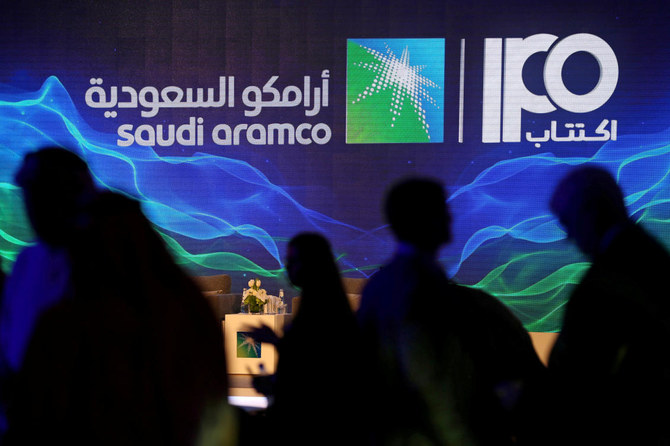
A sign of Saudi Aramco's initial public offering (IPO) is seen during a news conference by the state oil company at the Plaza Conference Center in Dhahran, Saudi Arabia November 3, 2019. (Reuters)
Updated 24 November 2019
Follow

SAMA says Aramco IPO not causing liquidity issues for banks

  • Listing to make Tadawul ‘one of the world’s top 10 biggest stock exchanges,’ says Al-Hussan
  • Saudi Aramco plans to sell 1.5% of the company to raise $25.6 billion

RIYADH: Saudi Arabia’s central bank is monitoring banking indicators on a daily basis and is not seeing any impact on liquidity from oil giant Saudi Aramco’s initial public offering (IPO), its governor said on Sunday.

Saudi Arabian Monetary Authority (SAMA) Gov. Ahmed Al-Kholifey told Reuters on the sidelines of a conference that he had no concerns about liquidity due to the size of Aramco’s IPO.

“We are monitoring all indicators on a daily basis and if there is any squeeze on liquidity, definitely we’ll be injecting liquidity but so far ... everything is assuring,” he said.

Aramco plans to sell 1.5 percent of the company, giving it a potential market value of as much as $1.7 trillion in a deal that is the centerpiece of Crown Prince Mohammed bin Salman’s plans to diversify the oil-dependent economy.

The IPO, which aims to raise as much as $25.6 billion in proceeds, has attracted approximately SR73 billion ($19.5 billion) in institutional and retail orders so far, Saudi Arabia’s Samba Financial Group said on Thursday.

Saudi banks are marketing loans, with some offering four times the usual limits, two financial sources told Reuters earlier this month, adding they were able to do so as they will hold the stock on behalf of clients so have it as security.

“The Saudi banking sector enjoys very high levels of liquidity compared to Basel requirements,” Al-Kholifey earlier told the conference, referring to international banking rules. 

Impact on stock index

Aramco’s weighting in Saudi Arabia’s main stock index once the oil giant has listed shares is not expected to breach the maximum limit set by the Kingdom’s Tadawul exchange, a senior executive said on Sunday.

“There is a ceiling for the maximum weight any listed company on the Saudi index can reach, it will be around 15 percent. It is unlikely that Aramco’s weight will reach the maximum level,” Argaam financial website quoted Tadawul Chief Executive Khalid Al-Hussan, as saying.

Hosting possibly the biggest IPO in history will be a huge leap for Tadawul for the 12-year-old exchange that only admitted foreign investors four years ago.

Hussan, who was speaking at a meeting with businessmen at the Riyadh Chamber of Commerce, said Aramco’s listing will help the Middle East’s largest bourse become one of the world’s top 10 biggest stock exchanges in terms of market value.


Saudi POS spending jumps 28% in final week of Jan: SAMA

Updated 06 February 2026
Follow

Saudi POS spending jumps 28% in final week of Jan: SAMA

RIYADH: Saudi Arabia’s point-of-sale spending climbed sharply in the final week of January, rising nearly 28 percent from the previous week as consumer outlays increased across almost all sectors. 

POS transactions reached SR16 billion ($4.27 billion) in the week ending Jan. 31, up 27.8 percent week on week, according to the Saudi Central Bank. Transaction volumes rose 16.5 percent to 248.8 million, reflecting stronger retail and service activity. 

Spending on jewelry saw the biggest uptick at 55.5 percent to SR613.69 million, followed by laundry services which saw a 44.4 percent increase to SR62.83 million. 

Expenditure on personal care rose 29.1 percent, while outlays on books and stationery increased 5.1 percent. Hotel spending climbed 7.4 percent to SR377.1 million. 

Further gains were recorded across other categories. Spending in pharmacies and medical supplies rose 33.4 percent to SR259.19 million, while medical services increased 13.7 percent to SR515.44 million. 

Food and beverage spending surged 38.6 percent to SR2.6 billion, accounting for the largest share of total POS value. Restaurants and cafes followed with a 20.4 percent increase to SR1.81 billion. Apparel and clothing spending rose 35.4 percent to SR1.33 billion, representing the third-largest share during the week. 

The Kingdom’s key urban centers mirrored the national surge. Riyadh, which accounted for the largest share of total POS spending, saw a 22 percent rise to SR5.44 billion from SR4.46 billion the previous week. The number of transactions in the capital reached 78.6 million, up 13.8 percent week on week. 

In Jeddah, transaction values increased 23.7 percent to SR2.16 billion, while Dammam reported a 22.2 percent rise to SR783.06 million. 

POS data, tracked weekly by SAMA, provides an indicator of consumer spending trends and the ongoing growth of digital payments in Saudi Arabia.  

The data also highlights the expanding reach of POS infrastructure, extending beyond major retail hubs to smaller cities and service sectors, supporting broader digital inclusion initiatives.  

The growth of digital payment technologies aligns with Saudi Arabia’s Vision 2030 objectives, promoting electronic transactions and contributing to the Kingdom’s broader digital economy.