

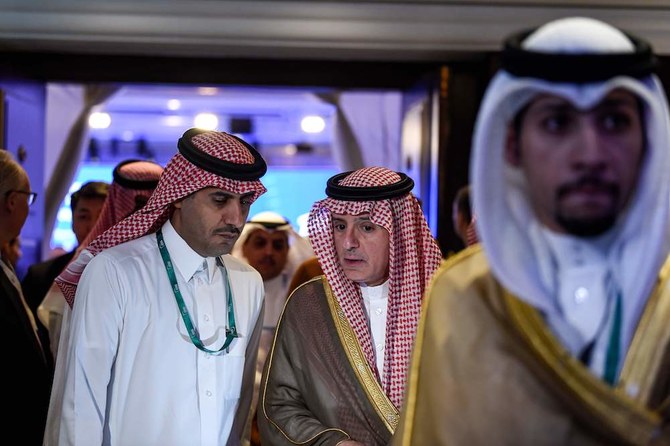
Al-Jubeir calls for ‘deterrence not appeasement’ to halt Iranian aggression towards Saudi Arabia

Adel Al-Jubeir told the Manama Dialogue Saturday that it was impossible to talk with Iran. (AFP)
Updated 23 November 2019
Follow

Al-Jubeir calls for ‘deterrence not appeasement’ to halt Iranian aggression towards Saudi Arabia

  • Minister of state for foreign affairs defended Riyadh’s measured response to attacks against the Kingdom's oil facilities
  • Adel Al-Jubeir said engagement with Iran had failed to work for 40 years

MANAMA: Deterrence is the only way to stop Iran from destabilizing the Middle East and attacking Saudi Arabia, the Kingdom’s minister of state for foreign affairs said Saturday.

An investigation into a drone and missile attack against Saudi oil facilities in September is still ongoing, Adel Al-Jubeir told a regional security conference in Bahrain. 

But he added that both the direction of the attack on the Abqaiq oil processing facility and Khurais oil field, and the types of weapons used meant Saudi Arabia held Iran responsible.

Al-Jubeir defended Riyadh’s measured response to the September strikes, saying the Kingdom was being “strategically very patient” in its investigation so there is “not a shadow of doubt” on where the drones and missiles came from.

“We have said all along we don't want war, so to jump into war very quickly is not a rational position,” he added.

The strikes on the oil facilities followed a series of incidents earlier this year blamed on Iran, including attacks on shipping in and near the Strait of Hormuz.

Faced with increasing US sanctions straining the Iranian economy, Tehran is accused of lashing out against its enemies in the region to prove it can disrupt global energy supplies.

The regime has also started breaking its commitments to an international deal to curb its nuclear program in response to an easing of sanctions. 

Donald Trump withdrew the US from the deal last year and immediately ramped up economic pressure on Iran. European states are scrambling to keep the deal intact.

But Al-Jubeir told the annual Manama Dialogue that deterrence, not appeasement was the only way to deal with Iran.

“The idea that perhaps engagement would cause the Iranians to change their behavior has not worked in 40 years, why would it work in the next four years,” he said. “The key to regional stability is deterrence. The key to regional stability is a steadfast position by the international community to make sure everyone has to abide by the rules of international law. 

“That’s how we can bring about a change in Iran’s behavior. If Iran wants to continue with its destructive past then sanctions should be increased, not reduced.”

Earlier, the French Defence Minister Florence Parly accused the US of failing to respond to Iran’s aggression in the region, including the shooting down of an American surveillance drone in June.

Al-Jubeir disagreed, saying the US had been a dependable ally for the past seven decades.


Najran’s camels are embedded in local culture and traditions

Camels are not only a vital livestock resource in Najran, but also a cornerstone of local identity and tradition. (SPA)
Updated 9 sec ago
Follow

Najran’s camels are embedded in local culture and traditions

  • Several distinct camel breeds are found in the region
  • Animals permeate Arab consciousness, says expert

RIYADH: In Najran, camels are not only a vital livestock resource but also a cornerstone of local identity and tradition.

According to Hadi Benyan Al-Amer, head of Najran’s Camel Association, the region has several distinct camel breeds.

Principal among them is the Awarik, an ancient Arabian lineage linked to territories where arak trees flourish, the Saudi Press Agency reported on Thursday.

These light-colored, sparsely-haired camels possess remarkable resilience, and are prevalent across southern Arabia.

The Majahim are characterized by dark hues spanning black to brown, and excel in both milk yield and endurance.

The Asayil are prized for their sleek, lean physiques, and dominate in speed-based competitions.

Al-Amer said traditional water sources known as Odood, or traditional water wells and artesian wells, have sustained herders navigating the Empty Quarter’s grazing lands for generations.

These permanent water points, equipped with dedicated drinking basins for camels, showcase the animals’ extraordinary environmental resilience.

Among the principal wells accessible from Najran are Al-Minkhali, Abu Shadid, Hamra Nathil, Tamani, Umm Al-Wahat, and Khujaima.

Countless additional wells dot the Empty Quarter and adjacent territories, forming the backbone of camel owners’ far-reaching pastoral networks.

Dr. Hind bint Dawood Al-Shuqair of Najran University’s Arabic Language Department explained how camels have permeated Arab consciousness through legends and stories spanning thousands of years.

Representing endurance, power, and grace, they have become inseparable from Arab cultural identity.

Archaeological evidence at Al-Ukhdood, Mount Al-Tharwa and Hima, preserves through carvings and ancient artwork the deep bond between people and camels, Al-Shuqair said.

She drew attention to Saudi Arabia’s substantial investment in camel heritage, exemplified by proclaiming 2024 as the Year of the Camel.

This designation emphasizes their importance to national prosperity and cultural heritage while backing global initiatives to promote awareness of camels as valuable economic and cultural assets.

The Kingdom further demonstrates its commitment to protecting the animals through the annual King Abdulaziz Festival, the SPA reported.