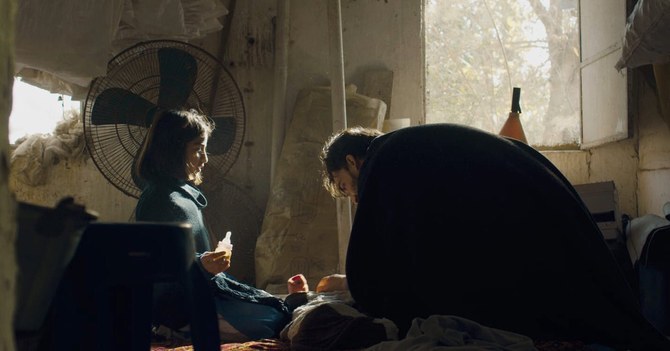
ISLAMABAD: In the opening sequence of Meelad Moaphi’s “Worth”, we are introduced to Darya, baby Ali and their father, Hamid, before the three set out for safer pastures against a backdrop recognizable by many in Pakistan, Afghanistan and other unstable regions in the world.
Viewers soon realise that throughout the short length of the film, the characters will be faced with very tough choices – something that's central to all our lives.
“‘Worth’ was actually distilled from a feature screenplay I wrote,” Moaphi, 32, tells Arab News from Canada where he is currently based, adding that the short film was adapted from a feature screenplay he was writing while studying for his Masters in film production at York University.
“I decided to select a single segment from the feature version and make it adaptable for a short format by modifying a few crucial elements that would give it an ending," he said
Drawn to the artform from a very young age, films for Moaphi – who was born in post Iraq-war Iran – were an integral part of his life.
“I got immersed in filmmaking practically from birth. My father (himself a cinephile) would find and collect VHS copies of Hollywood classics and expand what soon became a collection of nearly 50 films,” Moaphi, who has been making short films since 2009, told Arab News.
“We’re talking about the late 80s in Tehran, there was no internet, no video rentals, no film stores, and practically no films.”
By the time he was six and prior to relocating with his family to Japan, Moaphi had understood the nuances of films such as The Godfather, Lawrence of Arabia, E.T. and Back to the Future without knowing a single word of English. "I could fully grasp their narratives thanks to their profound cinematic syntax.”
“From that point onward, I insisted on wanting to make films without even having grasped an understanding of how they were produced,” Moaphi told Arab News.
“At first, I wanted to be an actor, since I thought they were responsible for a film’s creation. Later, when I learned that there is a crew behind the camera, I wanted to be a producer. Eventually, I learned that it was the director whose role and responsibilities corresponded best to what I wanted to do," he said.
Moaphi soon found his “Worth".
Clocking 13 minutes and 50 seconds, the film was shot in Pakistan and stars a local cast that are central to the film's theme of “parental sacrifice".
“What I wanted to explore was the idea of “parental sacrifice”: how a parent agrees to sacrifice a huge part of himself and submit to the permanent emotional agony that comes with the sacrifice, all for the benefit of their child,” Moaphi told Arab News.
“Almost only in the parent-child dynamic do we see someone willingly inflict such intense emotional pain onto themselves for the benefit of another. So I decided to create a narrative that follows a parent precisely at the moment in which he’s faced with having to undertake a heavy decision," he said.
Set against the backdrop of an unnamed foreign land, Hamid essays the role of Waqas Shahzad to perfection.
Hamid has recently lost his wife and is now faced with the decisions needed to keep his daughter Darya (Dania Jamil) and infant Ali (Syeda Ajwa Bibi) safe.
“‘Worth’ was easily the most memorable filming experience I’ve had thus far, and so much of it was thanks to the incredible time I had in Pakistan and with the Pakistani cast and crew,” Moaphi told Arab News.
“The piece initially had nothing to do whatsoever with Pakistan. The original feature script revolves around Afghan characters who flee to Iran. Long story short, due to practical issues, I wasn’t able to conduct the shoot either in Iran or in Afghanistan. Cheating Canada for that part of the world wouldn’t do the piece justice, so that’s when a friend and colleague, Shehrezade Mian, suggested I apply the script to Pakistan.”
Having had no prior relationship with Pakistan, Moaphi invited Mian on board as an Executive Producer and postponed shooting for three months to lay the ground work for the shoot where much of the detailing took place over Skype and WhatsApp.
With the help of producer and casting director, Ibrahim Khan, the team was able to hit the ground running when Moaphi arrived in Islamabad.
“Within a week we casted actors, held rehearsals, finalized crew, and locked equipment. The locations we secured, which is where most of the film was shot, were in a remote town just outside of Islamabad, called Sarai Kharbuza,” Moaphi said.
“As with any filmmaking endeavour, it was an extremely stressful period, but equally adventurous and totally worthwhile. From the cast to the crew, notably Ali Sattar, our cinematographer, and the folks at Bling Studio, who we partnered with for equipment, everybody gave it all and we were blessed to have had such an incredible team. Making this film became a highly rewarding way to experience a new country and a new culture as it plunged me directly into the heart of Islamabad, and I hope to find future opportunities to not just revisit Pakistan, but to also get involved with more projects there.”
When asked if he thought the film, which is entirely in Urdu, was one that would resonate with most people in Afghanistan and Pakistan, Moaphi said that it actually embodies the global narrative.
“Perhaps, the premise is such that the likelihood of it occurring is higher in certain parts of the world than others, but the themes of parenthood and sacrifice relate to all of us, so it’s a piece that international audiences can relate to," he said.
“Worth” began appearing on the film festival circuit this November with screenings at the Toronto Reel Asian Film Festival, the Vancouver Asian Film Festival, the Izmir International Short Film Festival (in Turkey), and the Asia Peace Film Festival (in Lahore).
At the Vancouver Asian Film Festival, it picked up the Best Short, Best Director, and Best Cinematography prizes in the Canadian category, and at Toronto Reel Asian the Air Canada Short Film prize.
“We’re extremely proud of the great start it has had and hope it can reach audiences in more in many more cities, especially in Pakistan,” Moaphi said.
Though “Worth” will not be widely available until it ends it’s film festival run, Moaphi is hoping to have it seen by Pakistanis as soon as possible.
"The Asian Study Group in Islamabad has generously asked to screen Worth in January. As a film shot in Pakistan, in Urdu, with a local cast and crew, our hope is that it can screen as widely as possible in Pakistan, and also for the Pakistani diaspora in other countries," he said.


![]()

Film on family sacrifice finds its "Worth" in Pakistan
Film on family sacrifice finds its "Worth" in Pakistan
- Shot entirely in Urdu, director says the story embodies "a global narrative"
- Modalities of award-winning piece were discussed for three months over Skype and WhatsApp
Latest updates


© 2026 SAUDI RESEARCH & PUBLISHING COMPANY, All Rights Reserved And subject to Terms of Use Agreement.