

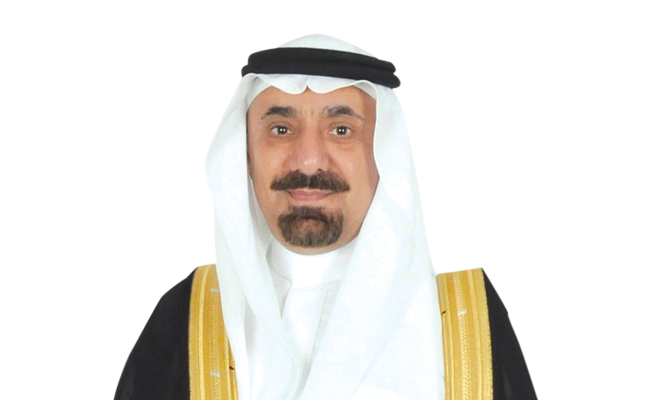
Prince Jalawi bin Abdul Aziz, governor of Najran province

Prince Jalawi bin Abdul Aziz
Updated 22 November 2019
Follow

Prince Jalawi bin Abdul Aziz, governor of Najran province

Prince Jalawi bin Abdul Aziz has been the governor of Najran Province since November 2014. He graduated from the School of Paratroopers and Special Forces Security Center. He has also received a diploma from the British Parachute Association.

Prince Jalawi also received a badge of honor for his role in Operation Desert Storm and a medal for the liberation of Kuwait.

Previously, Prince Jalawi served as deputy governor of Tabuk from April 2000 until July 2004.

He was then the deputy governor of the Eastern Province from July 2004 until November 2014.

Prince Jalawi praised the inclusiveness and clarity of King Salman’s speech on Wednesday during the annual session of the Shoura Council in Riyadh.

He said that the king’s speech was comprehensive in understanding local, political, security and economic spaces, adding that it was clear in determining the Kingdom’s positions on issues in the world.

He added that Saudi people will appreciate the speech in light of the progress being delivered by the wise leadership through the Saudi Vision 2030 reform plans, and that Crown Prince Mohammed bin Salman is advancing toward a bright future that reinforces greatness and individualism.

He said: “King Salman’s speech reflects the nature of the relationship between the king and the gracious people, as he thanked and praised men and women for their positions in eliminating forms of extremism, and for their decent treatment of tourists and residents.”


Iranian ambassador thanks Saudi for not allowing territory to be used during war

Updated 05 March 2026
Follow

Iranian ambassador thanks Saudi for not allowing territory to be used during war

  • Alireza Enayati tells AFP Iran appreciates Kingdom's pledge not to allow its 'airspace, waters, or territory' to be used in US attacks
  • Envoy also denies that his country hit the US embassy in Riyadh this week with drones

RIYADH: Iran’s ambassador to Saudi Arabia Alireza Enayati said on Thursday his country remained appreciative of Saudi Arabia’s pledge to not allow its airspace or territory to be used during the ongoing war with the US and Israel.
“We appreciate what we have repeatedly heard from Saudi Arabia — that it does not allow its airspace, waters, or territory to be used against the Islamic Republic of Iran,” he told AFP.
Before the outbreak of war, Riyadh had thrown its support behind diplomatic efforts to diffuse tensions between Tehran and Washington and vowed that its airspace would not be allowed to be used for attacks against Iran.
Enayati also categorically denied that his country hit the US embassy in Riyadh this week, after Saudi officials said Iran targeted the compound with drones.
Saudi Arabia has repeatedly accused Tehran of launching missile salvos and drone attacks at its territory and warned that the kingdom reserved the right to defend itself, including by retaliating.
Iran had earlier denied attacking the sprawling Ras Tanura refinery — one of the largest in the Middle East — which Riyadh had also accused Tehran of targeting twice with drones.
Enayati added to the denial, saying Iran also had no hand in the targeting of the US embassy that triggered a fire at the compound.
“We confirmed that Iran has no role in the attack on the US embassy in Riyadh,” the ambassador told AFP.
“If the operations command in Tehran attacks somewhere, it takes responsibility for it.”
The war in the Middle East has engulfed the otherwise stable Gulf region as Iran retaliates over US and Israeli strikes that killed its supreme leader, launching strikes at Israel, the wider region and beyond.
At least 13 people have been killed in the Gulf, including seven civilians, since Iran began its attacks on Saturday.
Enayati, however, denied that Iran was waging a regional war as retaliation for the attacks on his country by the US and Israel.
“This is not a regional war and it is not our war. It was imposed on the region,” he told AFP.