

EU should recognize Palestinian state, says Luxembourg

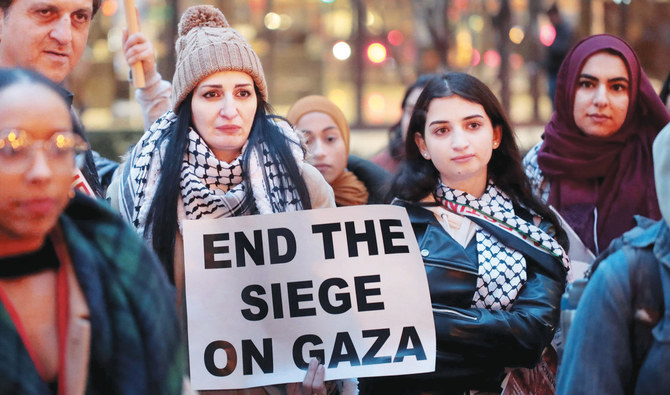
Demonstrators stage a protest in Chicago against the killings of Palestinians in airstrikes in Gaza. Nearly 30 Palestinians have been killed in the attacks. (AFP)
Updated 22 November 2019
Follow

EU should recognize Palestinian state, says Luxembourg

  • Palestinians say the settlements jeopardize their goal of a state in the West Bank and Gaza Strip

BERLIN: The EU should recognize a Palestinian state after the US expressed support for Israeli settlements in the occupied West Bank, Luxembourg Foreign Minister Jean Asselborn said.

Monday’s announcement by Secretary of State Mike Pompeo abandoned the position that settlements in Israeli-occupied territory were “inconsistent with international law,” reversing a stand taken under President Jimmy Carter in 1978.

Palestinians say the settlements jeopardize their goal of a state in the West Bank and Gaza Strip, with East Jerusalem as its capital, and that the US move will make an Israeli-Palestinian peace deal even more elusive.

“Recognizing Palestine as a state would be neither a favor nor a carte blanche but rather a mere recognition of the right of the Palestinian people to its own state,” Asselborn said. 

“It would not be meant against Israel,” he added, but a measure intended to pave the way for a two-state solution.

The US decision was a victory for Israeli Prime Minister Benjamin Netanyahu, who is struggling to remain in power after two inconclusive Israeli elections this year, and a defeat for the Palestinians.

It could deliver a new blow to President Donald Trump’s efforts to resolve the Israeli-Palestinian conflict through a peace plan that has been in the works for more than two years but has drawn widespread skepticism even before its release.

The EU said after the US announcement that it continued to believe that Israeli settlement building in occupied Palestinian territory was illegal under international law.

HIGHLIGHTS

• Israeli forces detained Adnan Ghaith, Palestinian governor of Jerusalem, taking him from his home in the city’s east for interrogation, police said.

• Israeli authorities earlier closed the offices of two Palestinian Authority-affiliated organizations in Jerusalem.

The European Parliament adopted a resolution in 2014 supporting Palestinian statehood in principle. The motion was a compromise reached after lawmakers on the left sought to urge the EU’s 28 member states to recognize Palestine unconditionally.

Since the collapse of US-sponsored peace talks in 2014, Israel has pressed on with building settlements in territory the Palestinians want for their future state.

More than 135 countries already recognize a Palestinian state, including several East European countries that did so before they joined the EU.

Netanyahu’s chief rival announced that he had failed to form a new government, dashing his hopes of toppling the long-time Israeli prime minister and pushing the country closer toward an unprecedented third election in less than a year.

The announcement by Benny Gantz, leader of the centrist Blue and White party, prolongs the political paralysis that has gripped the nation for the past year. It also provides a new lifeline for the embattled Netanyahu, who is desperate to remain in office as he prepares for an expected indictment on corruption charges, possibly as early as Thursday.

Gantz, a former military chief, was tapped to form a government last month after Netanyahu failed to cobble together a coalition in the wake of inconclusive
September elections. 

But during four weeks of intense negotiations, Gantz was unable to muster the support of a required 61-member majority in the 120-seat parliament by Wednesday’s midnight deadline.

Addressing reporters, Gantz accused Netanyahu of scuttling attempts to form a broad-based unity government between
their parties.

“He should have come to terms with the fact that the outcome of the elections required him to negotiate directly, with no blocks or barriers,” Gantz said angrily.

“Most of the people chose a liberal unity government headed by Blue and White,” he added. 

“Most of the people voted to weaken the power of extremists, and most of the people voted to go on a different path from that of Netanyahu in recent years.”

Rubio plans to update Netanyahu on US-Iran talks in Israel next week, officials say

Updated 8 sec ago
Follow

Rubio plans to update Netanyahu on US-Iran talks in Israel next week, officials say

WASHINGTON: Secretary of State Marco Rubio plans to travel to Israel next week to update Israeli Prime Minister Benjamin Netanyahu on the US-Iran nuclear talks, two Trump administration officials said.
Rubio is expected to meet with Netanyahu on Feb. 28, according to the officials, who spoke Wednesday on condition of anonymity to detail travel plans that have not yet been announced.
The US and Iran recently have held two rounds of indirect talks over the Islamic Republic’s nuclear program.
Iran has agreed to draw up a written proposal to address US concerns that were raised during this week’s Geneva talks, according to another senior US official who was not authorized to comment publicly and spoke on the condition of anonymity.
That official said top national security officials gathered Wednesday in the White House Situation Room to discuss Iran, and were briefed that the “full forces” needed to carry out potential military action are expected to be in place by mid-March. The official did not provide a timeline for when Iran is expected to deliver its written response.
Officials from both the US and Iran had publicly offered some muted optimism about progress this week, with Iranian Foreign Minister Abbas Araghchi even saying that “a new window has opened” for reaching an agreement.
“In some ways, it went well,” US Vice President JD Vance said about the talks in an interview Tuesday with Fox News Channel. “But in other ways, it was very clear that the president has set some red lines that the Iranians are not yet willing to actually acknowledge and work through.”
Netanyahu visited the White House last week to urge President Donald Trump to ensure that any deal about Iran’s nuclear program also include steps to neutralize Iran’s ballistic missile program and end its funding for proxy groups such as Hamas and Hezbollah.
Trump is weighing whether to take military action against Tehran as the administration surges military resources to the region, raising concerns that any attack could spiral into a larger conflict in the Middle East.
On Friday, Trump told reporters that a change in power in Iran “seems like that would be the best thing that could happen.” He added, “For 47 years, they’ve been talking and talking and talking.”
The Trump administration has dispatched the USS Gerald R. Ford, the world’s largest aircraft carrier, from the Caribbean Sea to the Mideast to join a second carrier as well as other warships and military assets that the US has built up in the region.
Dozens of US fighter jets, including F-35s, F-22s and F-16s, have left bases in the US and Europe in recent days to head to the Middle East, according to the Military Air Tracking Alliance, a team of about 30 open-source analysts that routinely analyzes military and government flight activity.
The team says it’s also tracked more than 85 fuel tankers and over 170 cargo planes heading into the region.
Steffan Watkins, a researcher based in Canada and a member of the MATA, said he also has spotted support aircraft like six of the military’s early-warning E-3 aircraft head to a base in Saudi Arabia.
Those aircraft are key for coordinating operations with a large number of aircraft. He says they were pulled from bases in Japan, Germany and Hawaii.