

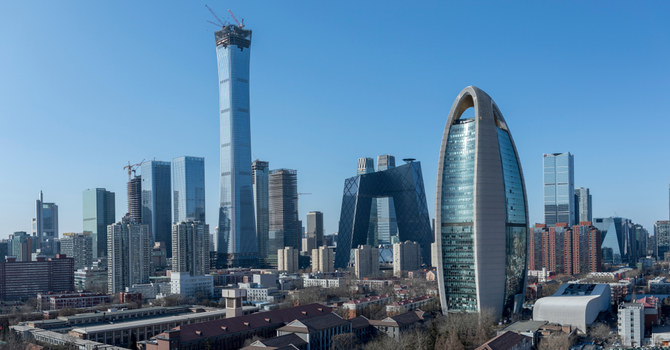

Thought leaders from the business world and the global political scene are descending on the Chinese capital Beijing for the New Economy Forum (NEF) run by the information and media giant Bloomberg.
The two-day event aims to encourage solutions from the private sector to some of the big challenges the global economy faces today — trade, climate change, technology and financial volatility. It will also prioritize issues of inclusion, urbanization and governance.
Justin Smith, chief executive officer of Bloomberg Media, told Arab News — which is a media partner for the event — that some 500 delegates would attend the forum, with about 200 coming from institutions within China.
“The reason we’re bringing people together is to produce a platform for discussion between people who represent the new global economy. There is a whole new class of people from Asia, the Middle East, Africa and Latin America who are not represented well in the ‘legacy gatherings’ that take place, which are typically more American and European oriented.
“The idea is to enable people at a principle level — chief executives, ministers, leaders — to have substantive conversations to find solutions to global problems and help mitigate the big issues the world faces. This is not just a talking shop,” he said.
Some 500 senior leaders will attend the gathering, of which about 200 will come from Chinese institutions. “There will be a big Chinese involvement, but this is because of how important China is in the global economy. This really is a one-of-a-kind gathering,” Smith said.
The opening keynote will be delivered by a senior member of the leadership of the Peoples Republic, whose identity has not been officially disclosed amid tight security at the conference venue outside Beijing city center.
While the issue of trade wars between China and the US will be a big issue at the gathering, Smith said that it was not the most important one. “This is not a US-China gathering — it is a global gathering located in Beijing,” he said.
Americans attending the event include former secretary of state Henry Kissinger, as well as Hank Paulson, who was Treasury secretary during the global financial crisis, and Janet Yellen, former chair of the US Federal Reserve.
There is a significant delegation from the Middle East, including Saudi business leader Lubna Olayan, as well as executives and policy-makers from other Arabian Gulf countries.
“The Middle East’s role in the new economy is critical. It has increasingly deep ties with China, but also has strong links with Europe and the West. They are in between western capitalism and state capitalism,” Smith said.


