

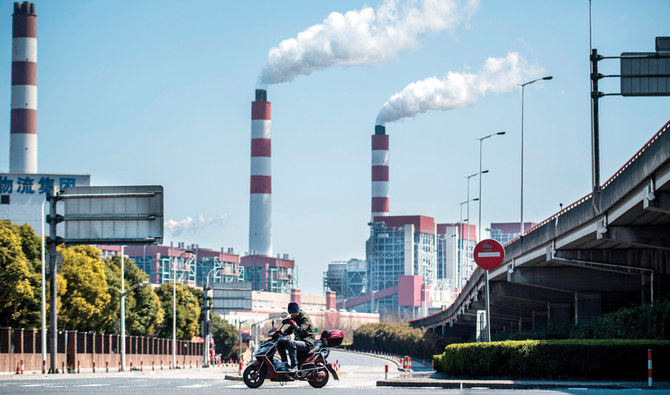
China coal-fired power capacity on the rise

To cut pollution and greenhouse gas emissions to meet global demand, China has promised an ‘energy revolution’ aimed at reducing its reliance on coal. (AFP)
Updated 21 November 2019
Follow

China coal-fired power capacity on the rise

  • 40 new coal mines approved in the first three quarters of 2019

SHANGHAI: China raised its coal-fired power capacity by 42.9 gigawatts (GW), or about 4.5 percent, in the 18 months to June, connecting new projects to the grid at a time when capacity in the rest of the world shrank, according to a study published on Wednesday.

China also has another 121.3 GW of coal-fired power plants under construction, US-based research network Global Energy Monitor said in its report, nearly enough to power the whole of France.

The increase followed a 2014-2016 “permitting surge” by local governments aiming to boost growth while formerly suspended projects have also been restarted, Global Energy Monitor said. In the rest of the world, coal-fired power capacity fell 8.1 GW over the same period.

To cut pollution and greenhouse gas emissions, China has promised an “energy revolution” aimed at dramatically reducing its reliance on coal. It cut coal’s share of the country’s total energy from 68 percent in 2012 to 59 percent last year, and researchers predict it will fall to 55.3 percent by 2020.

Absolute coal consumption, however, has continued to increase in line with a rise in overall Chinese energy demand.

Environmental groups have accused Beijing of relaxing its efforts on coal, pointing to remarks in October by Premier Li Keqiang, who urged China to make greater use of its coal “endowment” by building clean power plants.

China approved 40 new coal mines in the first three quarters of 2019, and it has continued to make use of “green” financing to support coal-related projects.

China’s total coal-fired power capacity stands at more than 1,000 GW. Global Energy Monitor said it needed to close more than 40 percent of that to meet greenhouse gas reductions.

It urged the government to strengthen policies discouraging coal plants, support low-carbon power and move toward clean energy, while an investor body warned of the risk of building new coal-fired plants.

“Over 40 percent of China’s existing coal fleet is already estimated to be loss making,” said Stephanie Pfeifer, chief executive of the Institutional Investors Group on Climate Change.

Though costs are now as low as fossil fuels, some Chinese policymakers worry renewables like wind and solar are unreliable, and there are concerns that decarbonisation will hurt the country’s coal regions.

Some also believe that future energy shortages could hurt China’s attempts to address its slowing economy, said Yang Fuqiang, senior adviser with the Natural Resources Defense Council, a US environment group.

“Right now there is a big argument about whether China needs more coal-fired power or not,” he told Reuters. “They think the 14th five-year plan (2021-2025) will stimulate economic development and they are a little afraid there won’t be enough electricity to support the economy.”


Saudi Arabia opens 3rd round of Exploration Empowerment Program

Updated 01 February 2026
Follow

Saudi Arabia opens 3rd round of Exploration Empowerment Program

RIYADH: Saudi Arabia’s Ministry of Industry and Mineral Resources, in collaboration with the Ministry of Investment, has opened applications for the third round of the Exploration Empowerment Program, part of ongoing efforts to accelerate mineral exploration in the Kingdom, reduce early-stage investment risks, and attract high-quality investment from local and international mining companies.

The third round of the Exploration Empowerment Program offers a comprehensive support package targeting exploration companies and mineral prospecting license holders.

The initiative aims to lower investment risks for projects and support a faster transition from prospecting to development.

"The program provides coverage of up to 70 percent of the total salaries of Saudi technical staff, such as geologists, during the first two years, increasing to 100 percent thereafter, in line with program requirements.

This support aims to develop talent, build national capabilities in mineral exploration, promote job localization, and facilitate the transfer of geological knowledge.

The application for the third round opened on Jan. 14, allowing participants to benefit from the Kingdom’s attractive investment environment, its stable legal framework, and streamlined regulatory structures, as well as integrated infrastructure that supports the transition from mineral resources to operational mines.

The ministry has set the timeline for the third round, with the application period running from Jan. 14 to March 31.

This will be followed by the evaluation, approval, and signing of agreements from April 1 to May 31, with the eligible projects set to be announced between June 1 and July 31 of the same year.

The program stages include submitting exploration data during the reimbursement and payment phase from Sept. 1 to Nov. 30, followed by technical and financial verification of work programs and approval of the disbursement of support funds in January 2027.

The exploration data will then be published on the National Geological Database in April 2027.

The ministry emphasized that the EEP focuses on supporting the exploration of strategically important minerals with national priority. It also contributes to enhancing geological knowledge by providing up-to-date data that meets international standards, helping investors make informed decisions and supporting the growth of national companies and local supply chains.

The ministry urged companies to apply early to benefit from the program’s third round, which coincided with the fifth edition of the International Mining Conference, which was held from Jan. 13 to 15.