RIYADH: Saudi Arabia seeks a political settlement in Yemen and hoped that a recent agreement signed in Riyadh would open the door to broader peace talks, King Salman said on Wednesday.
The king was speaking at an annual address to the Shoura Council.
King Salman said “we deserve to feel proud of our nation’s success in eliminating extremist manifestations, and besieging its ideology by all means, to return to moderation, which is a characteristic of the Saudi society.”
Saudi Arabia and its allies intervened in the conflict in 2015, shortly after the Iran-backed Houthi militia took over the capital Sanaa.
He said the Kingdom’s oil policy aims to promote stability in global oil markets and looks to serve consumers and producers alike.
King Salman also said the initial public offering of Saudi Aramco will allow investors inside and outside the Kingdom to take part and will create thousands of jobs.
The revenues from the sale, he said, will be allocated to the country’s Public Investment Fund.
He said Aramco’s ability to quickly restore oil production capacity after attacks in September proved the Kingdom could meet global demand during any shortage.
“Though the kingdom has been subjected to attacks by 286 ballistic missiles and 289 drones, in a way that has not been seen in any other country, that has not affected the kingdom’s development process or the lives of its citizens and residents,” the king told assembled council members, royals and foreign diplomats.
In the latest attack on September 14, drone strikes targeted two Saudi oil facilities, temporarily knocking out half of the kingdom’s oil production.
The attacks were claimed by the Houthis, but Washington and Riyadh said Iran was responsible, and that the strikes were carried out with advanced missiles and drones.
King Salman also urged Iran to abandon an expansionist ideology that has “harmed” its own people, following violent street protests in the Islamic republic.
A wave of demonstrations erupted in the sanctions-hit country on Friday after an announcement that petrol prices would be raised by as much as 200 percent with immediate effect.
“We hope the Iranian regime chooses the side of wisdom and realizes there is no way to overcome the international position that rejects its practices, without abandoning its expansionist and destructive thinking that has harmed its own people,” the king told the consultative Shoura Council.
The region’s leading Shiite and Sunni powers have no diplomatic ties and are at odds over a range of issues, including the wars in Syria and Yemen.
“The kingdom has suffered from the policies and practices of the Iranian regime and its proxies,” King Salman said, quoted by the foreign ministry, reiterating that Riyadh does not seek war but is “ready to defend its people.”
Meanwhile, King Salman hailed the Kingdom’s “huge achievements” in the past decades, adding that the country is determined to record further achievements through its Vision 2030.
He also mentioned that Saudi Arabia has been ranked in 2019 by the World Bank as the “most advanced and first reformed country among 190 countries in the world.
King Salman also commended his government’s decision to grant tourist visas, describing the move as a way to attract investments, create jobs and showcase Saudi heritage and culture.
Earlier during the meeting, Dr. Abdullah Al-Asheikh reviewed the Shoura Council’s accomplishments during the third year of the seventh session.
Al-Asheikh said: “Thanks to the support of the wise leadership and the council’s cooperation with the Cabinet, ministries and governmental bodies, the council was able to achieve significant accomplishments, where it held 65 sessions and issued 262 decisions that were referred to King Salman, to serve our dear country and guarantee welfare and prosperity for our people.”


![]()

Riyadh Agreement to ‘open the door’ for broader peace talks on Yemen, says King Salman
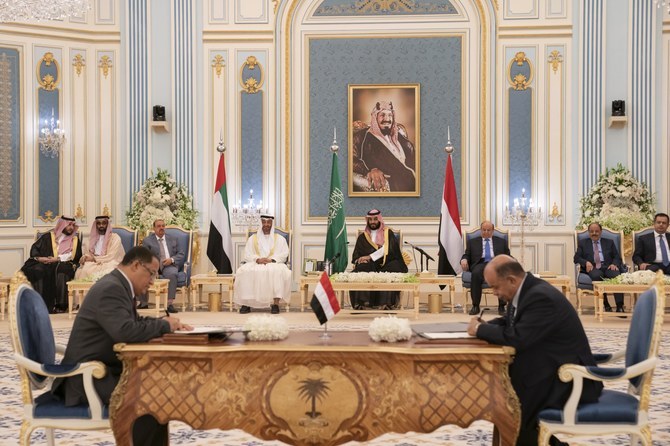
Riyadh Agreement to ‘open the door’ for broader peace talks on Yemen, says King Salman
- King Salman said the oil policy of the Kingdom is aimed at promoting market stability
- He urged Iran to abandon an expansionist ideology that has ‘harmed’ its own people
Latest updates


© 2026 SAUDI RESEARCH & PUBLISHING COMPANY, All Rights Reserved And subject to Terms of Use Agreement.