Militant violence putting ‘generation at risk’ in Africa’s Sahel-WFP

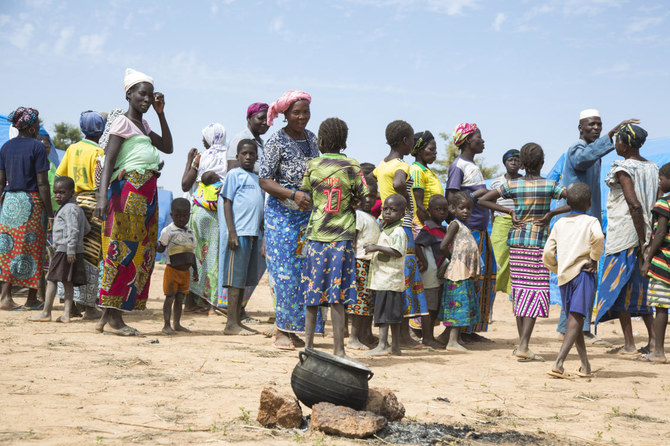
In this photograph taken Wednesday Nov. 13, 2019 and released by the World Food Program (WFP), Zore Yusef, 61, right, and his family, join other refugees in the Pissila camp, north of the capital Ouagadougou, Burkina Faso. (AP)
Updated 20 November 2019
Follow

Militant violence putting ‘generation at risk’ in Africa’s Sahel-WFP

  • Groups with links to Al-Qaeda and Daesh have in recent years spread across the arid scrublands of the Sahel

GENEVA: Extremist violence in Mali, Niger and Burkina Faso has forced nearly 1 million people to flee their homes, destroyed fragile agricultural economies and hobbled humanitarian aid efforts, the World Food Programme (WFP) said on Tuesday.
Groups with links to Al-Qaeda and Daesh, once confined to lawless areas of northern Mali, have in recent years spread across the arid scrublands of the Sahel, to the south of the Sahara, into Burkina Faso and Niger, stoking local ethnic conflicts and attacking security forces wherever they go.
“The world does not yet fully grasp the extent of the mounting humanitarian crisis in the central Sahel region,” said WFP spokesman Herve Verhoosel. “If we do not act now to tackle hunger in the Sahel, a whole generation are at risk.”
In all, 860,000 people have been displaced across the three countries and 2.4 million are in need of urgent food assistance, the WFP said. But a lack of security stops most of the aid reaching those in need.
Despite the presence of growing ranks of international troops, the violence continues to spread.
On Monday, unidentified gunmen killed 24 Malian soldiers and wounded 29 in an ambush that bore the hallmarks of a extremist attack. It was the third major attack against the army in less than two months that together have killed over 100 soldiers.
Those attacks mark a step-up in violence, according to records from Armed Conflict Location and Event Data Project, an NGO. In 2019, about 95 members of the Malian security forces, including soldiers, policemen, gendarmes and other officials, were killed. So far in 2019, about 249 have died.
Peace has been shattered in Burkina Faso, where in the first half of 2019 civilian deaths were four times what they were for the whole of 2018. One third of the country is now in a conflict zone, the WFP said. There were 480,000 people displaced at the end of 2018, which is expected to rise to 650,000 by the end of 2019.


Indonesia reaffirms Yemen’s territorial integrity, backs stability efforts amid tensions

Updated 01 January 2026
Follow

Indonesia reaffirms Yemen’s territorial integrity, backs stability efforts amid tensions

  • Statement comes after Saudi Arabia bombed a UAE weapons shipment at Yemeni port city
  • Jakarta last week said it ‘appreciates’ Riyadh ‘working together’ with Yemen to restore stability

JAKARTA: Indonesia has called for respect for Yemen’s territorial integrity and commended efforts to maintain stability in the region, a day after Saudi Arabia bombed a weapons shipment from the UAE at a Yemeni port city that Riyadh said was intended for separatist forces. 

Saudi Arabia carried out a “limited airstrike” at Yemen’s port city of Al-Mukalla in the southern province of Hadramout on Tuesday, following the arrival of an Emirati shipment that came amid heightened tensions linked to advances by the UAE-backed Southern Transitional Council in the war-torn country. 

In a statement issued late on Wednesday, the Indonesian Ministry of Foreign Affairs said it “appreciates further efforts by concerned parties to maintain stability and security,” particularly in the provinces of Hadramout and Al-Mahara. 

“Indonesia reaffirms the importance of peaceful settlement through an inclusive and comprehensive political dialogue under the coordination of the United Nations and respecting Yemen’s legitimate government and territorial integrity,” Indonesia’s foreign affairs ministry said. 

The latest statement comes after Jakarta said last week that it “appreciates the efforts of the Kingdom of Saudi Arabia, as well as other relevant countries, working together with Yemeni stakeholders to de-escalate tensions and restore stability.” 

Saudi Arabia leads the Coalition to Restore Legitimacy in Yemen, which includes the UAE and was established in 2015 to combat the Houthi rebels, who control most of northern Yemen. 

Riyadh has been calling on the STC, which initially supported Yemen’s internationally recognized government against the Houthi rebels, to withdraw after it launched an offensive against the Saudi-backed government troops last month, seeking an independent state in the south.  

Indonesia has also urged for “all parties to exercise restraint and avoid unilateral action that could impact security conditions,” and has previously said that the rising tensions in Yemen could “further deteriorate the security situation and exacerbate the suffering” of the Yemeni people. 

Indonesia, the world’s biggest Muslim-majority country, maintains close ties with both Saudi Arabia and the UAE, which are its main trade and investment partners in the Middle East.