Cabinet decides not to appeal court order allowing Sharif to leave Pakistan

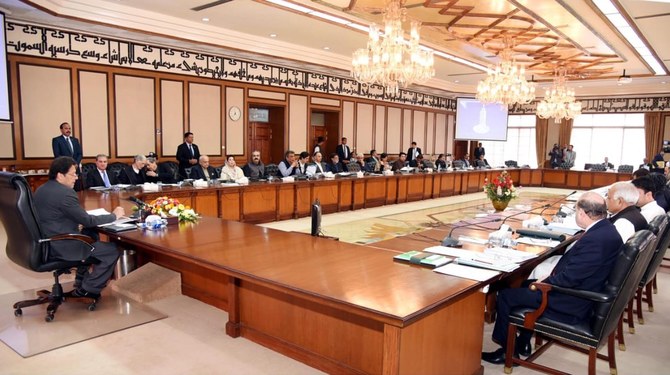
Prime Minister Imran Khan chairs meeting of the Federal Cabinet at PM Office Islamabad on 19th November, 2019. (PID Photo)
Updated 20 November 2019
Follow

Cabinet decides not to appeal court order allowing Sharif to leave Pakistan

  • Accountability process is for everyone, says the law minister
  •  Government says collecting data to provide relief to elderly prisoners

ISLAMABAD: Pakistan’s federal cabinet decided on Tuesday it would not appeal a court verdict that allowed the country’s ailing former prime minister, Nawaz Sharif, to travel abroad for medical treatment.

“The cabinet has decided not to file an immediate appeal against a Lahore High Court verdict,” Federal Minister for Law Farogh Naseem said while addressing a news conference in Islamabad.

The Lahore High Court on Saturday permitted Sharif to leave Pakistan for four weeks on medical grounds, without imposing any other conditions. The court said he could also apply for an extension to the bail period if his treatment required him to stay abroad for a longer duration.

69-year-old three-time premier, Sharif on Tuesday left for London on an air ambulance. He is suffering from an autoimmune blood disorder and was recently released on an eight-week medical bail from a prison facility in Lahore where he was serving a seven-year sentence on corruption charges.

The former prime minister, who has dominated Pakistan’s politics for about three decades, denies all corruption allegations against him, claiming they are politically motivated.

The government of Sharif’s rival, Prime Minister Imran Khan, had earlier said it would not stand in the way, though it demanded him to pay indemnity bonds of seven billion Pakistani rupees last week, which Sharif's party, the Pakistan Muslim League-Nawaz (PML-N), immediately rejected.

After days of political deadlock, the court has granted the PML-N founding leader four weeks to receive treatment after getting an undertaking from him and his younger brother Shehbaz Sharif that he would return to Pakistan soon after his medical recovery.

“We respect the court’s verdict …. The Pakistan High Commission in London and the British government will be informed about Nawaz Sharif’s illness and stay over there [for medical treatment],” the law minister said.

He added that the court would decide about the indemnity bond in January while clarifying that Prime Minister Khan did not have any personal “agenda” against the opposition. “We believe in accountability for all …. There is a need to make the criminal justice system more effective,” he continued.

Naseem said the government was collecting data of elderly and other prisoners involved in petty crime and “the cabinet will review all the cases [to provide them legal relief].”

Earlier in the day, in a veiled reference to Sharif’s departure to London for medical treatment, National Accountability Bureau Chairman Javed Iqbal said that while multiple people were sharing a single hospital bed in the country, there were others who were going abroad – “London or the US” – for treatment “even when they caught a cold.”

“Are the rest of us not humans …. God has created everyone equal,” he said while speaking at an event in Islamabad.


Pakistan approves first national gemstones policy, targets $1 billion exports

Updated 09 January 2026
Follow

Pakistan approves first national gemstones policy, targets $1 billion exports

  • Government seeks to overhaul certification, mining, processing to curb smuggling and boost value-added exports
  • Move follows broader push to tap Pakistan’s vast mineral wealth and attract much-needed foreign investment

ISLAMABAD: Pakistan has granted in-principle approval to its first national policy framework for gemstones and precious stones, aiming to reform the sector, align it with international standards and lift annual exports to $1 billion within five years, the prime minister’s office said on Friday.

The decision was taken during a meeting chaired by Prime Minister Shehbaz Sharif, which reviewed reforms for the largely underdeveloped gemstones sector despite Pakistan holding significant reserves of emeralds, rubies, sapphires, peridot and topaz.

The move comes as Pakistan intensifies efforts to monetize its untapped mineral resources amid fiscal pressures and an IMF-backed reform program. Over the past two years, Islamabad has hosted international minerals conferences and signed cooperation agreements with countries including the United States, Saudi Arabia and China to improve governance, attract foreign investment and move up the value chain in mining and minerals processing.

Despite officials estimating Pakistan’s gemstone reserves at around $450 billion, formal exports remain negligible, at about $5.8 million annually, due to weak certification systems, limited domestic processing capacity, widespread smuggling and fragmented regulation across federal and provincial authorities.

“Sharif has granted in-principle approval to a national policy framework to reform Pakistan’s gemstones and precious stones sector and align it with international standards,” the PM’s office said in a statement. 

“The Ministry of Industries and Commerce, after identifying challenges during the preparation of the national policy framework, has developed a comprehensive set of priority policy measures which aim to achieve $1 billion in gemstone-related exports within five years through sectoral reforms.”

According to the statement, the policy framework includes geological mapping to accurately assess reserves, the establishment of internationally accredited laboratories and certification regimes and the creation of a dedicated authority to regulate and promote the sector. The government also plans to set up a National Warranty Office and at least two centers of excellence this year to support training, research and value-added processing.

The policy prioritizes private sector participation, particularly encouraging young entrepreneurs, and seeks to shift Pakistan away from exporting raw stones toward domestic cutting, polishing and branding. The statement said this approach could significantly increase export earnings while generating skilled jobs.

The prime minister also directed the ministry of finance to ensure timely allocation of financial resources required to implement the reforms and stressed the need to involve provincial governments, industry stakeholders and international experts to address structural bottlenecks.

“Pakistani precious stones are renowned globally for their quality, and curbing smuggling while ensuring exports through legal channels will secure billions of dollars in foreign exchange,” the prime minister said, according to the statement.