

Cabinet decides not to appeal court order allowing Sharif to leave Pakistan

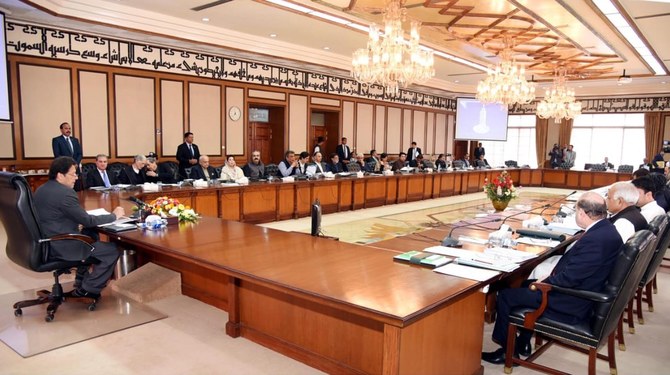
Prime Minister Imran Khan chairs meeting of the Federal Cabinet at PM Office Islamabad on 19th November, 2019. (PID Photo)
Updated 20 November 2019
Follow

Cabinet decides not to appeal court order allowing Sharif to leave Pakistan

  • Accountability process is for everyone, says the law minister
  •  Government says collecting data to provide relief to elderly prisoners

ISLAMABAD: Pakistan’s federal cabinet decided on Tuesday it would not appeal a court verdict that allowed the country’s ailing former prime minister, Nawaz Sharif, to travel abroad for medical treatment.

“The cabinet has decided not to file an immediate appeal against a Lahore High Court verdict,” Federal Minister for Law Farogh Naseem said while addressing a news conference in Islamabad.

The Lahore High Court on Saturday permitted Sharif to leave Pakistan for four weeks on medical grounds, without imposing any other conditions. The court said he could also apply for an extension to the bail period if his treatment required him to stay abroad for a longer duration.

69-year-old three-time premier, Sharif on Tuesday left for London on an air ambulance. He is suffering from an autoimmune blood disorder and was recently released on an eight-week medical bail from a prison facility in Lahore where he was serving a seven-year sentence on corruption charges.

The former prime minister, who has dominated Pakistan’s politics for about three decades, denies all corruption allegations against him, claiming they are politically motivated.

The government of Sharif’s rival, Prime Minister Imran Khan, had earlier said it would not stand in the way, though it demanded him to pay indemnity bonds of seven billion Pakistani rupees last week, which Sharif's party, the Pakistan Muslim League-Nawaz (PML-N), immediately rejected.

After days of political deadlock, the court has granted the PML-N founding leader four weeks to receive treatment after getting an undertaking from him and his younger brother Shehbaz Sharif that he would return to Pakistan soon after his medical recovery.

“We respect the court’s verdict …. The Pakistan High Commission in London and the British government will be informed about Nawaz Sharif’s illness and stay over there [for medical treatment],” the law minister said.

He added that the court would decide about the indemnity bond in January while clarifying that Prime Minister Khan did not have any personal “agenda” against the opposition. “We believe in accountability for all …. There is a need to make the criminal justice system more effective,” he continued.

Naseem said the government was collecting data of elderly and other prisoners involved in petty crime and “the cabinet will review all the cases [to provide them legal relief].”

Earlier in the day, in a veiled reference to Sharif’s departure to London for medical treatment, National Accountability Bureau Chairman Javed Iqbal said that while multiple people were sharing a single hospital bed in the country, there were others who were going abroad – “London or the US” – for treatment “even when they caught a cold.”

“Are the rest of us not humans …. God has created everyone equal,” he said while speaking at an event in Islamabad.


Pakistan’s president defends ongoing strikes in Afghanistan, urges Kabul to dismantle militants

Updated 02 March 2026
Follow

Pakistan’s president defends ongoing strikes in Afghanistan, urges Kabul to dismantle militants

  • Afghanistan on Thursday launched attacks in retaliation for Pakistani airstrikes the previous Sunday
  • Pakistan’s military says it is only targeting Afghan military installations to avoid civilian casualties

ISLAMABAD: Pakistan’s president on Monday defended his country’s ongoing military strikes in neighboring Afghanistan, saying Islamabad tried all forms of diplomacy before targeting militants operating from Afghan territory, and called on the Taliban government in Kabul to disarm groups responsible for attacks in Pakistan.

Pakistan earlier said it is in “open war” with Afghanistan, alarming the international community. The border area remains a stronghold for militant organizations including Al-Qaeda and the Daesh (Islamic State) group.

“(The Afghan Taliban) must choose to dismantle the terror groups that survive on conflict and its war economy,” Asif Ali Zardari said during a speech to lawmakers, adding that “no state accepts serial attacks on its soil.”

Afghanistan on Thursday launched attacks in retaliation for Pakistani airstrikes the previous Sunday. Since then, Pakistan has carried out operations along the border, with Information Minister Attaullah Tarar claiming the killing of 435 Afghan forces and the capture of 31 Afghan positions.

Kabul has denied such claims.

In Afghanistan, the deputy government spokesman Hamdullah Fitrat said Pakistan’s military fired mortar shells at a refugee camp in eastern Kunar province, killing three children and injuring three others.

Afghanistan’s defense ministry said Afghan forces carried out strikes targeting a Pakistani military facility near Paktia province, causing “substantial losses and heavy casualties.”

Pakistan’s military did not respond to questions. It has said Pakistan is only targeting Afghan military installations to avoid civilian casualties.

Pakistan has witnessed a surge of violence in recent months and blames it on the outlawed Pakistani Taliban, known as Tehreek-e-Taliban Pakistan or TTP. It operates both inside Pakistan and from Afghan territory.
Islamabad accuses Afghanistan’s Taliban government of providing safe havens for the TTP, which Kabul denies.

The latest cross-border fighting ended a ceasefire brokered by Qatar and Turkiye in October. The two sides failed to reach a permanent agreement during talks in Istanbul.

Zardari reiterated Pakistan’s call for talks, saying, “We have never walked away from dialogue.”

The Pakistani leader again accused Afghanistan of acting as a proxy for India by sheltering militant groups.

“Stop being used by another country as a battlefield for their ambitions,” he said.

Zardari cited a recent report from the United Nations Security Council’s monitoring team that described the presence of militant groups in Afghanistan as an extra-regional threat.