

Iran spy agency leaks reveal Tehran’s ‘horrifying’ grip on Iraq

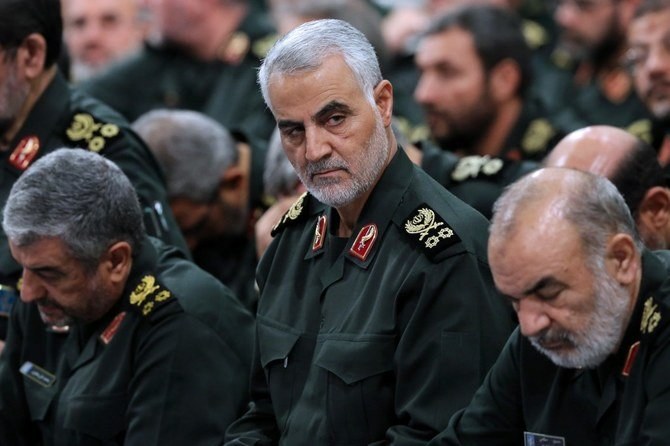
The leaked documents reveal the unique role of Qasem Soleimani in Iran's aggressive policy to dominate Iraq. (AFP/File photo)
Updated 19 November 2019
Follow

Iran spy agency leaks reveal Tehran’s ‘horrifying’ grip on Iraq

  • Leaks ‘provide cast-iron case against Soleimani and associates for complicity in war crimes,’ Mideast expert says
  • The new reports served to confirm the sentiment of protesters across Baghdad and the Shiite-majority south

JEDDAH: Hundreds of leaked Iranian intelligence documents have shed light on a shadow war for regional influence.
Monday’s reports on a trove of leaked cables expose Tehran’s vast influence in Iraq, detailing the painstaking efforts of Iranian spies to co-opt Iraqi leaders and infiltrate every aspect of political life. Tehran’s influence has fueled ongoing anti-government protests in Iraq.

The trove consists of roughly 700 pages of reports and cables written mainly in 2014 and 2015 by officers in Iran’s version of the CIA who were based in Iraq.
“These documents are horrifying,” Baria Alamuddin, a writer and expert in Middle Eastern affairs, told Arab News.
“Yet in a sense there’s almost nothing here that Iraq experts didn’t know very well already: That most of Iraq’s leadership, whatever their affiliation, is wholly in Iran’s pocket; that Iran bankrolled the mass murder and sectarian cleansing of sizable areas of Iraq under the pretense of fighting Daesh; and that Iran today is bribing Iraqi politicians in order to extend its dominance over the Iraqi economy. None of this is any longer deniable.”

The documents were sent anonymously to The Intercept, which shared them with the New York Times. Both publications verified the documents’ authenticity but do not know who leaked them.
In encrypted messages, the anonymous source said he or she wanted to “let the world know what Iran is doing in my country Iraq.”
Rahman Al-Jobouri, a senior fellow at the Institute of Regional and International Studies at the American University of Iraq Sulaimani, told Arab News: “Nothing new has been revealed by the New York Times’ report. The men of the Iraqi government are openly associated with Iran.”

Opinion

This section contains relevant reference points, placed in (Opinion field)


He said: “Actually, some of them consider Iran their first state, and any action they do (in its favor) is legitimate and legal, and nothing should be hidden from it.”
The leaked documents “are introductions to penalties that would be imposed on certain persons,” he added.
“It’s also a message sent by the US to say everything is being monitored by us in Iraq. We watch and use the information as and when we need.”
Alamuddin said the evidence “provides a cast-iron case against (Iranian Maj. Gen.) Qassim Soleimani and his associates for complicity in war crimes, in addition to recent evidence about his oversight of the deliberate killings of Iraqi protestors.”
She added: “Iraqis deserve to see these figures hauled before the International Criminal Court, perhaps in addition to the establishment of a special commission to investigate Iran’s role in sponsoring paramilitary violence and compromising the sovereign independence of multiple Arab states.”
Alamuddin said: “The only question here is what the world will do with this information — from the horse’s mouth — which provides irrefutable proof of Iran’s ambitions to dominate the entire region.”

Juhayman: 40 years on
On the anniversary of the 1979 attack on Makkah's Grand Mosque, Arab News tells the full story of an unthinkable event that shocked the Islamic world and cast a shadow over Saudi society for decades

Enter


keywords


UN nuclear watchdog says it’s unable to verify whether Iran has suspended all uranium enrichment

Updated 27 February 2026
Follow

UN nuclear watchdog says it’s unable to verify whether Iran has suspended all uranium enrichment

VIENNA: Iran has not allowed the United Nations nuclear watchdog to access nuclear facilities affected by the 12-day war in June, according to a confidential report by the watchdog circulated to member states and seen Friday by The Associated Press.
The report from the International Atomic Energy Agency stressed that therefore it “cannot verify whether Iran has suspended all enrichment-related activities,” or the “size of Iran’s uranium stockpile at the affected nuclear facilities.”
The IAEA report on Friday warned that due to the continued lack of access to any of Iran’s four declared enrichment facilities, the agency “cannot provide any information on the current size, composition or whereabouts of the stockpile of enriched uranium in Iran.”
The report stressed that the “loss of continuity of knowledge over all previously declared nuclear material at affected facilities in Iran needs to be addressed with the utmost urgency.”
Iran long has insisted its program is peaceful, but the IAEA and Western nations say Tehran had an organized nuclear weapons program up until 2003.
Highly enriched material should be verified regularly
According to the IAEA, Iran maintains a stockpile of 440.9 kilograms (972 pounds) of uranium enriched up to 60 percent purity — a short, technical step away from weapons-grade levels of 90 percent.
That stockpile could allow Iran to build as many as 10 nuclear bombs, should it decide to weaponize its program, IAEA director general Rafael Grossi warned in a recent interview with the AP. He added that it doesn’t mean that Iran has such a weapon.
Such highly enriched nuclear material should normally be verified every month, according to the IAEA’s guidelines.
The IAEA also reported that it had observed, through the analysis of commercially available satellite imagery, “regular vehicular activity around the entrance to the tunnel complex at Isfahan.”
The facility in Isfahan, some 350 kilometers (215 miles) southeast of Tehran, was mainly known for producing the uranium gas that is fed into centrifuges to be spun and purified.
Israel has struck buildings at the Isfahan nuclear site, among them a uranium conversion facility. The US also struck Isfahan with missiles during the war last June.
The IAEA also reported that through the analysis of commercially available satellite imagery, it has observed “activities being conducted at some of the affected nuclear facilities, including the enrichment facilities at Natanz and Fordow,” but it added that “without access to these facilities it is not possible for the Agency to confirm the nature and the purpose of the activities.”
The confidential IAEA report also said Friday that Iran did provide access to IAEA inspectors “to each of the unaffected nuclear facilities at least once since the military attacks of June 2025, with the exception of Karun Nuclear Power Plan, which is in the early stages of construction and does not contain nuclear material.”
IAEA joined Geneva talks between Iran and US
The IAEA reported on Friday that Grossi attended negotiations between the US and Iran on Feb. 17 and Feb. 26 in Geneva at which he “provided advice on issues relevant to the verification of Iran’s nuclear program.” The report said that those negotiations are “ongoing.”
The Trump administration has held three rounds of nuclear talks this year with Iran under Omani mediation. Thursday’s round of talks in Geneva ended without a deal, leaving the danger of another Mideast war on the table as the US has gathered a massive fleet of aircraft and warships in the region.
Oman’s Foreign Minister Badr Al-Busaidi said technical talks involving lower-level representatives would continue next week in Vienna, the home of the IAEA. The agency is likely to be critical in any deal.
The US is seeking a deal to limit Iran’s nuclear program and ensure it does not develop nuclear weapons.
Iran says it is not pursuing weapons and has so far resisted demands that it halt uranium enrichment on its soil or hand over its stockpile of highly enriched uranium.
Similar talks last year between the US and Iran about Iran’s nuclear program broke down after Israel launched what became a 12-day war on Iran, that included the US bombing Iranian nuclear sites.
Before the June war, Iran had been enriching uranium up to 60 percent purity.