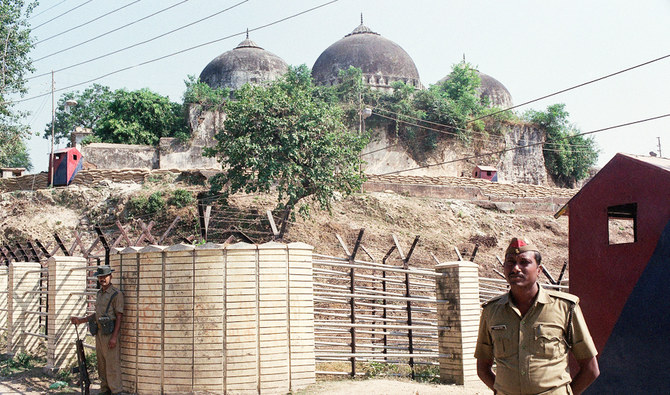

NEW DELHI: More than a week after the Supreme Court issued its verdict awarding a disputed religious site to Hindus in the northeastern city of Ayodhya, two prominent Muslim bodies on Sunday decided to challenge the decision.
The All India Muslim Personal Law Board (AIMPLB) and the Jamiat Ulama-i-Hind (JUH), a leading organization of Muslim scholars, held a joint meeting in Lucknow, the capital of the eastern state of Uttar Pradesh, where they contested the judges’ verdict on Nov. 9 paving way for the construction of a temple on the 2.77 acres of disputed land which both Hindus and Muslims claim belongs to them.
“The land of the mosque belongs to Allah and under the Islamic laws it cannot be given to anybody,” AIMPLB secretary Zafaryab Jilani told reporters on Sunday.
The court had ruled that the disputed land would go to a government appointed trust and a temple would be built there.
He awarded five acres of land to Muslims at an alternative site for a mosque.
A 16th century mosque known as the Babri Mosque existed at the disputed site. In the 1980s, the ruling Bharatiya Janata Party (BJP) reignited a campaign to build a temple on the site, claiming that it was the birthplace of their supreme deity Ram and that the mosque was built by Mughal emperor Babar in 1528 after the demolition of the temple.
The political mobilization led to the demolition of the mosque in 1992.
In its verdict, however, the court said that there was no evidence that a mosque was built by destroying a temple. It also condemned the placing of Hindu idols inside the mosque in 1949 and the destruction of the Islamic structure in 1992.
Jilani added: “It was a fight for the title and not for an ordinary piece of land. It’s our constitutional right to save our religious place.”
The land of the mosque belongs to Allah and under the Islamic laws it cannot be given to anybody.
Zafaryab Jilani, Secretary of All India Muslim Personal Law Board
“We feel the restitution by granting five acres of land, where fundamental values have been damaged to the extent of causing national shame, will not heal the wounds caused. Hence we decline to accept the said five acres of land.
Arshad Madani, president of the Jamiat Ulama-i-Hind, said that “the court’s verdict is beyond understanding.”
However, Nritya Gopal Das, head of the Ram Janmabhoomi Nyas, a BJP affiliated trust that has been leading a campaign for building a temple, called the decision of the Muslim organizations a delaying tactic.
“We have made all preparations for construction of the Ram temple. The decision to file a petition is a ploy to further delay construction of the temple,” he said.
The BJP parliamentarian and president of the Delhi BJP Manoj Tiwari called the review petition an attempt by Muslim groups to be in the limelight.
“They never fought for rebuilding the mosque, they fought for ulterior motives, for reaping political benefits. Now that the issue has been resolved they have nothing to be in the limelight for, their only motive is to spread hate in the country and therefore there is no need to pay any attention to them,” said Tiwari to reporters on Monday.
Hyderabad-based political analyst Prof. Afroz Alam, of Maulana Azad National Urdu University, says that “when the outcome of the review petition is almost certain it’s in the larger interest not to prolong the matter.”
Historically, politically and even legally, when faith is in conflict with law, “absolute fairness” in judgments is an impossibility. Undoubtedly, in Ayodhya case, Supreme Court gave the edge to faith over law. Undoubtedly, the Muslim community is at pain, Alam said. “Most of them accepted the judgment for the sake of peace only.”
He added that “the majoritarianism is now the norm of Indian democracy and the verdict has cast great doubt on the independent credibility of the judiciary.”