

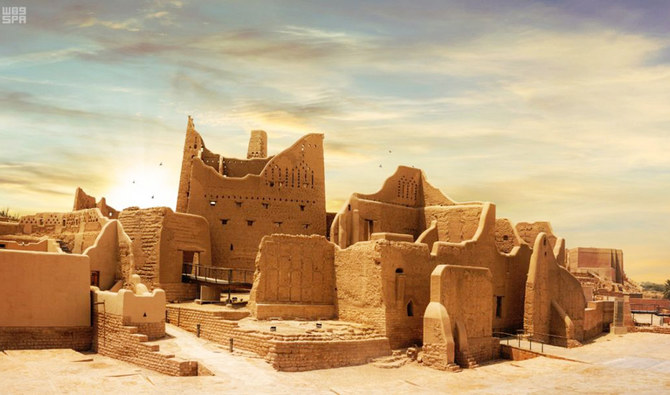
Saudi Arabia’s Diriyah Gate project cornerstone to be laid on Wednesday

The event comes as the country continues its transformation plans in line with Vision 2030. (SPA)
Updated 29 November 2019
Follow

Saudi Arabia’s Diriyah Gate project cornerstone to be laid on Wednesday

  • Diriyah Gate Project will kick off in earnest at the beginning of 2020, and will be one of the biggest projects within the Kingdom’s plans, at a cost of more than SR64 billion

RIYADH: The adobe city of Diriyah, the birthplace of the Saudi nation, is hosting the cornerstone-laying event organized by the Diriyah Gate Development Authority (DGDA) on Wednesday to inaugurate the Diriyah Gate project.

It aims to restore the historical city as a cultural heritage project, and restore it to its former state, to become a local and international tourist destination.

The event comes as the country continues its transformation plans in line with Vision 2030, with Diriyah considered one of the most prominent destinations for tourism and culture. The event will also feature fireworks and a performance by an Orchestra.

Diriyah Gate Project will kick off in earnest at the beginning of 2020, and will be one of the biggest projects within the Kingdom’s plans, at a cost of more than SR64 billion ($17 billion).

It will become a mixed-use traditional urban community, home to over 100,000 tourists, guests, residents and students at a time.

It is hoped Diriyah Gate will attract 25 to 30 million visitors annually, to enjoy word-class cultural, educational and recreational facilities, including museums and galleries that will offer visitors interactive and fun experiences.

The project will also include exhibitions, restaurants and arts academies that will launch educational initiatives in local specializations, including Arabic calligraphy, Islamic arts, Najdi architectural style, Najdi cuisine arts, theater, and Arab music.


Saudi reserve records critically endangered Ruppel’s vulture

Updated 4 sec ago
Follow

Saudi reserve records critically endangered Ruppel’s vulture

RIYADH: King Abdulaziz Royal Reserve Development Authority has announced the sighting and documentation of a Ruppel’s vulture (Gyps rueppellii) within the boundaries of the reserve — a landmark environmental and historical event.

This is the third officially documented record of the species at national level and the first of its kind in the central and eastern regions of the Kingdom, the Saudi Press Agency reported.

The sighting carries global significance given the conservation status of the vulture, which is classified as critically endangered by the International Union for Conservation of Nature, following the loss of more than 90 percent of its population throughout its original range in Africa over the past three decades.

The appearance of this rare bird in King Abdulaziz Royal Reserve adds a new entry to the limited record of its sightings in the Kingdom, which began in Aseer region in 1985, followed by a sighting in 2018, and another in AlUla in September 2025. 

Its latest recording in central and eastern Saudi Arabia is considered an important environmental indicator of the quality of natural habitats provided by the reserve.

Globally, Ruppel’s vulture faces major threats, including poisoning from pesticides, electrocution, collisions with power lines, and the loss of nesting sites as a result of urban expansion and land-use change. 

Additional challenges include the decline of carrion resulting from changes in livestock-rearing practices, illegal hunting for use in traditional beliefs, and the adverse effects of climate change on its breeding areas and migratory routes.

The vulture is primarily found in the African Sahel and is considered extremely rare in the Arabian Peninsula. Its sighting in King Abdulaziz Royal Reserve underscores the Kingdom’s leading role in conserving biodiversity and supporting the objectives of Saudi Vision 2030 for protecting ecosystems.

It also reflects the success of the authority’s efforts to protect wildlife and restore ecosystems, positioning the reserve as a safe and attractive habitat for rare and native species.