Yemeni government back in Aden under deal with separatists

1 / 6
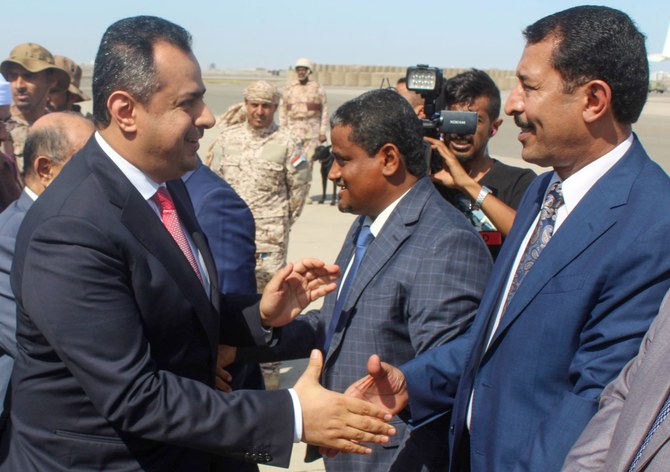
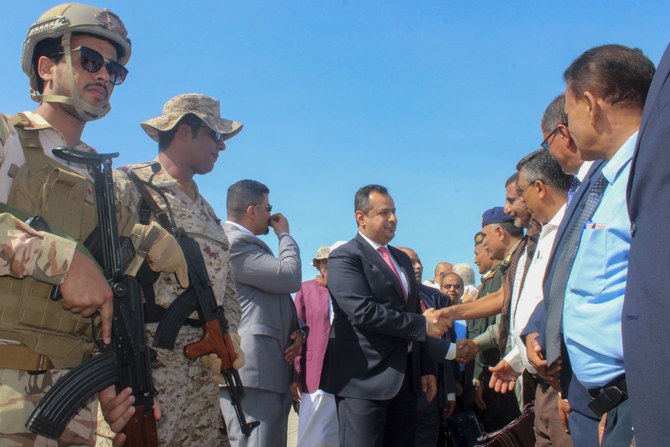
Yemen's Prime Minister Maeen Abdulmalik Saeed arrives in Aden Monday. (AFP)
2 / 6
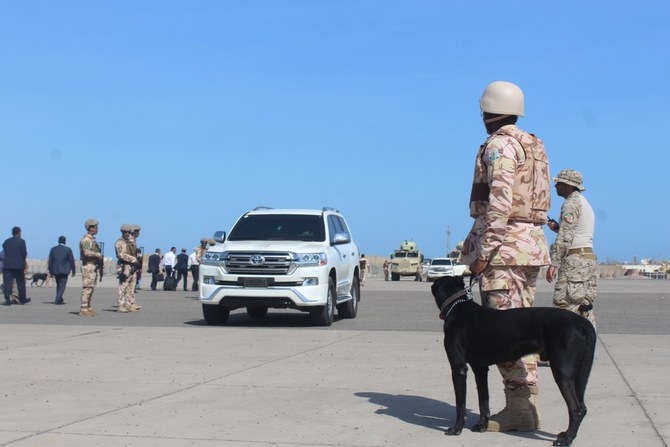
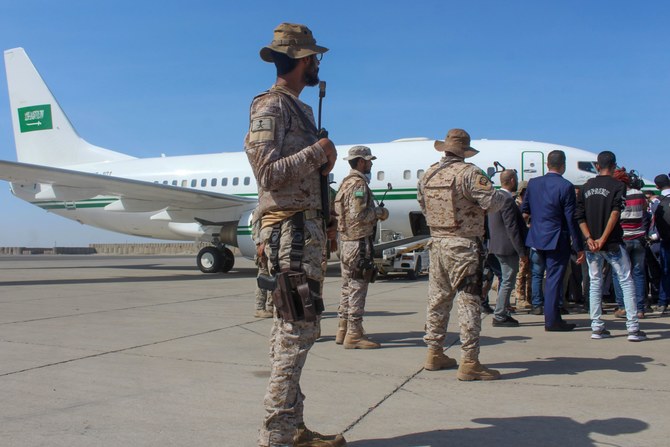
Saudi forces stand guard during the arrival of Yemen's Prime Minister in Aden Monday. (AFP)
3 / 6
Yemen's Prime Minister Maeen Abdulmalik Saeed arrives in Aden Monday. (AFP)
4 / 6
Saudi forces stand guard during the arrival of Yemen's Prime Minister in Aden Monday. (AFP)
5 / 6
Saudi forces stand guard during the arrival of Yemen's Prime Minister in Aden Monday. (AFP)
6 / 6
Yemen's Prime Minister Maeen Abdulmalik Saeed arrives in Aden Monday. (AFP)
Updated 18 November 2019
Follow

Yemeni government back in Aden under deal with separatists

  • Prime Minister Maeen Abdulmalik Saeed landed in Aden, fulfilling a key point in the power-sharing deal brokered by Saudi Arabia
  • Saeed was accompanied by five key ministers from President Abed Rabbo Mansour Hadi’s government

ADEN: Yemen’s internationally recognized government returned to the war-torn country on Monday for the first time since it was forced out by southern separatists during clashes last summer.
Prime Minister Maeen Abdulmalik Saeed landed in Aden, fulfilling a key point in the power-sharing deal brokered by Saudi Arabia that ended months of infighting with separatists in Yemen’s south.
“The government’s priorities in the next stage are to normalize the situation in Aden first and then consolidate state institutions on the ground ... as a guarantor of stability,” Saeed told The Associated Press when he disembarked onto the tarmac.
He described the government’s return as “foundational for the improvement of civic services,” but added that “security challenges cannot be overlooked, especially at this stage.”
Saeed, accompanied by five key ministers from President Abed Rabbo Mansour Hadi’s government, was received by local officials and Saudi forces at the air base.
“Today we are uniting our efforts to defeat the Iranian project in Yemen and restore the state,” the government said in a statement.
In August, the separatists, overran Aden and drove out forces loyal to President Hadi, who has been based in Saudi Arabia since 2015.
The outbreak of violence between nominal partners in the coalition fighting against Iran-allied Houthi rebels added a new twist to the country’s complex civil war.
The power-sharing deal, signed earlier this month in Riyadh, calls for both sides to pull their forces out of Aden. That leaves the city under the coalition’s control, with only a presidential guard for Hadi’s protection if the exiled president were to return.
The agreement also asks that the separatists break up their militias and integrate them into Hadi’s forces.
“The plan for incorporating the security services needs to be clear and transparent,” Saeed told The Associated Press. “We have the support of the Saudis and the coalition leaders, factors that will help to implement the agreement through promising steps on the ground.”
The conflict in the Arab’s world’s poorest country started in 2014, when the Houthi rebels captured the capital, Sanaa, along with much of the country’s north. The Saudi-led alliance intervened in 2015 to drive out the Houthis and restore Hadi’s government.


UN Security Council urged to put pressure on UAE to stop arming Sudanese paramilitary

Updated 8 sec ago
Follow

UN Security Council urged to put pressure on UAE to stop arming Sudanese paramilitary

  • Activist accuses Rapid Support Forces and its allies of widespread conflict-related sexual violence during war, calls for action against faction’s powerful international backers
  • Plea comes amid growing warnings of genocide in Sudan, ‘unchecked external interference’ that is allowing atrocities to continue, and the risk of further regional destabilization

NEW YORK CITY: The UN Security Council faced calls on Thursday to put pressure on the UAE to stop arming the Rapid Support Forces, one of the warring military factions in Sudan, amid warnings that atrocities bearing “the hallmarks of genocide” were spreading and the situation in the country risks causing further regional destabilization.

Sudanese activist Hala Alkarib said that “unchecked external interference” was allowing atrocities to continue. She cited the documentation by a UN panel of experts and international nongovernmental organizations of weapons and military equipment being shipped into Darfur, “including by the United Arab Emirates, in violation of this Council’s arms embargo.”

She told council members: “You can stop the violence by pressuring the RSF’s powerful backers with economic, political and criminal consequences.”

The council also heard warnings from Alkarib and senior UN officials that after more than 1,000 days of war, civilians face renewed risks of mass atrocities in Darfur and Kordofan.

Earlier on Thursday, the International Independent Fact-Finding Mission for Sudan issued a report that described atrocities committed by the RSF in and around El-Fasher in late October last year as “indicators of a genocidal path.”

Alkarib, regional director of the Strategic Initiative for Women in the Horn of Africa, told the Security Council that she had lost family members and her home in the conflict between the RSF and the Sudanese Armed Forces, which began in April 2023.

“To be here a third time, only to report that the situation is even worse, is an indictment not just of the warring parties but of this council’s inability to stop the bloodshed,” she said.

“Over 1,000 days since the start of the war, despite repeated warnings, this council has failed to act. Every red line — siege, forced displacement, man-made famine, genocide, mass rape — has been crossed.”

She warned that the kinds of atrocities seen in El-Geneina and El-Fasher now risk being repeated in Greater Kordofan and Blue Nile, where drone attacks by all sides are killing civilians and destroying hospitals, schools and markets.

“Unless you act now, you will have more blood on your hands,” Alkarib said.

Her organization has documented more than 1,294 cases of conflict-related sexual violence against women and girls since the war began, she said, “perpetrated primarily by the RSF and their allies.”

She accused RSF forces in Darfur of deliberately targeting women and girls from the Fur, Masalit, Berti, Zaghawa and Tunjur communities on the basis of ethnicity.

“As the UN Fact-Finding Mission confirmed in a report today, this is part of a strategy of genocide aimed at eradicating native African communities,” Alkarib said.

Sexual violence, arbitrary detention and enforced disappearances in RSF-controlled areas remain severely underdocumented due to access restrictions, communications blackouts and retaliation, she added.

Thousands of women and children have been detained in villages including Garny, Tura and Tabit in North Darfur, she said, and hospitals and schools have been turned into detention centers. Forced marriages, including child marriages, to RSF soldiers are frequently linked to abductions and enforced disappearances.

Alkarib called for an immediate end to hostilities, the release of civilians held by the warring parties, “particularly women held by the RSF in conditions amounting to sexual slavery,” and the deployment of a mission with a clear mandate to protect civilians across Sudan in collaboration with the African Union.

She also urged the Security Council to expand the arms embargo to the whole of Sudan; impose targeted sanctions on violators; demand safe and sustained humanitarian access; condemn attacks on aid convoys, including a recent strike on a World Food Programme convoy in North Kordofan; support Sudanese women-led organizations; and back efforts to ensure accountability, including the work of the International Criminal Court.

“None of this will stop without immediate action from you, the international community,” Alkarib added.

The UN’s political affairs chief, Rosemary DiCarlo, said: “Sudan reached a horrific milestone: 1,000 days of a brutal war that has nearly destroyed the third-largest country in Africa. 1,000 days of total impunity for the perpetrators of a long list of atrocities and war crimes.”

She warned that “the risk of regionalization of the conflict is a matter of urgent concern,” citing in particular the movement of armed groups across the border between Sudan and South Sudan “in both directions,” and reports that weapons continue to transit through neighboring states.

“The horrific events in El-Fasher in October 2025 were preventable,” DiCarlo said. During the time the city was under siege, more than a year, the UN’s Human Rights Office “repeatedly sounded the alarm about the risk of mass atrocities. But the warnings were not heeded.”

The UN high commissioner for human rights, Volker Turk, had also alerted the international community to the possibility of similar crimes in Kordofan, where civilians are once again at risk of “summary executions, sexual violence, arbitrary detention and family separation,” she added.

“During the final offensive of the RSF on El-Fasher, reports indicate that sexual violence against women and girls was widespread,” DiCarlo said. “The time to act to prevent a repeat of atrocities elsewhere in the country is now.”

She welcomed progress in an initiative to secure a humanitarian truce, led by Egypt, Saudi Arabia, the UAE and the US.

“These efforts offer a critical opportunity for immediate and much-needed deescalation and could pave the way for a sustainable cessation of hostilities,” she said. “We call on both parties to the conflict to engage with this initiative in good faith and without preconditions.”

But she stressed that unity among Sudan’s partners was essential.

“This entails ensuring that the flow of weapons to the warring parties is cut off,” DiCarlo said. “The war has gone on this long and been this deadly in large part because of the support the parties have received from abroad.”

Speaking on behalf of UN humanitarian chief Tom Fletcher, Edem Wosornu, the director of the crisis response division at the Office for the Coordination of Humanitarian Affairs, said violence continues to spread “relentlessly.”

“Nearly three years have passed since this war began — humanitarian needs have deepened and countless civilian lives have been shattered,” she added.

Since the start of this year, she said, conditions in much of Kordofan and Darfur have deteriorated and drone attacks across the three states in Kordofan have escalated, resulting in civilian casualties and displacement. More than 1 million people are now displaced in the region.

In North Kordofan, fighting around the state capital, El-Obeid, was restricting the delivery of humanitarian and commercial supplies, Wosornu said. In South Kordofan, there has been intensified fighting and aerial attacks in and around Kadugli and Dilling, where an assessment by the Integrated Food Security Phase Classification indicates famine conditions may be prevalent.

Despite recent announcements that sieges had been broken and convoys could move between El-Obeid to Kadugli and Dilling, “humanitarian access along these key supply lines remains unpredictable,” Wosornu added.

In December, rates of acute malnutrition in Um Baru and Kernoi in North Darfur exceeded the threshold for famine, she said, and more than 1,000 newly displaced people recently arrived in Tawila, joining 600,000 who were already living there “in dire conditions.”

She continued: “For over 12 million women and girls, this is a crisis within a crisis. Violence against women and girls in Sudan has reached catastrophic levels. Sexual violence against women and girls has reached horrific levels. Documented cases have nearly tripled – yet this is but a fraction of the real scale.”

Wosornu also warned that 4.2 million children and pregnant and breastfeeding women face acute malnutrition.

She urged the council to work together “in pursuit of an immediate stop to the fighting, to stem the flow of weapons into Sudan, and to press for the lasting, inclusive peace that is so desperately needed.”

The UK is chairing the Security Council this month, with British Foreign Minister Yvette Cooper serving as president of the council for February.