Yemeni government back in Aden under deal with separatists

1 / 6
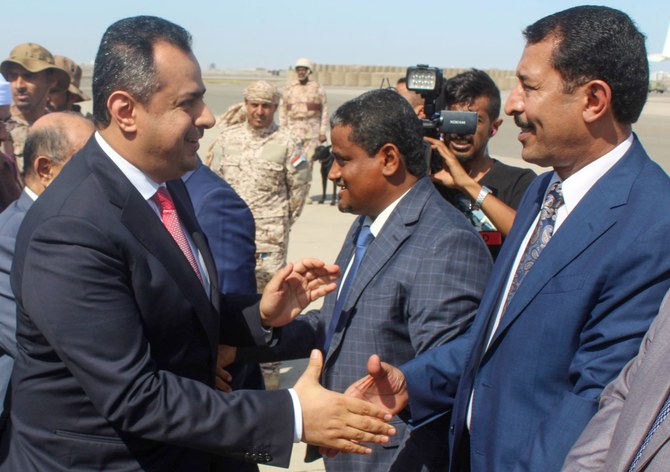
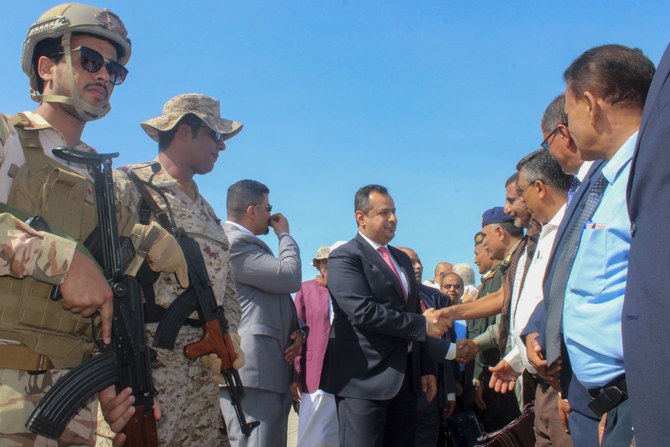
Yemen's Prime Minister Maeen Abdulmalik Saeed arrives in Aden Monday. (AFP)
2 / 6
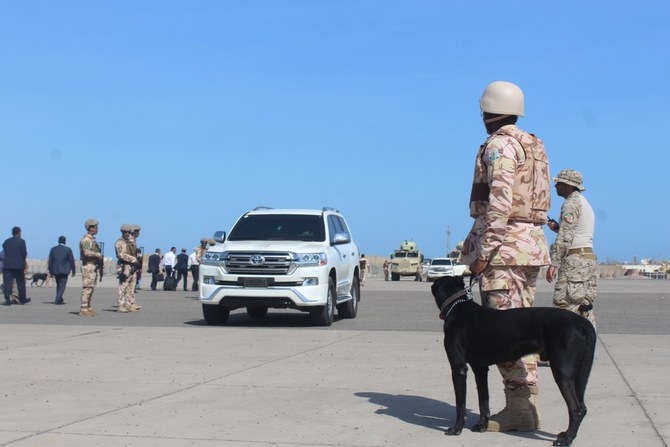
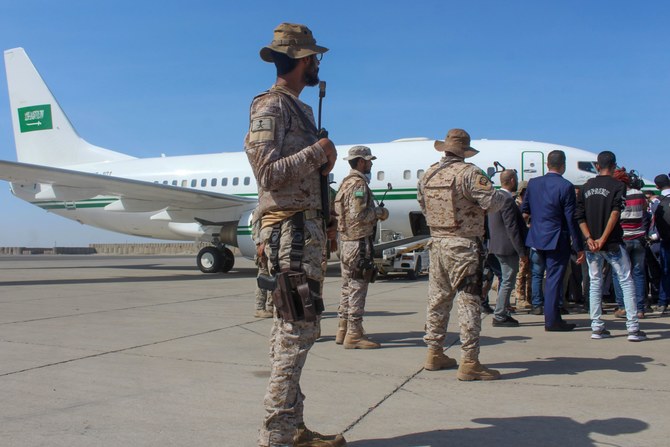
Saudi forces stand guard during the arrival of Yemen's Prime Minister in Aden Monday. (AFP)
3 / 6
Yemen's Prime Minister Maeen Abdulmalik Saeed arrives in Aden Monday. (AFP)
4 / 6
Saudi forces stand guard during the arrival of Yemen's Prime Minister in Aden Monday. (AFP)
5 / 6
Saudi forces stand guard during the arrival of Yemen's Prime Minister in Aden Monday. (AFP)
6 / 6
Yemen's Prime Minister Maeen Abdulmalik Saeed arrives in Aden Monday. (AFP)
Updated 18 November 2019
Follow

Yemeni government back in Aden under deal with separatists

  • Prime Minister Maeen Abdulmalik Saeed landed in Aden, fulfilling a key point in the power-sharing deal brokered by Saudi Arabia
  • Saeed was accompanied by five key ministers from President Abed Rabbo Mansour Hadi’s government

ADEN: Yemen’s internationally recognized government returned to the war-torn country on Monday for the first time since it was forced out by southern separatists during clashes last summer.
Prime Minister Maeen Abdulmalik Saeed landed in Aden, fulfilling a key point in the power-sharing deal brokered by Saudi Arabia that ended months of infighting with separatists in Yemen’s south.
“The government’s priorities in the next stage are to normalize the situation in Aden first and then consolidate state institutions on the ground ... as a guarantor of stability,” Saeed told The Associated Press when he disembarked onto the tarmac.
He described the government’s return as “foundational for the improvement of civic services,” but added that “security challenges cannot be overlooked, especially at this stage.”
Saeed, accompanied by five key ministers from President Abed Rabbo Mansour Hadi’s government, was received by local officials and Saudi forces at the air base.
“Today we are uniting our efforts to defeat the Iranian project in Yemen and restore the state,” the government said in a statement.
In August, the separatists, overran Aden and drove out forces loyal to President Hadi, who has been based in Saudi Arabia since 2015.
The outbreak of violence between nominal partners in the coalition fighting against Iran-allied Houthi rebels added a new twist to the country’s complex civil war.
The power-sharing deal, signed earlier this month in Riyadh, calls for both sides to pull their forces out of Aden. That leaves the city under the coalition’s control, with only a presidential guard for Hadi’s protection if the exiled president were to return.
The agreement also asks that the separatists break up their militias and integrate them into Hadi’s forces.
“The plan for incorporating the security services needs to be clear and transparent,” Saeed told The Associated Press. “We have the support of the Saudis and the coalition leaders, factors that will help to implement the agreement through promising steps on the ground.”
The conflict in the Arab’s world’s poorest country started in 2014, when the Houthi rebels captured the capital, Sanaa, along with much of the country’s north. The Saudi-led alliance intervened in 2015 to drive out the Houthis and restore Hadi’s government.


Iraqi lawmakers to elect president Tuesday, PM appointment next

Updated 55 min 9 sec ago
Follow

Iraqi lawmakers to elect president Tuesday, PM appointment next

  • Parliamentary speaker Haibat Al-Halbussi announced on Sunday that the new parliament will convene on Tuesday to elect a president

BAGHDAD: Iraq’s parliament will meet on Tuesday to elect the country’s new president, who will then appoint a prime minister expected to be Nouri Al-Maliki after he was endorsed by the largest Shiite bloc.
By convention, a Shiite Muslim holds the post of prime minister, the parliament speaker is Sunni and the largely ceremonial presidency goes to a Kurd.
Parliamentary speaker Haibat Al-Halbussi announced on Sunday that the new parliament will convene on Tuesday to elect a president, according to the official INA press agency.
The president will then have 15 days to appoint a prime minister, who is usually nominated by the largest Shiite bloc formed through post-election alliances.
On Saturday, the Coordination Framework alliance — whose Shiiite factions have varying links to Iran — endorsed former prime minister and powerbroker Al-Maliki as the country’s next premier.
The alliance, to which Al-Maliki belongs, spoke of his “political and administrative experience and his record in running the state.”
Kurdish parties have yet to agree on a presidential candidate, who must be endorsed by other blocs and win a two-thirds majority in parliament.
The presidency is usually held by the Patriotic Union of Kurdistan (PUK). This year, the rival Kurdistan Democratic Party (KDP) named its own candidate: Foreign Minister Fuad Hussein.
Although Maliki’s endorsement effectively guarantees him the post, forming a new government remains a daunting challenge that could drag on for months and still fail.
The designated premier has one month to form a government and present it to parliament for a vote of confidence.
The 75-year-old Maliki, a shrewd politician, is set to return to power at a time of seismic changes in the Middle East, as Tehran’s regional influence wanes and tensions with Washington rise.
Government formation in Iraq must balance internal political dynamics and power-sharing among major parties, all under the continued influence of Iraq’s two main allies: Iran and the United States.
A close Iran ally, Al-Maliki will be expected to address Washington’s longstanding demand that Baghdad dismantle Tehran-backed factions, many of which are designated terrorist groups by the US.
Last month, Iraqi officials and diplomats told AFP that Washington demanded the eventual government exclude Iran-backed armed groups, even though most of them hold seats in parliament, and have seen their political and financial clout increase.
But Iraq is struggling with weak economic growth and cannot risk punitive measures by the US, which has already sanctioned several Iraqi entities, accusing them of helping Tehran evade sanctions.