

Saudi student reflects on ‘Silk Road’ at China Youth Dialogue Forum

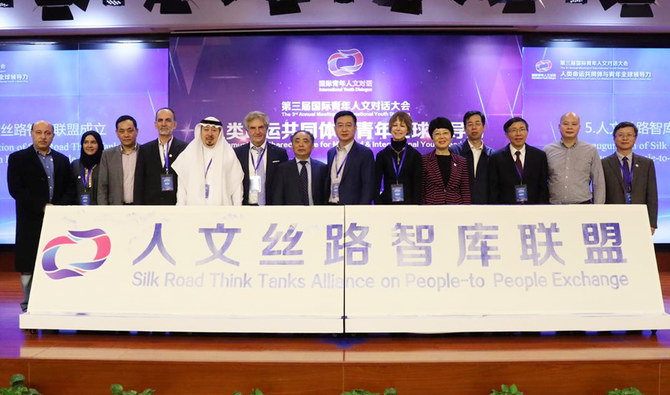
The ‘Silk Road’ initiative includes more than 60 countries in Asia, Europe and Africa, covering a population of 4.4 billion. (Photo/Supplied)
Updated 17 November 2019
Follow

Saudi student reflects on ‘Silk Road’ at China Youth Dialogue Forum

  • The Kingdom is considered China’s primary economic partner in the region, with yearly trade worth $70 billion

JEDDAH: A Saudi female student attracted more than 300 experts, specialists and others from 60 countries to her talk at the yearly International Youth Dialogue Forum, which began on Saturday.
The forum, in the Chinese capital Beijing, is being held as part of the “Silk Road” initiative, part of Saudi Vision 2030’s partnership with the Chinese government to revive historical trade routes for the modern era.
Miraz Ahmed Badris, a student at King Abdul Aziz University, spoke with the participants of the “Modern Culture for Young Saudi Women” forum, and shed light on the fast-moving changes and developments in young Saudi women’s ambitions, in line with Saudi Vision 2030.
She also highlighted the support of King Salman and Crown Prince Mohammed bin Salman’s government of Saudi women, and how the “Silk Road” initiative would contribute to fulfilling these aspirations and desired goals.

HIGHLIGHT

Miraz Ahmed Badris, a student at King Abdul Aziz University, spoke with the participants of the ‘Modern Culture for Young Saudi Women’ forum, and shed light on the fast-moving changes and developments in young Saudi women’s ambitions, in line with Saudi Vision 2030. 

Badris was invited by the Chinese government and the Academy of International Trade and Economic Cooperation for the “Silk Road” initiative in China, to be the only Arab and Saudi from the Middle East to express Arab women’s point of view. The “Silk Road” initiative includes more than 60 countries in Asia, Europe and Africa, covering a population of 4.4 billion, or 63 percent of the world population, with a combined economy of $21 trillion, or 29 percent of today’s global economy.
The Kingdom is considered China’s primary economic partner in the region, with yearly trade worth $70 billion.
Saudi inventor wins two gold medals at Mideast International Invention Fair

Updated 14 February 2026
Follow

Saudi inventor wins two gold medals at Mideast International Invention Fair

  • Khudry was recognized for inventing a device designed to filter materials and recycle used liquids
  • The innovation aims to improve efficiency in liquid purification and reuse

RIYADH: Saudi inventor Duaa Nizar Khudry won two gold medals at the 16th International Invention Fair in the Middle East (IIFME), held in Kuwait from February 8 to 11, the Saudi Press Agency (SPA) reported.

Khudry was recognized for inventing a device designed to filter materials and recycle used liquids, an innovation aimed at improving efficiency in liquid purification and reuse. The technology has potential applications in environmental protection, industrial processing, and water conservation, particularly in regions where sustainable resource management is critical.

A member of the Mawhiba Alumni Program, Khudry represented Saudi Arabia with the support and nomination of the King Abdulaziz and His Companions Foundation for Giftedness and Creativity (Mawhiba), which was participating in the fair for the third time.

She received her first gold medal from the fair’s organizers and was also awarded the IFIA Best Invention Award by the International Federation of Inventors’ Associations, recognizing her innovation as one of the most outstanding entries in the exhibition.

The IIFME, organized annually by the Kuwait Science Club since its launch in 2007, is regarded as one of the region’s largest specialized invention exhibitions and a major platform for inventors to present their work to international audiences.

As a student, Khudry won first place nationwide at the National Olympiad for Scientific Creativity (Ibdaa) in 2013 for the same recycling device, competing against tens of thousands of students across the Kingdom. She later obtained an official patent for the invention in 2024, strengthening its scientific and commercial potential. 

She studied chemistry and is currently pursuing graduate studies in materials science and engineering under the Custodian of the Two Holy Mosques Scholarship Program. Her research focuses on environmental sustainability, advanced materials, and liquid purification technologies.