Pakistan’s KP province to sterilize stray dogs, say officials

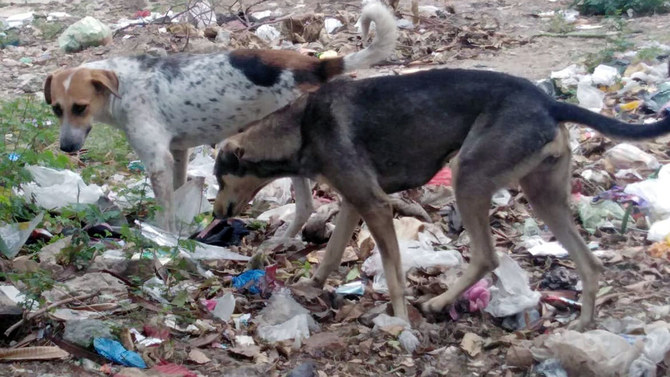
Stray dogs roam the streets of Peshawar on Nov. 12, 2019. (AN photo)
Updated 15 November 2019
Follow

Pakistan’s KP province to sterilize stray dogs, say officials

  • The provincial administration previously killed these animals, but the practice was banned by a court that called it inhumane
  • The overall project to deal with stray dogs may cost about Rs50 million

PESHAWAR: Following a volley of citizen complaints, the Water and Sanitation Services Peshawar (WSSP) in the country’s northwestern Khyber Pakhtunkhwa province has decided to start sterilizing thousands of stray dogs to cease their reproduction soon after the completion of the first-ever census of these animals by next week, an official said on Friday.
“Backed by thousands of staff, a comprehensive survey of stray dogs in Peshawar will be completed by coming Monday which will then set the sterilization process of these canines in motion,” Hassan Ai, media manager at the WSSP, told Arab News.
He added the provincial government previously killed stray dogs but a court verdict banned the practice, calling it inhumane.
After a series of meetings and deliberations, the WSSP, in coordination with other departments, reached a sterilization mechanism which would prevent dogs from breeding further and reduce the danger of them biting the general public.
Dr. Syed Masoom Ali, district director of the Livestock Department, told Arab News his team would carry out the sterilization and vaccination process for stray dogs.
“The male dogs will be surgically neutered while the female dogs will undergo spaying surgeries. The dogs will be tagged with microchips and a ribbon will also be tied to their collars to identify them after vaccination and sterilization,” he added.
Dr. Ali said a spacious location had been identified outside the city where these stray dogs would be kept for four days after necessary medical formalities.
The WSSP surged to action after it received an overwhelming number of citizen complaints through an app, Safa Pekhawar (Clean Peshawar), regarding stray dogs in the city.
Depending on the success of the drive, the provincial government could think about extending the program to other big cities of the province as well, said the WSSP media manager.
The vaccination of one dog, he said, would cost Rs2500. The vaccinated animals, he continued, would be kept in a solitary place for 15 days, adding that a rough estimate suggested that the project would cost Rs50 million.
“It is premature to say about the number of stray dogs in Peshawar city, but a ballpark estimate suggests it has surged to 15000,” Hassan Ali said.


Pakistan president meets UAE counterpart, explores trade, investment opportunities

Updated 27 January 2026
Follow

Pakistan president meets UAE counterpart, explores trade, investment opportunities

  • Asif Ali Zardari is in UAE on four-day visit to strengthen bilateral ties, review bilateral cooperation
  • Both sides discuss regional, international developments, reaffirm commitment to promote peace

ISLAMABAD: President Asif Ali Zardari met his UAE counterpart Sheikh Mohammed bin Zayed Al-Nahyan in Abu Dhabi on Tuesday during which both sides explored new opportunities in trade, investment, energy and other sectors, Zardari's office said. 

Zardari arrived in Abu Dhabi on Monday evening with a high-level delegation on a four-day official visit to the UAE to review trade, economic and security cooperation. 

"The leaders discussed ways to further deepen the longstanding and brotherly relations between Pakistan and the UAE," a statement from Zardari's office said about his meeting with the UAE president. 

"They reviewed the full spectrum of bilateral cooperation and explored new opportunities in trade, investment, energy, infrastructure, technology, and people-to-people exchanges, highlighting the significant potential for expanding economic and strategic partnership.

Zardari highlighted the significance of Al-Nayhan's visit to Pakistan last month, the statement said, expressing appreciation for the UAE's continued support for strengthening bilateral ties.

It said both sides also exchanged views on a range of regional and international developments, reaffirming their commitment to promoting peace, stability and sustainable development.

The meeting was also attended by Pakistan's First Lady Aseefa Bhutto-Zardari, the Pakistani president's son Bilawal Bhutto-Zardari, who is also the chairman of the Pakistan Peoples Party, Interior Minister Mohsin Naqvi and Pakistan's ambassador to the UAE. 

ZARDARI MEETS AD PORTS CEO

Zardari earlier met AD Ports Group CEO Captain Mohamed Juma Al-Shamisi to discuss the group's investment initiatives in Karachi. 

"Both sides agreed that the expansion and modernization of port infrastructure would strengthen trade flows and support Pakistan’s broader economic development and country’s seaborne trade," the President's Secretariat said in a statement.

It added that Zardari described the AD Ports Group's long-term investment and expanding role in Pakistan's maritime and logistics sector as a key pillar of Pakistan–UAE economic cooperation.

Pakistan and the UAE maintain close political and economic relations, with Abu Dhabi playing a pivotal role in supporting Islamabad during periods of financial stress through deposits, oil facilities and investment commitments. 

The UAE is Pakistan's third-largest trading partner, after China and the United States, and a key destination for Pakistani exports, particularly food, textiles and construction services.

The Gulf state is also home to more than 1.5 million Pakistani expatriates, one of the largest overseas Pakistani communities in the world, who contribute billions of dollars annually in remittances, a crucial source of foreign exchange for Pakistan’s economy.

Beyond trade and labor ties, Pakistan and the UAE have steadily expanded defense and security cooperation over the years, including military training, joint exercises and collaboration in counter-terrorism and regional security matters.