

Baby talk: Tips for mothers with teething babies

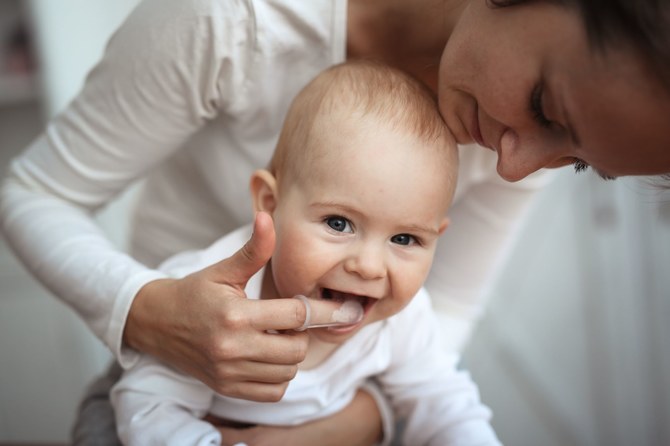
A baby’s toothbrush should be small. (Shutterstock)
Updated 14 November 2019
Follow

Baby talk: Tips for mothers with teething babies

DUBAI: It’s a happy event when the first tooth appears in the laughing little mouth and their teeth gradually start peeking out proudly and happily at the parents. To ask an obvious question: How should you choose your baby’s first toothbrush?

What specifications are suitable for your baby’s soft, fragile gums?

Among the helpful tips about choosing the toothbrush for your baby’s first teeth, we have compiled the following for you:

First, a baby’s toothbrush should be small, adapted to fit the little one’s mouth, and it should reach two of the baby’s teeth with each movement.

The most important specifications of the baby’s toothbrush are that it have smooth bristles arranged in three lines and a round head to protect the baby’s gums from injury.

It’s best if the bristles are industrially manufactured and not made of animal hair because the latter is hollow on the inside and can store a lot of germs.

The toothbrush can have sloped or straight bristles, according to the recommendation of your pediatrician, who will prefer one shape over the other based on your baby’s mouth shape and their ability to adapt to the brush.

It’s best to sometimes set aside two toothbrushes for the baby, one for the morning and the second for the evening, so that each has plenty of time to dry, preventing an accumulation of germs on them, or you can have one and place it in the open air after each use.

To distinguish between the morning brush and the evening brush, you can choose different colors, of course, knowing that toothbrushes made of nylon need more time to dry. It’s always best not to clean a baby’s teeth with a damp brush.

Replace your baby’s toothbrush every two months because it becomes damaged or warped from use, and the child’s gums could be injured by using it. It’s also better to replace it immediately after your child recovers from the flu or any other infectious disease.

Finally, and to help your little angel form the habit of brushing their teeth, choose a toothbrush decorated with funny faces from a cartoon they love or their favorite animal, if possible.

This article was first published on babyarabia.com.  


Review: ‘Sorry, Baby’ by Eva Victor

Eva Victor appears in Sorry, Baby by Eva Victor, an official selection of the 2025 Sundance Film Festival. (Supplied)
Updated 27 December 2025
Follow

Review: ‘Sorry, Baby’ by Eva Victor

  • Victor makes a deliberate narrative choice; we never witness the violence of what happens to her character

There is a bravery in “Sorry, Baby” that comes not from what the film shows, but from what it withholds. 

Written, directed by, and starring Eva Victor, it is one of the most talked-about indie films of the year, winning the Waldo Salt Screenwriting Award at Sundance and gathering momentum with nominations, including nods at the Golden Globes and Gotham Awards. 

The film is both incisive and tender in its exploration of trauma, friendship, and the long, winding road toward healing. It follows Agnes, a young professor of literature trying to pick up the pieces after a disturbing incident in grad school. 

Victor makes a deliberate narrative choice; we never witness the violence of what happens to her character. The story centers on Agnes’ perspective in her own words, even as she struggles to name it at various points in the film. 

There is a generosity to Victor’s storytelling and a refusal to reduce the narrative to trauma alone. Instead we witness the breadth of human experience, from heartbreak and loneliness to joy and the sustaining power of friendship. These themes are supported by dialogue and camerawork that incorporates silences and stillness as much as the power of words and movement. 

The film captures the messy, beautiful ways people care for one another. Supporting performances — particularly by “Mickey 17” actor Naomi Ackie who plays the best friend Lydia — and encounters with strangers and a kitten, reinforce the story’s celebration of solidarity and community. 

“Sorry, Baby” reminds us that human resilience is rarely entirely solitary; it is nurtured through acts of care, intimacy and tenderness.

A pivotal scene between Agnes and her friend’s newborn inspires the film’s title. A single, reassuring line gently speaks a pure and simple truth: “I know you’re scared … but you’re OK.” 

It is a reminder that in the end, no matter how dark life gets, it goes on, and so does the human capacity to love.