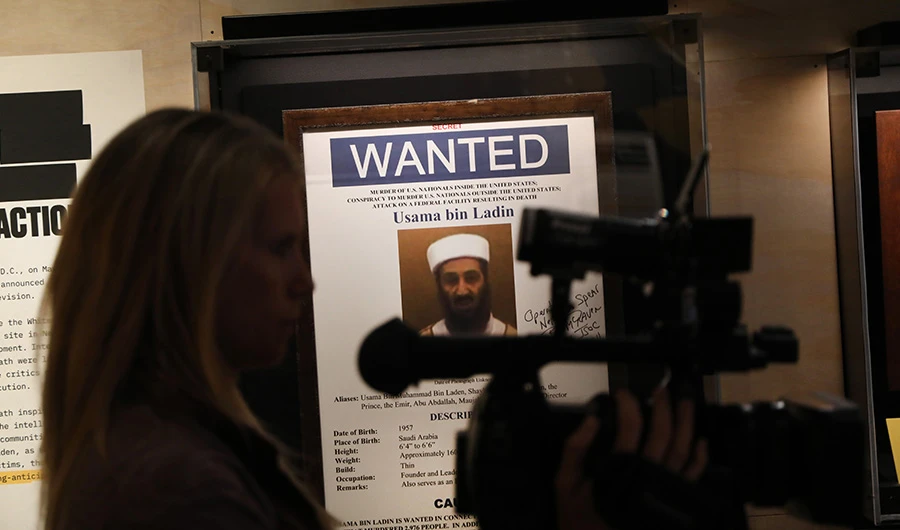
NEW YORK: With a model of the Pakistani villa where he lived and a video of Barack Obama explaining his hesitancy about approving the raid, a new exhibition details the operation that killed 9/11 mastermind Osama bin Laden.
“Revealed: The Hunt for Bin Laden,” which opens Friday at the September 11, 2001 attacks museum in New York, plots the ten-year search for the brains behind the single deadliest attack ever on the United States.
“It’s like being in the front row of history,” Alice Greenwald, president and chief executive of 9/11 Memorial Museum, told AFP.
“We get an insider’s view into ... how the raid was actually conducted from the people that were there,” she added.
The US intelligence services-led manhunt culminated overnight on May 1 and 2, 2011 with operation Geronimo, the commando raid that left Bin Laden, the orchestrator of the atrocity that killed almost 3,000 people and destroyed the Twin Towers, dead.
The
But using around 60 objects, including some seized in the villa, and dozens of photos and videos, visitors can see the work of the intelligence services as they try to find the Al-Qaeda leader.
The timeline includes bin Laden’s departure without a trace from the Tora Bora mountains in Afghanistan in late 2001 and the key identification of his messenger Abu Ahmad Al-Kuwaiti and his jeep in Peshawar in 2010.
Al-Kuwaiti would lead US agents to the quiet garrison city of Abbottabad, 50 miles (80 kilometers) from the Pakistani capital Islamabad and the villa where a mysterious figure would take a few steps inside the compound every day, like a prisoner.
The Americans nicknamed him “Pacer” before becoming convinced over time that he was the man they had been looking for — bin Laden.
The exhibition focuses on the “human” story of the operation through multiple interviews: from senior officials who validated the assault to Navy Seal commandos who invaded the villa.
Anonymous agents explain how they understood that to find bin Laden they had to follow people who were likely to help him.
“The gravity of that decision-making and the burden of that decision-making really comes across in this exhibition,” said Greenwald.
“I think it is a reminder of how decisions that are so momentous actually get made,” she added, referring to dilemmas about whether to attack the residence when it puts lives at risk.
After 9/11, rivalries between the various branches of the US intelligence services were blamed for not sharing information that might have thwarted the attacks.
The exhibition celebrates their renewed unity, tenacity and courage.
It displays a cap worn by an agent who suffered head injuries when a bomb triggered by a double agent exploded at a meeting that they hoped would lead to new information about bin Laden.
Clifford Chanin, deputy director for programs at the museum, said the exhibition is the result of over three years of discussions with government agencies, during which he wondered “how much of the story would they let us tell because it’s a classified mission.”
“We don’t know what we weren’t able to get because we don’t know what it is. (But) in terms of the artifacts loaned to us and the access we got to people for interviews, we got much further into this story than anybody,” he said.
The death of bin Laden, announced by Obama just before midnight eastern US time on May 1, 2011, was celebrated across the United States and particularly in New York, where there were spontaneous rallies in Times Square and at the World Trade Center site.
For many Americans the exhibition is a moment to savor that night again.
“It’s awe-inspiring to me to see the amount of work and effort, commitment done on behalf of our loved ones, by the military and intelligence division,” said Patricia Reilly whose sister died on the 101st floor of one of the towers.
“It just brings back that feeling of gratefulness that I felt on the day that the president announced that they had killed bin Laden. We had waited so long for justice,” she added.

New York exhibition details 10-year hunt for Bin Laden
- Displays a model of Pakistani villa where 9/11 mastermind Bin Laden lived
- The exhibition runs until May 2021, contains no shattering revelations like possible collaboration between American and Pakistani spies
New PIA owner plans more GCC flights, lower airfares
- New management will focus on religious tourism to Makkah, Madinah and other sites to expand global reach
- Owner Arif Habib says airfares will be rationalized to make PIA flights affordable for low-income Pakistanis
KARACHI: Pakistan’s recently privatized national carrier, the Pakistan International Airlines (PIA), plans to increase its flights to the Gulf Cooperation Council (GCC) region as part of its post-privatization business strategy to achieve 7.5% annual revenue growth, its new owner said this week.
A Pakistani consortium, led by Arif Habib Group, clinched a 75% stake in PIA for Rs135 billion ($482 million) on Dec. 23 after a competitive bidding process, in a deal that valued the airline at Rs180 billion ($643 million).
The sale marked Pakistan’s most ambitious effort in decades to reform the debt-ridden airline that had accumulated over Rs784 billion ($2.8 billion) in losses. The government said it aimed to end decades of state-funded bailouts and support the airline’s revival.
In an exclusive interview with Arab News, Arif Habib, chairman of Arif Habib Group, shared that he aims to attract around 70 million Pakistanis, who travel annually via different airlines, by making airfares more affordable.
“That [GCC region] is our biggest market... We would definitely try to increase the frequency of flights, increase the number of planes there, and try to capture more market share in that area,” Habib told Arab News on Monday.
“So, there we see a lot of opportunity.”
The new management of PIA, which currently caters to 4 million passengers annually, aims to target religious tourism, which Habib called a “captive market” in Pakistan and the Middle East.
According to PIA spokesperson Abdullah Hafeez Khan, the airline runs around 20 flights daily to the Middle East.
Habib plans to invest around Rs112 billion ($400 million) in PIA to turn the airline around, implementing short- and long-term improvements ranging from upgrading seats to tripling the 19-aircraft fleet, and engaging a foreign airline as a technical partner through strategic divestment over the next seven to eight years.
The group also intends to reduce PIA fares to make air travel more affordable for passengers from Pakistan’s low-income groups.
“Yes, we have been advised that in order to increase our market share, we will have to rationalize the airfares,” Habib said. “That is in the plan, and we will unfold it as it comes.”
The new owners have engaged a global advisory firm, Seabury Aviation Partners, to identify viable markets for the newly privatized airline and expand its presence both locally and internationally.
Habib aims for up to 7.5% annual growth in PIA’s operational revenues to make it profitable and the new management is targeting European and North American markets, particularly routes to and from the United Kingdom, the United States and Canada, for this purpose.
“The UK is the most lucrative market where I think there is a lot of demand,” he said, adding they would also be seeking more flight destinations. “Even for USA there is demand there.”
Habib, however, said the airline would take time to deliver “reasonable” returns to its investors, including AKD Group Holdings, Fatima Fertilizer Company, City Schools, Lake City Holdings and Fauji Fertilizer Company, a publicly listed firm owned by Pakistan’s military.
“In initial period of one to two years, we may see some losses but into medium term, I think, that would be turned around,” he concluded.
PIA posted a pre-tax profit of Rs11.5 billion ($41 million) for the January–June 2025 period, its first such profit for this timeframe in nearly two decades, according to a Reuters report in September. The airline recorded losses during the same period in 2024.
Once considered one of Asia’s leading carriers, PIA struggled with chronic mismanagement, political interference, overstaffing, mounting debt, and operational issues that led to a 2020 ban on flights to the European Union, the UK, and the US following a pilot licensing scandal. The EU and UK have since lifted their bans, giving the airline renewed momentum, while the US ban remains in place.
On Tuesday, PIA announced that the airline will be expanding its UK operations and will operate four weekly flights from Islamabad to London starting Mar. 29.
“The flights are being resumed after a long gap of six years,” PIA spokesman Khan said in a statement. “PIA is already operating three weekly flights to Manchester.”