BAGHDAD: For Iraqis opposed to the Baghdad government and its sponsor Tehran, there is even more than football at stake when Iraq faces Iran in a World Cup qualifier on Thursday.
Anti-regime rallies at the epicenter of protests in the capital’s Thrill Square have faded in recent days, following a spree of arrests, threatening messages and killings of activists.
Hussein Diaa hopes that victory over Iran, in the match whose venue has been changed to neighboring Jordan, could light a fire under the weeks-long protest movement.
“If our team beats Iran, it will bring more people out onto the streets and lift protesters’ spirits,” said the 24-year-old, kicking a football around in Tahrir.
Behind him stood Al-Jumhuriyah bridge, the main frontline between angry protesters and security forces using tear gas, live rounds and at times machine-gun fire.
“Our players have to give their all so we can hold our heads up high and confront Iran,” said Diaa.
Demonstrators have criticized Iran for backing the very government they want to bring down, accusing Tehran of economic and political overreach in Iraq.
The two countries fought a 1980-1988 war and were rivals under Saddam Hussein, but the predominantly Shiite states have grown close since the dictator was ousted in the 2003 US-led invasion.
The ensuing years saw Iraq swept up in sectarian violence and a war against the Daesh group, and FIFA banned international football matches on its territory.
The match between the two football-mad nations was to have been played in the southern port city of Basra.
But FIFA said it had assessed “the current security situation in Iraq” and informed the local federation that upcoming matches “must be played on neutral ground.”
It accepted Iraq’s proposal to change the venue to Amman.
FIFA’s decision came as a blow to Iraq after global football’s governing body had only earlier this year finally lifted a three-decade ban on it hosting internationals for safety reasons.
For Ahmad Al-Washa, Thursday’s match couldn’t come at a better time.
“Football is the best way to send a message to the whole world. We’re betting on this match,” said the activist.
Washa hoped it could be a way to attract international attention to the protests “so the United Nations can intervene and end the bloodshed.”
Well over 300 people have died since protests erupted on October 1 and 12,000 people have been wounded, but rallies have continued in Baghdad and across the south.
And when the game gets underway, the “Lions of Mesopotamia” will have fans “not just in Amman, but all across Tahrir,” said Washa.
Activists have erected a large screen to watch the match from 5:00 p.m. (1400 GMT), usually the time when crowds start to swell in the square.
They will be expecting solidarity from the large Iraqi diaspora in Jordan.
Some have already posted online to call on fans in the stadium to wear medical masks in solidarity with protesters confronted by tear gas back in Iraq.
Other activists have called for fans to stand up in the 25th minute and chant, “We want a country!” — a key slogan of the protest movement and an ode to the day it was relaunched, October 25.
Sensing the encounter on the field could be heated, the head of Iraq’s football federation has been trying to head off any skirmishes.
“No racist banners against the Iranian team, otherwise FIFA could punish us,” he warned.
In more than a dozen showdowns between the national teams, Iran have won 11 times, with six wins for Iraq and two draws.
On Tahrir, Hussein Jawwad said the match could be a shot at a desperately-wanted win, both for the team and the protests.
“We’ve been targeting our leaders recently but on Thursday night, we’ll be aiming for the Iranian football team in Amman,” said the 25-year-old fan.


![]()

Iraqis aim to rekindle protests with Iran football match
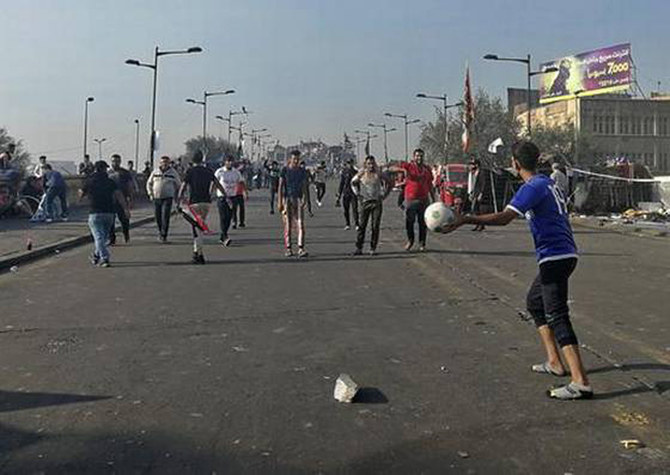
Iraqis aim to rekindle protests with Iran football match
- Victory over Iran in the World Cup qualifier being played in neighboring Jordan could light a fire under the weeks-long protest movement
- Demonstrators have criticized Iran for backing the very government they want to bring down, accusing Tehran of economic and political overreach in Iraq


Latest updates




© 2026 SAUDI RESEARCH & PUBLISHING COMPANY, All Rights Reserved And subject to Terms of Use Agreement.