

Amid unrest, Sudan’s bourse maps out expansion plans

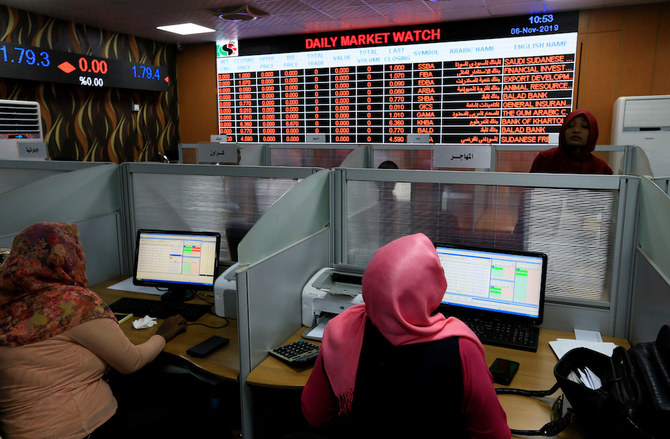
Women work at the Khartoum Stock Exchange in Khartoum, Sudan. (File/Reuters)
Updated 13 November 2019
Follow

Amid unrest, Sudan’s bourse maps out expansion plans

  • Though still tiny, Sudan's trade volumes have risen steadily in local currency terms in recent years
  • Most trade in is a type of sukuk, or Islamic bonds, known as shahamas

KHARTOUM: In the small basement of a two-story building next to Khartoum’s central bus station, around 40 smartly dressed men and women gather around terminals for an hour a day with one eye on the future of Sudan’s fledgling financial market.
The stock exchange they work at managed to avoid a crash during the unrest that convulsed the country this year, toppling long-time ruler Omar Al-Bashir.
And now it has ambitions to expand once the government has stabilized an economy in crisis and ended the country’s isolation.
“With the changes that happened in Sudan we expect there will be big interest from non-Sudanese investors,” said the exchange’s assistant director Abdelrahman Majeed.
Though still tiny with a market capitalization of around 8 billion pounds at the end of 2018, its trade volumes have risen steadily in local currency terms in recent years. They increased to some 11 billion pounds ($245 million) this year from 9 billion for all of 2018, said Majeed.
It has also upgraded technology with Oman’s help and hopes to connect all brokers online soon, he said. Currently only one brokerage can trade real-time online, traders say.
Most trade in is a type of sukuk, or Islamic bonds, known as shahamas. On the three days that Reuters visited the bourse, few of the 68 stocks moved.
Some foreigners, notably from the Gulf, have bought into the market but many have struggled to repatriate their investments since the 2011 secession of South Sudan, which took away most of Sudan’s oil wealth and caused hard currency shortages, dealers say.
The civilian government appointed in April plans to set up investment body to review investment regulations, Finance Minister Ibrahim Elbadawi told Reuters.


Women walk out of the Khartoum Stock Exchange in Khartoum, Sudan. (File/Reuters)

This will encourage higher volumes once economic reforms have been enacted and inflation brought down, he said, adding that the government hoped the United States would remove Sudan from its list of state sponsors of terrorism.
DIVERSIFICATION
For Dima Awad, General Manager at Sudan’s biggest brokerage Sanabel Securities, the market also needs to offer a greater range of tradeable products, given many foreign investors are not interested in sukuk.
“We need to develop ...first the infrastructure (and) secondly we need new products,” she said.
.”..We need the government to give more support... have a vision, on what technologies we need, how can we connect to Gulf markets.”
Her brokerage is part Bank of Khartoum, the biggest local bank whose owners include several Gulf lenders.
Meanwhile authorities expect to issue 4 billion Sudanese pounds ($89 million) of sukuk this year. They are the main investment tool for banks and the public and offer a chunky annual profit rate of between 17 and 20%.
Osama Elnour Saeed, an official at the Sudan Financial Services Co. which issues sukuk on behalf of the government, said the last issue was oversubscribed as some investors were betting USsanctions would be lifted.
But a financial source said banks had invested excess liquidity after the central bank printed more money to address a cash crisis.
($1 = 44.9952 Sudanese pounds)


Closing Bell: Saudi main market ends week in red at 11,189

Updated 9 sec ago
Follow

Closing Bell: Saudi main market ends week in red at 11,189

RIYADH: Saudi Arabia’s Tadawul All Share Index closed lower at the end of the trading week on Thursday, falling 1.34 percent, or 152.54 points, to finish at 11,188.73. 

The benchmark index opened at 11,320.52 and trended lower throughout the session, finishing well below its previous close of 11,341.27.  

Market breadth was sharply negative, with only 28 gainers compared with 236 decliners. Trading activity saw a volume of 239 million shares exchanged, with total turnover reaching SR5.5 billion ($1.47 billion). 

In the parallel market, Nomu closed higher, rising 0.23 percent to 23,865.95, although decliners continued to outnumber advancers. The MT30 index closed at 1,508.60, down 1.46 percent, shedding 22.38 points by the end of the session. 

Among the session’s top gainers, Dar Al Majed Real Estate Co. led advances, rising 5.43 percent to close at SR9.91. 

Al Aziziah REIT Fund added 4.67 percent to SR4.48, while Al Majed Oud Co. gained 2.81 percent to SR161.20. AFG International Co. advanced 2.45 percent to SR17.17, and Al Mawarid Manpower Co. rose 1.37 percent to SR125.70.

On the losing side, Saudi Research and Media Group posted the steepest decline, falling 6.88 percent to SR107. Cherry Trading Co. dropped 6.23 percent to SR28.88, while Saudi Arabian Mining Co. slipped 5.41 percent to SR72.55.  

Almasane Alkobra Mining Co. declined 5.38 percent to SR102, and Power and Water Utility Co. for Jubail and Yanbu ended 4.56 percent lower at SR31.36. 

On the announcements front, Saudi Industrial Investment Group released its interim financial results for the twelve-month period ended Dec. 31, 2025, reporting a return to profitability on an annual basis despite posting a quarterly loss.  

The company recorded a net loss of SR104 million in the fourth quarter, compared with a net profit of SR201 million in the same quarter of the previous year, which it attributed mainly to lower selling prices, higher operating costs, and increased general and administrative expenses.  

For the full year, however, the group posted a net profit attributable to shareholders of SR197 million, compared with SR161 million a year earlier, supported by higher sales volumes and improved operational performance at several subsidiaries. The stock last traded at SR14.77, down 3.59 percent. 

Separately, Saudi Exchange Co. announced the approval of a request by Merrill Lynch Kingdom of Saudi Arabia to terminate its market-making activities for Saudi Arabian Oil Co., effective Feb. 8.

The exchange said the termination relates specifically to the market-making agreement for Saudi Aramco shares and was approved in line with applicable market-making regulations.