


ERBIL, DUBAI: In a humiliating rebuke to Turkish President Recep Tayyip Erdogan in the lead-up to his visit to Washington, members of the Foreign Affairs Committee of the US House of Representatives have written a strong letter urging US President Donald Trump to withdraw the White House invitation.
The letter says Erdogan’s “decision to invade northern Syria on Oct. 9 has had disastrous consequences for US national security, has led to deep divisions in the NATO alliance, and caused a humanitarian crisis on the ground.”
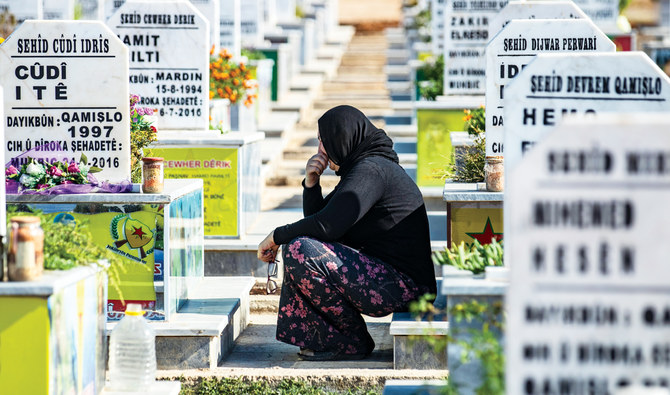
The Congress members said: “Turkish forces have killed civilians and members of the Syrian Democratic Forces (SDF), a critical US partner in the fight against (Daesh), and displaced over one hundred thousand people from their homes in northern Syria.”
The committee’s concerns are well founded. After weeks of instability and violence following the Turkish incursion, the situation in northeastern Syria remains tense despite the implementation of a ceasefire and an agreement between Russia and Turkey that compelled Kurdish-led SDF troops to withdraw from the border.
According to multiple sources, residents of this part of Syria are fearful for their future and the humanitarian situation is a cause for concern.
Since Turkey launched its assault, shortly after the US troop withdrawal from the border, approximately 180,000 Syrian civilians, primarily Kurds, have been displaced from their homes.
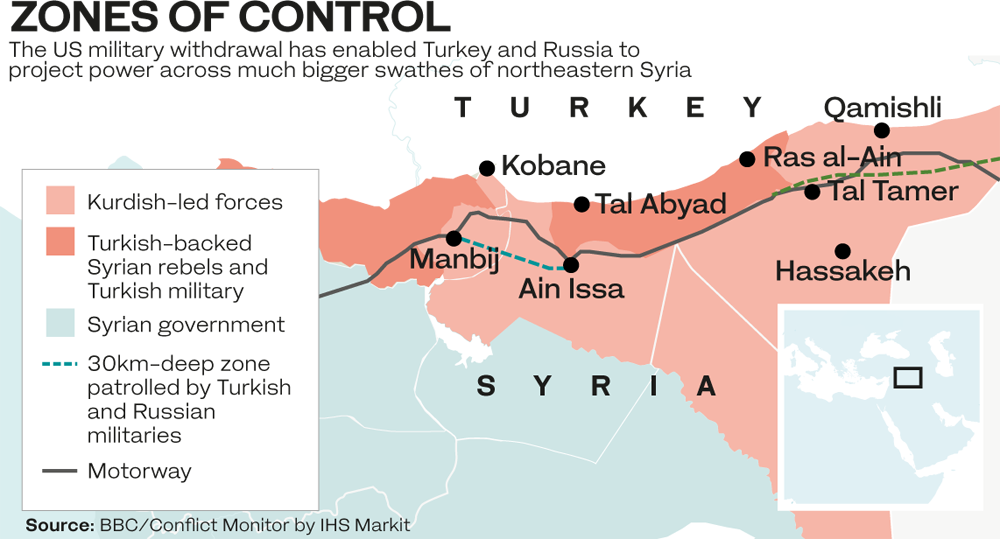
Turkey, with the help of its Syrian militia proxies, has carved out a large swath of territory — about 120 kilometers wide — that extends from Tal Abyad to Ras Al-Ayn (known by Kurds as Serekaniye).
On Oct. 31 at a gathering in Istanbul, Erdogan boasted that the “safe zones” were the most peaceful and livable places in Syria today. “We did not provide all these services with any expectation, but as our human and moral responsibilities,” he said, adding “when we look around, we see only humans, souls and life.”
Most Kurds of northeastern Syria see the situation very differently. In their view, what Erdogan has undertaken in the name of resettling millions of Syrian refugees in the so-called safe zone is a giant demographic-engineering exercise.
What has reinforced their suspicions have been incidents of Turkish-backed Syrian militias looting civilian homes and businesses, clips of which have flooded social media since the first days of the Turkish invasion.
Sounding a direct warning via Twitter, Mazloum Abdi, the SDF’s general commander, said: “There are efforts by Turkey to achieve its demographic-change goals in Northeast Syria through international organizations. The UN head’s willingness to form a team to study the proposal and engage in discussions with Turkish authorities on the issue is deeply worrying and dangerous.”
Dr. Nemam Ghafouri heads a charity called Joint Help for Kurdistan that is distributing humanitarian aid in the region. As someone who is familiar with the facts on the ground, she says “the humanitarian situation could not have been worse.”
She says because northeastern Syria has been practically under an embargo for years, “it’s very hard to find even the most basic items in significant quantities. Even finding and buying simple clothing for the displaced is very difficult and expensive.”
Ghafouri has talked to many people displaced from different areas. Some spoke of how they tried to return to their homes but the presence of the militias, whose roadside executions of Kurds have been filmed and posted on the web, acted as a deterrent.
Among the displaced Syrians Ghafouri spoke to were a pharmacist and a doctor from Ras Al-Ayn who tried to return to their homes.
“They told me about another pharmacist they knew who was arrested along with his son by these militias, who demanded a large ransom for their release,” she said. After being detained for eight hours, both were released without the ransom being paid. Instead, the militiamen “stole everything they could find in their home and their pharmacy.”
The general atmosphere, as inferred by Ghafouri, is one of “suffering and hopelessness.”
Alluding to the resettlement of Arabs on confiscated Kurdish land by Syrian President Hafez Al-Assad back in the mid-1970s, she said: “This is not the first time efforts have been made to change demographics.”
Ghafouri said that even today, on the road from Hasakah to Derik, “you can see where Arab villages have been built on the best agricultural lands in the region.”
On Oct. 24, in an interview to Turkey’s state broadcaster TRT, Erdogan came close to making the case for ethnic cleansing. “What is important is to prepare a controlled life in this enormous area, and the most suitable people for it are Arabs,” he said. “These areas are not suitable for the lifestyle of Kurds … because these areas are virtually desert.”
In actual fact, northeastern Syria, where the country’s largest Kurdish-majority areas are located, is also where Syria’s best agricultural lands happen to be. The region is often referred to as the country’s “breadbasket.”
Ghafouri believes the events of the past several weeks are “all about destroying the landscape and demography of the Kurdish regions for good,” adding: “It has been partially accomplished already.”
Besides Turkey, Russia and the Syrian regime have also sent troops to the Turkey-Syria border, but locals Ghafouri spoke to “don’t see the Russian deployment as a cause for hope.”
She said: “Despite feeling betrayed by America, people I’ve talked to there trust Russia even less. It seems that with Russian support, the Syrian regime has achieved what it wants — namely the ‘Arabization’ of predominantly Kurdish areas with the help of Turkey.”
In recent weeks, more than 14,000 Syrians have fled the conflict in the country’s northeast to neighboring Iraqi Kurdistan, which already hosts a huge refugee population.
Jotiar Adil, a spokesperson for the Kurdistan Regional Government (KRG), said the KRG “does not have the capacity to handle and care for a new wave of refugees coming across the border on its own.
“Therefore, we ask the international community to take a serious stance on this and assist us in sheltering and providing for these refugees.”
While the Russian-Syrian deployment along the border in northeastern Syria is expected to lessen the likelihood of a total Turkish takeover, the agreement with Russia permits Turkey to retain forces in Syrian territories under its control and states: “Joint efforts will be launched to facilitate the return of refugees in a safe and voluntary manner.”
Nevertheless, Joshua Landis, a Syria expert and head of the Middle East department at the University of Oklahoma, rules out the worst case scenarios, saying: “Erdogan’s resettlement plan is dead. The Russians will fight it and so will the Syrians. There may be some resettlement around Tal Abyad and Ras Al-Ayn, but beyond that, it is hard to imagine that right now. Even in this area, it is doubtful there will be any large-scale refugee resettlement.
“The situation will not be like in Afrin, where the Kurdish population could be chased out to make way for Arab refugees.”
However, the US lawmakers who have called on the White House to disinvite Erdogan believe “his calamitous actions in Syria follow a long list of disconcerting steps”.
Reminding Trump about the resolutions passed last month by the House warning of sanctions against Turkey, the statement said: “Given this situation, we believe that now is a particularly inappropriate time for President Erdogan to visit the US, and we urge you to rescind this invitation.”


