

‘Innovation, cooperation’ key to GCC’s economic vitality

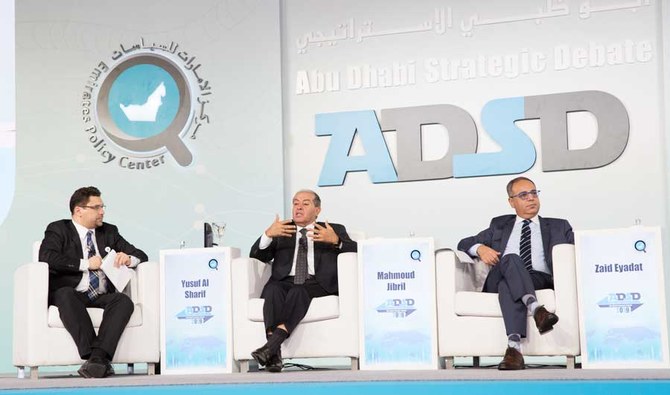
The speakers underscored the need for GCC countries to strengthen their economies by continuing to invest in health care and education. (Photo/Supplied)
Updated 12 November 2019
Follow

‘Innovation, cooperation’ key to GCC’s economic vitality

  • Abu Dhabi Strategic Debate features discussions on pressing geopolitical issues

ABU DHABI: The Gulf Cooperation Council (GCC) could become the sixth-largest economic power in the world by 2030 if it can maintain the same pace of growth and development, according to a senior Bahraini official.

Dr. Abdulla bin Ahmed Al-Khalifa, chairman of the Bahrain Center for Strategic, International and Energy Studies (DERASAT), made the remark while speaking at the Abu Dhabi Strategic Debate (ADSD) on Monday.
With “Old Power Competition in the New Age” as its theme, the conference has featured an impressive lineup of speakers.

The topics for the second and final day were broadly “Power distribution in the Gulf region” and “Repercussions of conflicts on the future of Arab states.”
Al-Khalifa underscored the need for GCC countries to strengthen their economies by continuing to invest in health care and education and boosting the quality of human resources.
On the subject of regional tensions, Al-Khalifa had three likely scenarios, starting with one in which Gulf states become a united political bloc that serves as a “regional center for innovation, entrepreneurship, cooperation and sustainable development.” In the second scenario, a dire fate awaits the region, with terrorism and unrest prevailing over the forces of social and economic stability.
An equally worse-case scenario sees a “static” future, with the GCC region condemned to a prolonged period of unrest and constant interference by regional and global powers in their affairs.
Similar apprehensions were expressed by Mahmoud Jibril, a former prime minister of Libya and president of the National Forces’ Alliance, during a separate panel discussion, “Middle East Power Distribution: Hard, Soft and Artificial.”
Arguing that Israel has emerged as “the main winner” in Middle East conflicts, Jibril blamed the Arab world for not moving in step with “the trends of this era.”

HIGHLIGHT

With ‘Old Power Competition in the New Age’ as its theme, the conference has featured an impressive line-up of speakers.

He said that Israel was the recipient of 21 percent of international investments by technology giants such as Apple, Microsoft and Amazon in their research and development centers.
“Investment channeled to Israel is 200 times as a proportion of the country’s population. These are its source of power,” Jibril said. By contrast, he said, the Arab world has one of the highest budgets for military acquisitions and yet its security environment keeps deteriorating.
Jibril identified three forces that he said are shaping modern history. The first is technologies such as AI (artificial intelligence) and digitalization. The second is youth, which he described as a “game changer” in the region. The third force, according to Jibril, is climate change.
“In the coming years, cities will disappear because of rising temperatures and economies will collapse due to expanding desertification,” he said. “The consequences will be migration and conflict. Unfortunately, these three forces cannot be reversed. At best, their impacts can be mitigated.”
Earlier in the day, Dr. Ebtesam Al-Ketbi, president of the Emirates Policy Center, the ADSD’s organizer, said that the Gulf region is witnessing “fierce competition among states over power redistribution.”
While the region’s security and stability will continue to be among the primary challenges, change will come once a deal with Iran is reached, she said.
“Iran doesn’t have anything to lose at the level of infrastructure,” El-Ketbi said.
“If a missile hits Iran, the country will not lose much but if a missile hits Aramco from Iran, there is a lot to lose.”
Al-Ketbi said that a balance of hard and soft power is crucial for achieving stability in the region. “Having hard power alone leads to wars and acts of sabotage,” she said, evidently alluding to recent incidents in the Gulf, while “possession of soft power alone is not enough for achieving security, especially for the GCC countries.”


Washington presses Syria to shift from Chinese telecom systems

Updated 27 min 24 sec ago
Follow

Washington presses Syria to shift from Chinese telecom systems

  • Syria is exploring the possibility of procuring Chinese technology
  • It was unclear whether the United States ⁠pledged financial or logistical support to Syria to do so

DAMASCUS: The United States has warned Syria against relying on Chinese technology in its telecommunications sector, arguing it conflicts with US interests and threatens US national security, according to three sources familiar with the matter.
The message was conveyed during an unreported meeting between a US State Department team and Syrian Communications Minister Abdulsalam Haykal in San Francisco on Tuesday. Washington has been coordinating closely with Damascus since 2024, when Syria’s now President Ahmed Al-Sharaa ousted longtime leader Bashar Assad, who had a strategic partnership with China.
Syria is exploring the possibility of procuring Chinese technology to support its telecommunications towers and the infrastructure of local Internet service providers, according to a Syrian businessman involved in the procurement talks.
“The US side asked for clarity on the ministry’s plans regarding Chinese telecom equipment,” said ⁠another source briefed on ⁠the talks.
But Syrian officials said infrastructure development projects were time-critical and that Damascus was seeking greater vendor diversity, the source added.
SYRIAN OFFICIALS CITE US EXPORT CONTROLS AS TELECOMS BARRIER
Syria is open to partnering with US firms but the matter was urgent and export controls and “over-compliance” remained an issue, according to person familiar with the meeting in San Francisco.
A US diplomat familiar with the discussions told Reuters that the US State Department “clearly urged Syrians to use American technology or technology from allied countries in the telecoms sector.”
It was unclear whether the United States ⁠pledged financial or logistical support to Syria to do so.
Responding to Reuters questions, a US State Department spokesperson said: “We urge countries to prioritize national security and privacy over lower-priced equipment and services in all critical infrastructure procurement. If it seems too good to be true, it probably is.”
The spokesperson added that Chinese intelligence and security services “can legally compel Chinese citizens and companies to share sensitive data or grant unauthorized access to their customers’ systems” and promises by Chinese companies to protect customers’ privacy were “entirely inconsistent with China’s own laws and well-established practices.”
China has repeatedly rejected allegations of it using technology for spying purposes.
The Syrian Ministry of telecommunications told Reuters any decisions related to equipment and infrastructure are made “in accordance with national technical and security standards, ensuring data protection and service continuity.”
The ministry said it is also prioritizing the diversification of partnerships and technology sources to ⁠serve the national interest.
Syria’s telecom ⁠infrastructure has relied heavily on Chinese technology due to US sanctions imposed on successive Assad governments over the civil war that grew from a crackdown on anti-government protests in 2011.
Huawei technology accounts for more than 50 percent of the infrastructure of Syriatel and MTN, the country’s only telecom operators, according to a senior source at one of the companies and documents reviewed by Reuters. Huawei did not immediately respond to a request for comment.
Syria is seeking to develop its private telecommunications sector, devastated by 14 years of war, by attracting foreign investment.
In early February, Saudi Arabia’s largest telecom operator, STC, announced it would invest $800 million to “strengthen telecommunications infrastructure and connect Syria regionally and internationally through a fiber-optic network extending over 4,500 kilometers.”
The ministry of telecommunications says that US restrictions “hinder the availability of many American technologies and services in the Syrian market,” emphasizing that it welcomes expanding cooperation with US companies when these restrictions are lifted.
Syria has inadequate telecommunications infrastructure, with network coverage weak outside city centers and connection speeds in many areas barely exceeding a few kilobits per second.