

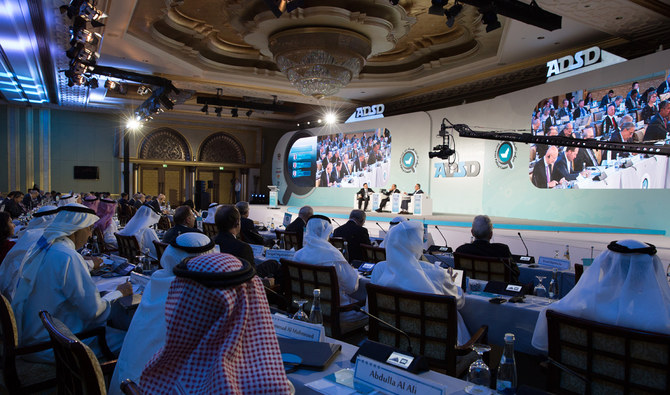


ABU DHABI: On the second day of the Abu Dhabi Strategic Debate, experts on foreign-policy and security issues took part in an exhaustive discussion on the Israeli-Palestinian conflict.
As panelists in a session entitled “The Deal of the Century: Rewriting the Rules of the Regional Game,” they discussed the US role in the Israeli-Palestinian issue in the context of President Donald Trump’s promise during his 2016 election campaign to broker a deal that caters to the demands of both sides.
David Makovsky, Ziegler distinguished fellow and director of the project on Arab-Israel relations at The Washington Institute for Near East Policy, said that for a solution to work, it “needs to give dignity to both parties.”
Referring to the phrase “The Deal of the Century,” Makovsky said that it was not coined by the US or the Trump administration, and was in effect first used at a press conference in the Middle East.
While the deal’s political components remain a mystery, Makovsky said the economic elements consisted of “raising around $50 billion from affluent countries in the region, in the form of loans, grants and investments.”
According to him, “most of it will be spent in Palestine, some in Jordan, Egypt and Lebanon, to support infrastructure and business projects.”
However, the economic elements remain “a part of a package of five core issues” known as the “final status,” said Makovsky.
They include “borders, Jerusalem, refugees, and mutual recognition of the other state,” he added, pointing out that the issues had not yet been fleshed out.
“They are waiting for a new government in Israel but this late in the cycle of the first administration, with US elections coming up in 2020, they will put out a vision and not a plan.”
He said a vision would lay out US ideas in 60 to 70 pages, with the presumption that Palestinian President Mahmoud Abbas would reject it.
“At the minimum, it is a historic reference point,” said Makovsky, who went on to express his disagreement with the “all or nothing” approach taken by the Trump administration with regard to Middle East issues.
“If you say yes on the five issues, you get 178 economic projects. My fear is in the Middle East, when it is all or nothing, it is nothing.”
As part of the same panel discussion, Dr. Shibley Telhami of the University of Maryland said previous US administrations, including that of President Barack Obama, had failed to solve the Israeli-Palestinian conflict simply because “the issue has become less strategically important” to the US.
“Never has a US president since the end of the Cold War made the (Israeli-Palestinian issue) a top priority,” he said.


