


ANKARA: After Turkey’s public broadcaster TRT and pro-government Daily Sabah harshly hit back at Qatar-owned Al Jazeera over anti-Turkish coverage, another fault line is emerging between the two countries over their activities in the Eastern Mediterranean.
Qatar, once a very close ally to Turkey in its regional policies, appears to have pivoted by involving itself in offshore gas drilling in Cyprus — a red line for Ankara.
On Sunday, Qatar Petroleum also announced the successful startup of a refinery venture in Egypt which is expected to reach full production level by the end of the first quarter of next year.
Such increased engagement in the Mediterranean is seen by many as a move to consolidate the country’s footprint, despite risking Turkish relations.
Dr. Michael Tanchum, senior fellow at the Austrian Institute for European and Security Policy (AIES), said that it was important not to overstate the divergence between Ankara and Doha, but also to recognize that the Turkey-Qatar partnership had its limits.
“Qatar’s refinery venture in Egypt goes back to 2012. As for its share in the drilling operations off the southern coast of Cyprus, Qatar made a strategic business choice to partner with Exxon. Of course, there are political implications,” he told Arab News.
The refinery venture project cost $4.4 billion and will chiefly produce Euro V refined products, such as jet fuel and diesel.
However, for Tanchum, Qatar’s position in the global hydrocarbons market creates business imperatives that Doha must consider in addition to the parameters of its geopolitical partnership with Turkey.
“Qatar’s presence in the waters off the southern coast of Cyprus may turn out in the end to be beneficial to Turkey,” he also added.
According to Tanchum, “Qatar may be able to act as a bridge in the Eastern Mediterranean and help provide Turkey a role in the marketing of Eastern Mediterranean hydrocarbons, providing a mechanism that would allow Turkey to reduce its naval presence south of the island.”
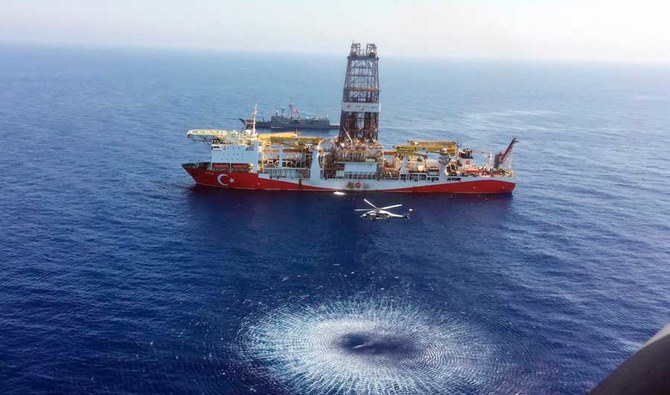
Turkey has its own drilling vessels in the area and two of the seven ships that hold drilling activities in the region are currently Turkish. The country aims to open five new deep-sea wells by next year.
BACKGROUND
In 2017, ExxonMobil and Qatar Petroleum signed an exploration and production sharing contract with Greek Cyprus, allowing the companies to start drilling in the contested offshore Block 10 area. ExxonMobil has since discovered a huge natural gas reservoir in the disputed maritime zone.
However, the simmering Cypriot conflict is a political and practical hurdle to consider, as the Greek side has awarded international oil and drilling companies — Italy’s Eni and France’s Total — with exploration rights in the area it declared as its own exclusive economic zone (EEZ).
This zone, which mostly clashes with the EEZ declared by Turkish Cyprus, is believed to have rich hydrocarbon reserves, and Turkey’s presence in waters off the south of Cyprus has been heavily criticized by the EU and is considered “illegal” by the US.
Gallia Lindenstrauss, senior research fellow from the Institute for National Security Studies in Tel Aviv, said that the current rift between Turkey and Qatar was surprising, and that although Turkey paid high-profile visits to Qatar recently, it cannot change the country’s foreign policy paradigms.
“Turkey cannot change the basic traits of Qatari foreign policy, which is very active and has close contacts at times with opposing sides to various conflicts in the Middle East. Qatar also uses its vast resources as an insurance policy, to make sure that at any given point there are enough actors that are interested in its survival as an independent entity,” she told Arab News.
In 2017, ExxonMobil and Qatar Petroleum signed an exploration and production sharing contract with Greek Cyprus, allowing the companies to start drilling in the contested offshore Block 10 area. ExxonMobil has since discovered a huge natural gas reservoir in the disputed maritime zone.


