

Protesters storm Bahraini embassy in Baghdad in protest against US ‘deal of the century’

Security forces opened fire in the air to disperse the protesters. (AP)
Updated 28 June 2019
Follow

Protesters storm Bahraini embassy in Baghdad in protest against US ‘deal of the century’

BAGHDAD:  At least 54 people were reportedly arrested after dozens of Iraqi protesters stormed the Bahraini embassy in Baghdad on Thursday night to protest against Bahrain’s participation in the US-led economic “deal of the century” plan for Palestine.

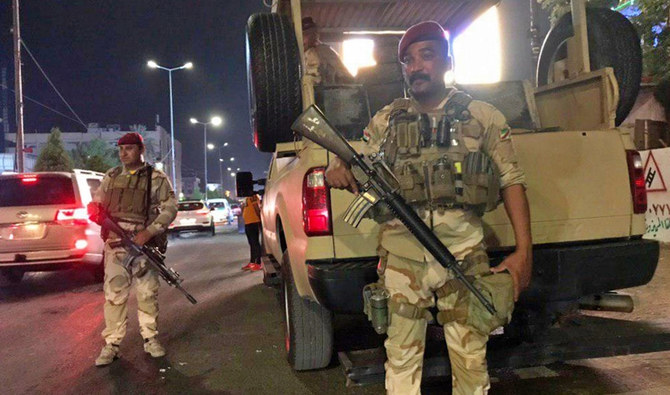
Iraqi authorities deployed additional troops to disperse the demonstrators and secure the embassy, which sources said appeared to have been targeted by Kata’ib Hezbollah, one of the most powerful pro-Iranian Shiite armed factions in Iraq.

The protesters burned US and Bahraini flags outside the embassy in Mansour, western Baghdad, before entering the inner courtyard, taking down the Bahraini flag and replacing it with a Palestinian flag. The gesture seemingly symbolized their rejection of US President Donald Trump’s recently unveiled economic plan to resolve the Palestinian-Israeli conflict.

Bahraini capital Manama this week hosted a two-day “Peace to Prosperity” workshop to discuss the plan, which was attended by Jared Kushner, Trump’s adviser. Palestinian authorities rejected the proposal, which does not address the two-state solution, and refused to participate in the workshop.

Although shots were heard ringing out in the vicinity of the embassy for about eight minutes, no casualties were immediately reported. Iraqi security forces in Baghdad were put on high alert and roads leading to the embassy were closed to prevent more protesters gathering there.

Iraqi Interior Minister Yassin Al-Yassiri went to the embassy in an attempt to “calm the situation” and meet the Bahraini ambassador. Security was heightened in nearby areas. Saad Maan, the official spokesman for the Ministry of Interior said Al-Yassari had stressed that the security of embassies and diplomatic missions is a red line that must not be crossed under any circumstances.

He also revealed that 54 people were arrested in connection with the attack and that the minister will appoint a committee to investigate the incident and the individuals responsible for ensuring the safety and security of the embassy and its staff.

In response to the incident, Bahrain recalled its ambassador for a consultation. The Iraqi government expressed its “deep regret” over what it described as “encroachment on the embassy building” and “acts of sabotage that violate the law and the authority of the state and the immunity of diplomatic missions.”

Iraqi Prime Minister Adel Abdul-Mahdi’s office issued a statement early on Friday that read: “The Iraqi government is serious in preventing the violation of the law and will never tolerate such acts, and affirms its absolute rejection of any action threatening diplomatic missions, their security and safety of their employees.”


‘No one to back us’: Arab bus drivers in Israel grapple with racist attacks

Updated 18 February 2026
Follow

‘No one to back us’: Arab bus drivers in Israel grapple with racist attacks

  • “People began running toward me and shouting at me, ‘Arab, Arab!’” recalled Khatib, a Palestinian from east Jerusalem

JERUSALEM: What began as an ordinary shift for Jerusalem bus driver Fakhri Khatib ended hours later in tragedy.
A chaotic spiral of events, symptomatic of a surge in racist violence targeting Arab bus drivers in Israel, led to the death of a teenager, Khatib’s arrest and calls for him to be charged with aggravated murder.
His case is an extreme one, but it sheds light on a trend bus drivers have been grappling with for years, with a union counting scores of assaults in Jerusalem alone and advocates lamenting what they describe as an anaemic police response.

Palestinian women wait for a bus at a stop near Israel's controversial separation barrier in the Dahiat al-Barit suburb of east Jerusalem on February 15, 2026. (AFP)

One evening in early January, Khatib found his bus surrounded as he drove near the route of a protest by Israel’s ultra-Orthodox Jewish community.
“People began running toward me and shouting at me, ‘Arab, Arab!’” recalled Khatib, a Palestinian from east Jerusalem.
“They were cursing at me and spitting on me, I became very afraid,” he told AFP.
Khatib said he called the police, fearing for his life after seeing soaring numbers of attacks against bus drivers in recent months.
But when no police arrived after a few minutes, Khatib decided to drive off to escape the crowd, unaware that 14-year-old Yosef Eisenthal was holding onto his front bumper.
The Jewish teenager was killed in the incident and Khatib arrested.
Police initially sought charges of aggravated murder but later downgraded them to negligent homicide.
Khatib was released from house arrest in mid-January and is awaiting the final charge.

Breaking windows

Drivers say the violence has spiralled since the start of the Gaza war in October 2023 and continued despite the ceasefire, accusing the state of not doing enough to stamp it out or hold perpetrators to account.
The issue predominantly affects Palestinians from annexed east Jerusalem and the country’s Arab minority, Palestinians who remained in what is now Israel after its creation in 1948 and who make up about a fifth of the population.
Many bus drivers in cities such as Jerusalem and Haifa are Palestinian.
There are no official figures tracking racist attacks against bus drivers in Israel.
But according to the union Koach LaOvdim, or Power to the Workers, which represents around 5,000 of Israel’s roughly 20,000 bus drivers, last year saw a 30 percent increase in attacks.
In Jerusalem alone, Koach LaOvdim recorded 100 cases of physical assault in which a driver had to be evacuated for medical care.
Verbal incidents, the union said, were too numerous to count.
Drivers told AFP that football matches were often flashpoints for attacks — the most notorious being those of the Beitar Jerusalem club, some of whose fans have a reputation for anti-Arab violence.
The situation got so bad at the end of last year that the Israeli-Palestinian grassroots group Standing Together organized a “protective presence” on buses, a tactic normally used to deter settler violence against Palestinians in the Israeli-occupied West Bank.
One evening in early February, a handful of progressive activists boarded buses outside Jerusalem’s Teddy Stadium to document instances of violence and defuse the situation if necessary.
“We can see that it escalates sometimes toward breaking windows or hurting the bus drivers,” activist Elyashiv Newman told AFP.
Outside the stadium, an AFP journalist saw young football fans kicking, hitting and shouting at a bus.
One driver, speaking on condition of anonymity, blamed far-right National Security Minister Itamar Ben Gvir for whipping up the violence.
“We have no one to back us, only God.”

‘Crossing a red line’ 

“What hurts us is not only the racism, but the police handling of this matter,” said Mohamed Hresh, a 39-year-old Arab-Israeli bus driver who is also a leader within Koach LaOvdim.
He condemned a lack of arrests despite video evidence of assaults, and the fact that authorities dropped the vast majority of cases without charging anyone.
Israeli police did not respond to AFP requests for comment on the matter.
In early February, the transport ministry launched a pilot bus security unit in several cities including Jerusalem, where rapid-response motorcycle teams will work in coordination with police.
Transport Minister Miri Regev said the move came as violence on public transport was “crossing a red line” in the country.
Micha Vaknin, 50, a Jewish bus driver and also a leader within Koach LaOvdim, welcomed the move as a first step.
For him and his colleague Hresh, solidarity among Jewish and Arab drivers in the face of rising division was crucial for change.
“We will have to stay together,” Vaknin said, “not be torn apart.”