



DHAKA: In a bid to mitigate an onion crisis in its local market, Bangladesh has decided to import 300 tons of the vegetable from Pakistan after nearly 15 years, despite strained diplomatic relations between the two countries in recent years, local media reported on Saturday.
Relations between the two countries have never recovered from the 1971 war when Bangladeshi nationalists broke away from what was then West Pakistan. Most recently, relations have been marred by the trials of prisoners taken in Bangladesh during the war nearly five decades ago. Pakistan publicly condemned the trial process by Dhaka, which the latter considered an interference into its internal affairs.
The surprise decision to import from Pakistan was taken during a government level discussion on Friday, when Bangladesh’s Tasho Enterprise finalized the deal with Karachi-based Roshan Enterprise, as reported by Pakistan’s The News International.
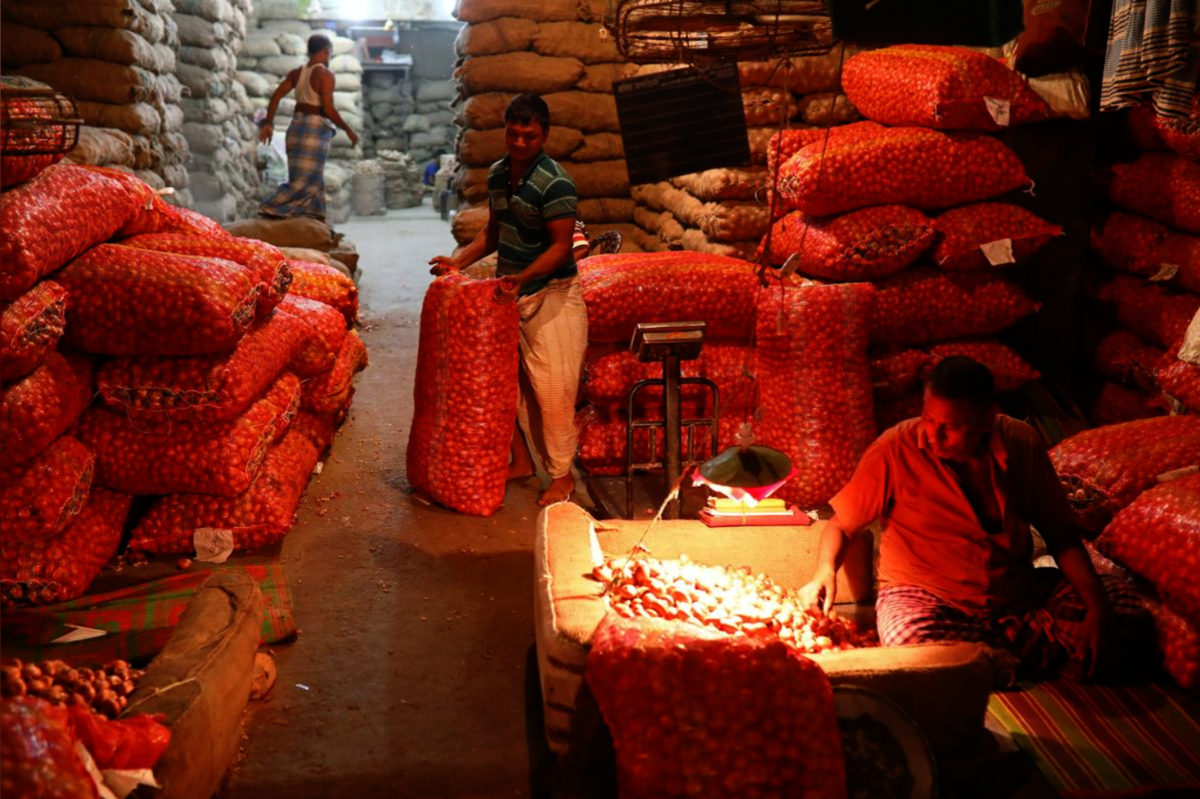
Men work at an onion wholesale market in the Kawran Bazar in Dhaka, Bangladesh, July 24, 2019. ( Reuters/File photo)
Last September, following a ban on onion exports in India, the price of onions in Bangladesh rose threefold.
Now, experts in Bangladesh said the rise of trade relations between Pakistan and Bangladesh, especially with the new ‘onion diplomacy’ could prove to have some positive impact over diplomatic relations between Dhaka and Islamabad.
“With this onion diplomacy, there is the chance of expanding trade relations between the countries,” Dr. Delwar Hossain of Dhaka University, told Arab News and added: “It will definitely have a good impact on diplomatic relations but I wouldn’t say it will create a new era of relationship overnight.”
“As a whole, if Bangladesh reviews its foreign policy in a pragmatic context, the latest onion import trading may take a positive turn in terms of diplomatic relations,” Hossain said.
Last year, Dhaka did not approve the appointment of a new Pakistan High Commissioner in Bangladesh and Pakistan has been waiting for the appointment’s approval for over a year, though it is expected to come soon, sources inside Pakistan’s Dhaka mission said.
Former Bangladesh Ambassador to the United States, Humayun Kabir, told Arab News that the onion trade could open up a window for better diplomatic relations if the political leadership of both countries wanted it to, but that it was still too early to consider it a diplomatic win.
“Bangladesh needs onions and so we are importing them from Pakistan. But at this moment, there is not enough scope to attach it with diplomacy,” Kabir said.
On the other hand, Dr. Shammi Ahmed, International Affairs Relations Secretary of the ruling party Awami League, told Arab News that Bangladesh already had diplomatic relations with Pakistan but conceded there were “problems” between the two countries.
“Importing onions from Pakistan is a government level decision... and the country’s (Bangladesh’s) foreign policy also upholds the spirit of friendship with all nations,” he said and added that the bilateral relationship could move in a “positive direction” in the days to come.
According to the State Bank of Pakistan figures, Pakistan’s exports and imports with Bangladesh during the year 2018 were $782 million and $67 million respectively.
But Ambassador Mohammad Zamir, a former career diplomat, said there was little scope for politicizing the onion import, which was merely a necessity for Bangladesh.
“We have bilateral relations with Pakistan and have also imported many goods from the country in previous years. Currently, we are in need of onions and Bangladesh is also importing them from some other countries, like Myanmar, Egypt, Turkey for its national interest,” Zamir told Arab News.
According to Muhammad Aurongzeb Haral, Press Counselor of Pakistan’s High Commission in Dhaka, bilateral trade between Pakistan and Bangladesh was already showing a rising trend with signs of a new and “positive” attitude toward Pakistan in Dhaka’s foreign ministry.
Total bilateral trade figures for the year 2018 reached $850 million as compared to $681 million in the year 2017, Haral said.
“Pakistan has been contributing to Bangladesh’s export industry and hence it's economy by providing textile raw material to the country, and contributing to the ready-made garment industry exports of Bangladesh,” he continued.
“There is huge potential for further boosting of trade between the two countries.”


