


BAGHDAD: Qassim Suleimani, the commander of Iran’s Quds Force and field commander in charge of Iran’s operations in Iraq, has been in Baghdad for 11 days to manage the crisis and provide direct support to Iraqi Prime Minister Adel Abdul Mahdi, two of Suleimani’s associates told Arab News on Saturday.
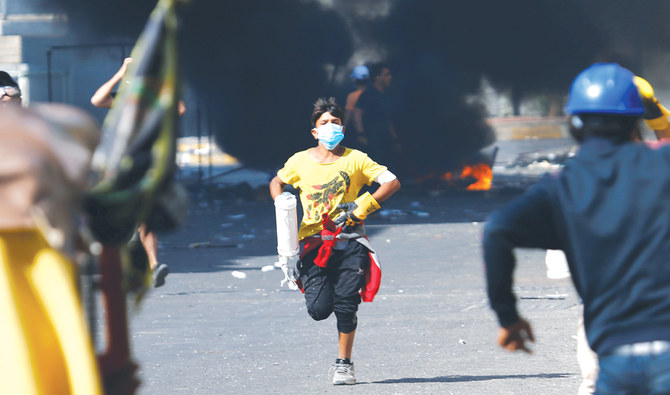
Baghdad and nine southern Shiite-dominated provinces have witnessed anti-government mass demonstrations since Oct. 1.
More than 300 demonstrators have been killed and 15,000 wounded, mostly in Baghdad, with tear gas and live bullets used by Iraqi forces to quell the protests, while scores of activists and journalists have been arrested.
Suleimani and his deputy, Maj. Gen. Hamed Abdollahi, are in Baghdad “to provide the necessary moral and logistical support” to Abdul Mahdi, whose dismissal has become the first demand of the protesters, a prominent Shiite leader told Arab News.
The general, or Abu Duaa, as his closest allies call him, attends almost daily meetings in Baghdad with leaders of Iranian-backed political forces in an attempt to dismantle the crisis and prolong the time Abdul Mahdi remains in office.
“Abu Duaa has been in Baghdad for 11 days. He is here to provide the necessary support to Abdul Mahdi,” one of the top Iraqi Shiite leaders told Arab News.
“The demonstrations will end soon in one way or another. There is money spent generously to get some engines (organizers of demonstrations) out of the scene, at the same time there are other means (arrests and kidnapping).
“The carrot and stick policy has been operational for weeks and is beginning to bear fruit.”
The dismissal or resignation of Abdul Mahdi, which has become one of the most important demands of the demonstrators, is not put forward as one of the solutions for Suleimani and his allies, and the military solution is also not on the table.
Suleimani’s ally said some Iraqi military leaders were demanding military intervention to end the demonstrations, especially in Tahrir Square where most demonstrators are gathering in Baghdad.
“They demanded the intervention of the Popular Mobilization Forces (PMU), but Suleimani rejected this option in principle.
“He clearly said that this is an American trap to drag the PMU factions to clash with the demonstrators and then demand their dissolution.”
NUMBER
300 - demonstrators have been killed and 15,000 wounded, mostly in Baghdad.
The PMU factions have not intervened as combat troops, “but that does not mean it (PMU) did not intervene as intelligence or security support,” the ally said.
Suleimani’s ally said that the solutions offered do not include the dismissal or resignation of Abdel Mahdi, although everyone knows that the cause of the current problem is him and his private office manager Abu Jihad.
“Our problem with the Americans, Sadr and Najaf is caused by Abu Jihad,” he said.
“Adel Abdul Mahdi has not taken any real decision since he became prime minister and all the decisions were made by Abu Jihad.
“Those two (Abdul Mahdi and Abu Jihad) are protected and their protector (Suleimani) insists that there is no real problem worth sacrificing them.
“He (Suleimani) does not deal with Iraq as a single country, but rather as part of a system that includes Iran, Syria, Lebanon, Yemen and Palestine, so any suggested solutions that exclude Adel or Abu Jihad are not acceptable (by Suleimani).
“The Iranians are not like Americans. They do not give up their ally easily, so they will continue to support Abdul Mahdi until the very last moment.”
The solutions proposed by Suleimani and agreed by the majority of key political players include a ministerial change involving more than half of the Cabinet, and to gradually vote on a number of important laws, accelerate the adoption of constitutional amendments to be ready for a referendum in April, vote to reduce the number of members of the Parliament to half, the abolition of the provincial councils, “which represent the vicious circle of corruption in the provinces,” change the election law “to allow the rise of individuals and small lists” and change the High Electoral Commission, the source said.
Changing the system from parliamentary to presidential may be included in the constitutional amendments but will not be passed as the Kurds, Sunnis and Najaf reject this system “because it is the key to sliding into dictatorship.”
“Now we are worried about Najaf (Grand Ayatollah Ali Al-Sistani) because it is really upset. This is really our last chance. (If not taken) then people will come out in an armed revolution,” Suleimani’s ally said.
“I’m not optimistic because the tools are the same. Real solutions mean big losses and no one is willing to take any losses.
“The situation will calm down and people (demonstrators) will return to their homes, but they will return to the street later.”


