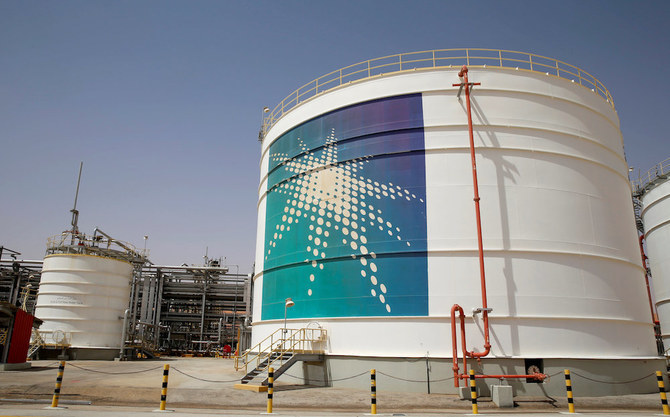
Saudi Aramco to offer 1 billion shares to private investors in world’s biggest IPO
Saudi Aramco could eclipse the $25 billion IPO of Alibaba in New York
Bookbuilding starts for both tranches of investors on November 17
Updated 11 November 2019
Frank Kane
Saudi Aramco is looking to sell 0.5 per cent of its shares to private investors – Saudi nationals, qualifying resident expatriates, and GCC citizens – as part of the record breaking initial public offering of shares in the most profitable company in history.
The percentage allotted to private shareholders was officially confirmed for the first time in the formal prospectus for the share offer on the Tadawul stock exchange, along with a wealth of information about the world’s biggest oil company.
With 200 billion Aramco shares current owned by the government, the amount targeted towards private shareholders would be 1bn shares.
The 658-page document was filed on the website of the Capital Markets Authority (CMA) – the Saudi regulator – late on Saturday night, following approval by the CMA for the IPO last week.
It still lacks crucial information on the sale – like the total percentage of the company to be sold, the level at which the shares will be priced, and an estimate of the total value OF Aramco.
But the prospectus will be pored over by private investors and foreign investing institutions as they weigh up whether to invest in the most profitable company in the world - and how much of their funds to allocate to the IPO.
If the IPO goes ahead at previously indicated levels, it could easily beat the previous record share sale, the $25bn offering of stock in Alibaba on the New York Stock Exchange.
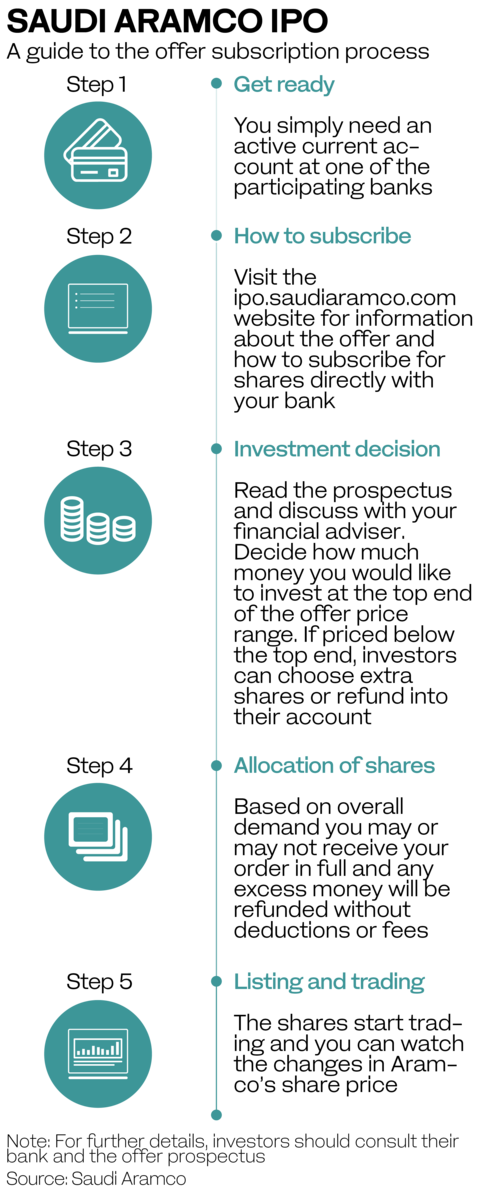
Aramco executives, bankers and other investment advisers will now embark on a whirlwind tour of Saudi, Gulf and international investors to gauge support for the IPO – a process known as “bookbuilding” – after which the final financial aspects of the offer will be determined.
Bookbuilding starts for both tranches of investors on Nov. 17, and end on Nov. 28 for individual investors, and on Dec. 4 for investing institutions.
Private investors who buy shares in the IPO, and who hold them for a period of six month after trading begins in December, will receive bonus shares up to a total of 100 shares, the prospectus confirmed.
The government of Saudi Arabia, which current owns the shares, has undertaken to sell no more for a six-month period after trading begins, nor can Aramco issue more shares in that period.
Although the IPO at this stage is a Tadawul-only launch, the government has said that in the future it could consider selling further shares on a foreign stock exchange.
The prospectus also recognizes “foreign strategic investors” as a source of potential demand for the IPO, opening up the possibility that big foreign wealth funds in Asia or elsewhere may want to get involved in the offering. There has been speculation that Chinese financial groups could be interested, as well as sovereign wealth funds in other GCC countries.
The prospectus also contains detailed information on Aramco’s estimates of demand growth for its key crude product, as well as data on the Kingdom’s oil reserves, refining capacity and governance procedures.
As is standard in all share prospectuses, there is also a detailed analysis of the risks involved in investing in the shares.
Red Sea’s oxygen balance under strain, experts warn
Scientists say warming waters, nutrient runoff and coastal development could quietly erode coral resilience
Updated 13 February 2026
Ghadi Joudah
RIYADH: The Red Sea may not have dead zones, but its fragile ecosystem is vulnerable to oxygen depletion — a quiet decline that can undermine coral health and disrupt marine life.
Sea dead zones are hypoxic or low-oxygen pockets that form most often when nutrient pollution — especially nitrogen and phosphorus from farm runoff and wastewater — fuels blooms that ultimately strip oxygen from the water.
Experts say the risk is not inevitable, but it depends on earlier detection and tighter control of the conditions that drain oxygen from coastal waters.
A sea that relies on its own “breathing” is also a sea shaped by geography.
FASTFACT
DID YOU KNOW?
The Red Sea is naturally low in oxygen because of its warm waters and high salinity — making it especially vulnerable to further oxygen decline.
The Red Sea’s narrow Bab Al-Mandab strait limits deepwater exchange, meaning the basin largely depends on its own internal circulation to ‘replenish’ oxygen.
Saudi Arabia’s coastline features steep underwater drop-offs, allowing deep, oxygen-poor water to move closer to coral reefs near shore.
Matheus Paiva, a senior oceanographer, told Arab News that “the Red Sea’s shallow Bab Al-Mandab choke point limits deepwater exchange,” meaning oxygen replenishment depends heavily on internal overturning circulation.
He said this circulation is driven as surface waters flow north, cool, become denser and sink, helping ventilate deeper layers through vertical mixing.
Paiva said the Saudi coastline’s underwater topography makes the risk more immediate close to shore.
Coral reefs along Saudi Arabia’s Red Sea coast, where scientists say warm, salty waters and limited deep-water exchange can leave ecosystems vulnerable to low-oxygen stress. (Unsplash.com)
“Unlike regions with wide, gradual shelves, our coast features narrow fringing reefs that drop sharply into deep water via steep underwater cliffs and canyons,” he said.
“This ‘step-and-drop’ topography brings deep oxygen-poor water close to shore.”
Paiva said warming at the surface can intensify stratification and reduce vertical mixing. He said that can allow low-oxygen water to creep upslope and affect shallower reef zones.
How oxygen gets consumed faster than it’s replaced is where human pressure can tip the balance.
Carlos Duarte, executive director or the Coral Research and Development Accelerator Program at KAUST, told Arab News that the Red Sea’s baseline conditions create vulnerability. “Because of its warm waters and high salinity, the Red Sea is inherently low in oxygen and, therefore, vulnerable to processes that decline oxygen further.”
He said algal blooms and heat waves raise biological oxygen demand, linking low oxygen to coral mortality.
Duarte said human-driven nutrient and organic inputs can intensify these declines.
He said poorly managed urban development and aquaculture operations can contribute nutrient and organic loads that fuel algal blooms.
Coral reefs along Saudi Arabia’s Red Sea coast, where scientists say warm, salty waters and limited deep-water exchange can leave ecosystems vulnerable to low-oxygen stress. (Unsplash.com)
Duarte said that as bloom material decomposes, it strips oxygen from the water and can lead to hypoxia.
The Red Sea’s celebrated clarity reflects a naturally nutrient-poor system. “The risk is amplified because the Red Sea is naturally oligotrophic. It is nutrient-poor and crystal clear,” Paiva said.
He added that wastewater releases and heavy rain events that trigger flash floods can push large nutrient loads into coastal waters in a short time.
In turn, those pulses can threaten biodiversity and the marine environment that underpins tourism investments along the Kingdom’s Red Sea coast.
Seeing low oxygen coming — rather than reacting after the fact — is the promise of new monitoring and analytics.
Paiva said high-accuracy oxygen data still relies on direct measurements collected during vessel surveys.
Carlos Duarte, executive director or the Coral Research and Development Accelerator Program at KAUST.
“We still depend heavily on classic vessel surveys,” he said. Teams deploy multiparameter sondes to profile the water column and collect water samples to establish a baseline.
“This ‘water-truthing’ remains the industry standard for high-accuracy data,” he said.
Saeed Al-Zahrani, general manager for Saudi Arabia at NetApp, said continuous data can help teams intervene earlier. “Oxygen depletion is rarely sudden; it tends to build over time when conditions line up,” he said.
Al-Zahrani said AI can flag anomalies, learn what “normal” looks like in specific locations, and generate short-horizon risk forecasts.
He added that it creates a decision window — guidance on when to increase sampling, where to focus response efforts, and when to tighten controls around discharges.
Coastal development that reduces oxygen risk starts, Duarte said, with what never reaches the sea.
Duarte said Saudi Arabia’s west coast investments have an advantage compared with older coastal destinations: the opportunity to design sustainability into projects from the outset rather than trying to retrofit after degradation becomes evident.
Duarte said nutrient control is a direct lever to reduce oxygen-depletion risk. “Achieve circular economies where organic products and nutrients are recycled and reused in the system to avoid discharging nutrients to the marine environment,” he said.
Al-Zahrani said wastewater and environmental systems produce huge volumes of information, but fragmentation can slow decisions.
He said connecting data in near real time can help detect problems earlier and anticipate load spikes tied to rainfall, tourism peaks, or industrial activity.
Reef resilience depends on reducing stress before heat and low oxygen overlap.
Duarte told Arab News: “Coral reefs are extremely vulnerable to oxygen depletion.” He added that it can contribute to bleaching and mortality in a warmer ocean.
He said marine heat waves can worsen oxygen stress by reducing oxygen solubility and limiting ventilation of subsurface waters, while increasing oxygen demands of organisms.
Duarte said reducing nutrient inputs and managing reefs to avoid excessive growth of seaweed can build resistance.
He also said models that account for how waves and currents interact with reef topography — work he said is being developed at KAUST — can help guide restoration toward sites more likely to remain oxygenated during heat stress.