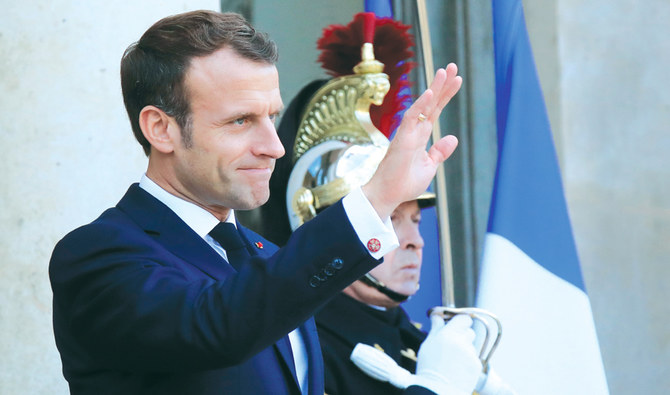

JEDDAH: In an interview published on Thursday, French President Emmanuel Macron told The Economist that NATO is suffering “brain death.” He cited a lack of strategic coordination between the US and other member states, and Turkey’s “uncoordinated aggressive action” in Syria as two of the symptoms.
Turkey’s actions in particular, he said, raised questions about the “collective defense” agreement stipulated in article five of NATO’s founding treaty, under which an attack on one member is viewed as an attack on all members. What would happen, he asked, if the Bashar Assad regime decided to retaliate against Turkey over its incursion into Syria? “Will we commit ourselves under it (Article 5)? It is a crucial question,” he said. The article has only been invoked once before, in response to the Sept. 11 attacks in 2001.
During Turkey’s fortnight-long incursion into northern Syria, Macron called on Ankara to cease its attacks immediately and criticized NATO’s failure to respond to what he called Turkey’s “crazy” offensive. France also suspended arms sales to Turkey.
Questioning NATO’s commitment to the protection of a member state demonstrates how disapproval against Ankara has grown, with some prominent members of the alliance already turning their backs on Turkey. Turkey has the second-largest standing military force in NATO, after the US, and has been a member of the alliance since 1952.
But statements such as Macron’s may push Ankara to reassess its defense needs in regards to growing regional security threats, and to procure alternative mechanisms — such as the Russian-made S-400 air defense system, so that it is not relying solely on one side.
Relations between European NATO members and the US have been soured recently by America’s decision to withdraw troops from northeastern Syria without consulting or warning other members. US President Donald Trump’s threat to “moderate” the US’ economic commitment to NATO — which accounts for around 70 percent of the alliance’s military expenditure — if members failed to honor their current pledge of spending 2 percent of their GDP on defense has also raised the hackles of some NATO members, and caused some observers to question the solidity of the 70-year-old alliance.
“Macron’s statements are not to be taken too literally,” Sinan Ulgen, chairman of the Istanbul-based EDAM think tank and a visiting scholar at Carnegie Europe, told Arab News. “His goal is to convince European nations to spend more on defense and to build up European capabilities. The alarmism about NATO is designed to emphasize this message.”
Ulgen also noted that establishing a European defense structure able to replace NATO may not be a realistic goal, especially given the likelihood of the UK’s exit from the European Union. However, the former diplomat added that he does not believe Turkey has a realistic alternative to NATO as an ally.
HIGHLIGHT
Questioning NATO’s commitment to the protection of a member state shows how disapproval against Ankara has grown.
“For Turkey, bilateral ties with the US will matter more in terms of how Ankara evaluates the future contributions of NATO to Turkey’s national security,” he said.
Macron’s comments prompted reaction from NATO Secretary-General Jens Stoltenberg, German Chancellor Angela Merkel, and US Secretary of State Mike Pompeo, who emphasized the critical importance of NATO as a strategic partnership, while stressing that it needed to “grow and change” or risk becoming “ineffective or obsolete.”
Ozgur Unluhisarcikli, Ankara office director of the German Marshall Fund of the US, a think tank, believes there is no question that NATO has the means and the will to provide security guarantees to all member states.
“What we are seeing today is the result of years of complacency and different perspectives on the nature of the threats member states are facing,” he told Arab News. “Despite multiple tensions between different members of NATO, the transatlantic alliance is still the central pillar of Turkey’s security strategy and this is not about to change any time soon.”
However, Unluhisarcikli suggested, Turkey does not see NATO membership and ties to the alliance’s adversaries such as Russia to be mutually exclusive, which is the underlying reason behind the current issues Turkey has with other NATO members.
Not all members, though. For Luxembourg, at least, Turkey would certainly be able to invoke article five if its troops were attacked by the Syrian regime’s forces.
“In that case, NATO would have to step in to assist Turkey,” Luxembourg Foreign Minister Jean Asselborn told German radio station Bayerischer Rundfunk on Oct. 14, adding that that assistance would not necessarily be military in nature as the alliance would look to “restore and maintain the security of the North Atlantic area.”