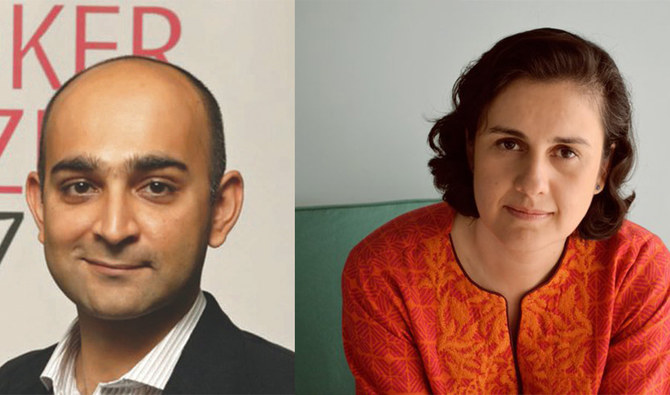
Pakistani authors make it to BBC’s ‘100 Novels that Shaped our World’

Pakistani authors Mohsin Hamid and Kamila Shamsie. (Courtesy: Twitter)
Updated 08 November 2019
Follow

Pakistani authors make it to BBC’s ‘100 Novels that Shaped our World’

  • Kamila Shamsie and Mohsin Hamid rank amongst novels ranging from literary classics to contemporary works
  • Mohsin Hamid's The Reluctant Fundamentalist, listed under Crime & Conflict, has also been adapted into a film

ISLAMABAD: Two of Pakistani authors have made it to the BBC’s list of ‘100 Novels that Shaped Our World.’
The list which features authors from across the globe includes Kamila Shamsie and Mohsin Hamid.
Shamsie’s ‘Home Fire’ made the list under the category ‘Politics, Power, and Protest.’ The author’s seventh novel follows the lives of siblings whose connection to home, faith and each other undergoes trials and tribulations played to the backdrop of political turmoil and corruption. Home Fire is in the company of ‘The Color Purple’ by Alice Walker, ‘A Thousand Splendid Sons’ by Khaled Hosseini and Harper Lee’s ‘To Kill a Mocking Bird.’
Hamid’s ‘The Reluctant Fundamentalist’ is housed under Crime & Conflict amid such novels as ‘The Talented Mr.Ripley by Patricia Highsmith,’ ‘The Quiet American’ by Graham Greene and ‘Ice Candy Man’ by Bapsi Sidhwa.
The Reluctant Fundamentalist is narrated by a Pakistani man in Lahore speaking to an American, possibly a CIA agent, about how they both ended up in conversation and how he ended up teetering or perhaps crossing the lines into jihadism. The book was also adapted into a film starring British-Pakistani actor Riz Ahmed.
The list was curated by a diverse panel including editors, authors and literary experts like Times Literary Supplement editor Stig Abell, broadcaster Mariella Frostrup, authors Juno Dawson, Kit de Waal and Alexander McCall Smith, and Bradford Festival Literary Director Syima Aslam.


Pakistan slashes power tariff for industries by Rs4.4 per unit to spur growth

Updated 12 min 40 sec ago
Follow

Pakistan slashes power tariff for industries by Rs4.4 per unit to spur growth

  • The development comes as Pakistan seeks to boost exports to ensure economic recovery under a $7 billion IMF program
  • PM Sharif also announces lowering export refinance rate from 7.5 percent to 4.5 percent, and electricity wheeling charges to Rs9 per unit

ISLAMABAD: Prime Minister Shehbaz Sharif on Friday announced a Rs4.4 ($0.014) cut in electricity tariffs for industrial consumers, saying the move is aimed at lowering production costs and spurring economic activity in Pakistan.

Manufacturers in Pakistan have long complained of high electricity price, i.e. Rs22.98 per unit, for industrial consumers, arguing that it has dampened industrial growth and made local products less competitive globally.

The reduction in power tariffs for industries is expected to lower production costs that will allow exporters to offer more competitive prices in international markets and increase profit margins through higher capacity utilization.

Addressing businessmen and exporters at a ceremony in Islamabad, Sharif said there was no alternative to export-driven economic growth and his government will devise all future economic policies in consultation with them.

“Four rupees and four paisas per unit are being reduced in electricity tariffs for industry,” the prime minister announced at the ceremony. “If it were up to me, I would reduce it by another 10 rupees, but my hands are tied.”

The development comes as Pakistan, which has long struggled with boom-bust cycles, seeks to boost foreign investment and increase exports as it navigates a long path to economic recovery under a $7 billion International Monetary Fund (IMF) program.

The prime minister said they have reduced the export refinance rate from 7.5 percent to 4.5 percent.

“I believe this is a very significant facility being extended to you,” he said. “God willing, it will help Pakistan’s exports rebound and it will certainly be of immense benefit, especially to those who need financing.”

During his address, Sharif also announced lowering wheeling charges for industries by Rs9 ($0.032) per unit, noting the country’s economy had stabilized, inflation had come down to single digits and the policy rate stood at 10.5 percent.

In Pakistan, wheeling charges refer to fees paid by electricity consumers and generators to use the national grid’s transmission and distribution network to move electricity from suppliers to end-users under the Competitive Trading Bilateral Contracts Market (CTBCM).

“I think this should help you sell your power to neighboring industries,” he told businesspersons at the event.