

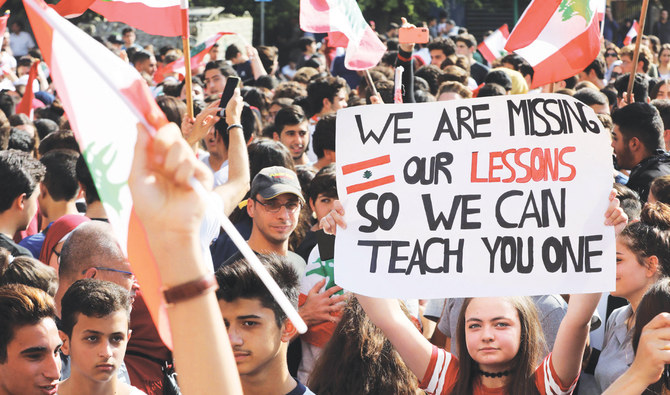
Lebanese students join Beirut protests

Lebanese students rally in front of the Ministry of Education during ongoing anti-government protests, in the capital Beirut on Thursday. (AFP)
Updated 08 November 2019
Follow

Lebanese students join Beirut protests

  • Students from public and private universities and schools took to the streets across Lebanon chanting “revolution.”

BEIRUT: The students of the Lebanese University known as “the university of the poor” joined public protests in their 22nd day. 

It is a state university and most of its students are from the poor and middle classes. According to its administration, its students make up 35 percent of the total number of the country’s university students.

Students chanted as they headed to Riad Al-Solh Square to demand basic services at their university. They spoke of the ambiguity of their professional future in the light of the domination of favoritism over the employment process. Their colleagues in other faculties complained about them on social media as the administration and teachers prevented students from leaving lecture halls to join the movement.

Students from public and private universities and schools took to the streets across Lebanon chanting “revolution.” They included students from Saint Joseph University, Haigazian University, Antonine University and the Lebanese American University.

Some groups focused on public institutions and prevented employees from entering, while others gathered in front of Zouk Thermal Power Plant to protest pollutant emissions.

Chants were accompanied by banging on pots and metal ware. This practice started on Wednesday night when people went to their balconies in Beirut, Sidon and Tripoli and banged on pots as a sign of their support for the protests.

The people of Beirut last used this method in 1916 during the famine that hit Lebanon under Ottoman rule.

The protests have not yet caused any responses from the authorities except for the resignation of the government. The president has not yet set a date for the binding parliamentary consultations to appoint a new prime minister, pending behind-the-scenes consultations with his political allies and outgoing Prime Minister Saad Hariri.

There is a possibility of forming a technocratic political government with a mixture of political ministers and experts, while protesters insist on a fully technocratic government that works to hold early parliamentary elections.

In the context of reviewing corruption cases, the financial prosecutor, Judge Ali Ibrahim, listened to the testimony of former Prime Minister Fouad Siniora at the Palace of Justice. The hearing lasted about three hours and “focused on the case of the $11 billion that was spent when Siniora was Prime Minister between 2006 and 2008,” according to the National News Agency.

Ibrahim also filed a lawsuit against the Director-General of Customs Badri Al-Daher for “wasting public funds.”

The Attorney General Judge Ghassan Oweidat referred a complaint presented by a number of lawyers against all ministers in successive governments since 1990 to attorney Ghassan Al-Khoury for “embezzling and wasting public funds for personal and material benefits, exploiting power and authority and seriously harming the Lebanese people,” in order to initiate investigations and take all necessary measures.


UN peacekeepers say Israeli forces fired on them in southern Lebanon

Updated 11 December 2025
Follow

UN peacekeepers say Israeli forces fired on them in southern Lebanon

  • “Yesterday, peacekeepers in vehicles patrolling the Blue Line were fired upon by IDF soldiers in a Merkava tank,” UNIFIL said
  • It said that both the peacekeepers and the Israeli tank were in Lebanese territory

BEIRUT: The United Nations Interim Force in Lebanon said Wednesday that Israeli forces fired on its peacekeepers a day earlier in the country’s south, urging Israel’s army to “cease aggressive behavior.”
It is the latest such incident reported by the peacekeepers in southern Lebanon, where UNIFIL acts as a buffer between Israel and Lebanon and has been working with Lebanon’s army to support a year-old truce between Israel and militant group Hezbollah.
“Yesterday, peacekeepers in vehicles patrolling the Blue Line were fired upon by IDF (Israeli army) soldiers in a Merkava tank,” a UNIFIL statement said, referring to the de facto border.
“One ten-round burst of machine-gun fire was fired above the convoy, and four further ten-round bursts were fired nearby,” the statement said.
It said that both the peacekeepers and the Israeli tank were in Lebanese territory at the time of the incident and that the Israeli military had been informed of the location and timing of the peacekeeping patrol in advance.
“Peacekeepers asked the IDF to stop firing through UNIFIL’s liaison channels... Fortunately, no one was injured,” it said.
Last month UNIFIL said Israeli soldiers shot at its troops in the south, while Israel’s military said it mistook blue helmets for “suspects” and fired warning shots.
In October, UNIFIL said one of its members was wounded by an Israeli grenade dropped near a UN position in the country’s south, the third incident of its kind in just over a month.
“Attacks on or near peacekeepers are serious violations of (UN) Security Council Resolution 1701,” UNIFIL said on Wednesday, referring to the 2006 resolution that formed the basis of the November 2024 truce.
“We call on the IDF to cease aggressive behavior and attacks on or near peacekeepers working to rebuild stability along the Blue Line,” the peacekeepers said.
Israel carries out regular attacks on Lebanon despite the truce, usually saying it is targeting sites and operatives belonging to Hezbollah, which it accuses of rearming.
It has also kept troops in five south Lebanon areas it deems strategic.
On Saturday, a UN Security Council delegation visiting Lebanon urged all parties to uphold the ceasefire.
It emphasized that the “safety of peacekeepers must be respected and that they must never be targeted,” after gunmen on mopeds attacked UNIFIL personnel last week.
