

MENA startups inject tech savvy into Saudi Arabia’s entertainment scene

Events and entertainment tourism are expected to play a key role in the Kingdom’s economic reform, with more than 5,000 events on the calendar for 2019. (Supplied)
Updated 08 November 2019
Follow

MENA startups inject tech savvy into Saudi Arabia’s entertainment scene

  • Event organizers are delivering an experience that lives up to the expectations of attendees
  • Up-and-coming event organizers will be able to provide professional and seamless digital experiences

CAIRO: While the Middle East and North Africa (MENA) region has always been a popular destination for business and entertainment events, a host of startups are taking the industry to the next level through the power of technology.

Earlier this year, Saudi Arabia’s General Entertainment Authority announced a new strategic plan to revamp the local entertainment sector. There are more than 5,000 events on the calendar for 2019, with investments projected to exceed $64 billion over the next decade.

The plan is part of a broader push to diversify the Kingdom’s economy away from oil by 2030. 

Events and entertainment tourism are expected to play a key role in this ambitious economic reform.

However, this sector boom is nothing new to the region. The UAE has established itself as a leading destination for business events and entertainment tourism, while more of MENA’s major economies are implementing economic plans that incorporate the thriving events industry in one way or another.

Startups in the region are capitalizing on the evolution of this space by developing a digital ecosystem which allows event organizers to deliver an experience living up to the expectations of their attendees.

Whether it is making ticket purchases easier, streamlining event check-in, or addressing a whole host of other challenges regional events organizers have historically faced, these startups are leveraging technology to raise the standards of event management.
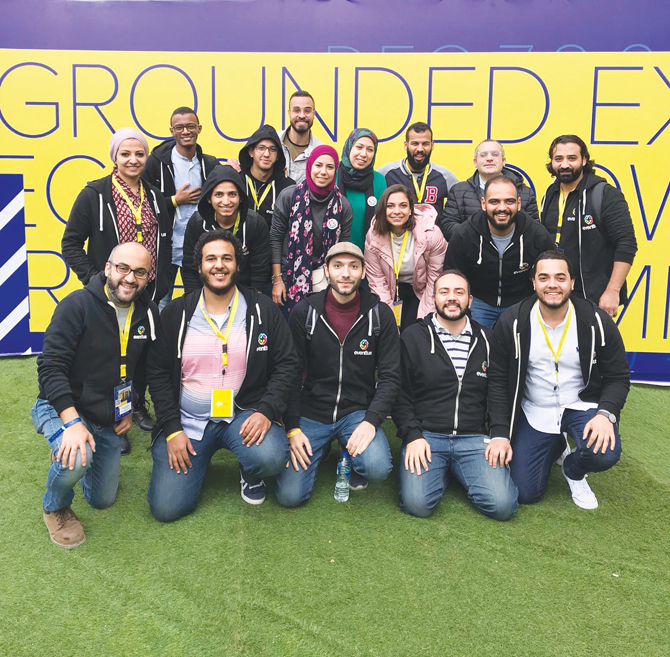


A new generation of startups are leveraging technology and tourist entertainment. (Supplied)

“After all, it is not enough to have great performers when the rest of the experience that comes with attending events is below par,” says Farrukh Bandey, a user experience research manager at UXBERT Labs, the digital experience design company behind event planning and discovery app HalaYalla.

Launched in early 2014 by Bandey and Nadeem Bakhsh, the Saudi-based venture came to dominate the country’s entertainment scene after becoming the official ticketing app for the Jeddah Season series of events.

HalaYalla provides a full suite of event-management features together with live event analytics and reporting for organizers. It also worked with local authorities to let international event attendees apply for a tourist visa while buying their tickets through the platform.

While gaining the trust of the government was a huge milestone for the company, it was also a challenge. The team’s abilities were first put to the test when they handled the registration for Saudi Arabia’s first-ever Baloot Championship, a card game popular in Gulf Cooperation Council countries.

Held in October 2018, the event saw more than 85,000 players register to compete.

Considered by many as one of the earliest disruptors in MENA’s event space, Eventus was founded in 2012 by Egyptian duo Mai Medhat and Nihal Fares. The company was backed by multimillion-dollar investment rounds from prominent local and international venture capitals.

The market Eventus excelled at addressing was providing event organizers with a customized app. The execution was a great hit for forums such as the Startup Grind’s Global Conference, an annual gathering for a community that supports 2 million entrepreneurs in more than 125 countries.


 This report is being published by Arab News as a partner of the Middle East Exchange, which was launched by the Mohammed bin Rashid Al Maktoum Global Initiatives and the Bill and Melinda Gates Foundation to reflect the vision of the UAE prime minister and ruler of Dubai to explore the possibility of changing the status of the Arab region.


Abbas reiterates opposition to displacement of Palestinians

Russian President Vladimir Putin with Palestinian President Mahmoud Abbas at the Senate Palace of the Kremlin in Moscow. (AP)
Updated 8 sec ago
Follow

Abbas reiterates opposition to displacement of Palestinians

  • During Moscow talks, president calls for immediate halt to Israeli acts of terror
  • Historically, Russia has supported and stood by the Palestinian people at political and diplomatic levels

MOSCOW: The Palestinian National Authority’s President Mahmoud Abbas has reiterated his opposition to all attempts to displace Palestinian people from their land.

Speaking with Russian President Vladimir Putin at the presidential palace in Moscow, Abbas was reported by the Kremlin’s official website as saying that “the Palestinian people are holding on to their land, and we categorically oppose attempts by the Americans and Israelis to expatriate Palestinians beyond Palestinian territory.” 
He said the Palestinian people “will not abandon their land, whatever the cost.” Abbas stressed the need to fully implement US President Donald Trump’s peace plan, leading to the withdrawal of occupation forces and the launch of the reconstruction process.
He emphasized that the Palestinian Authority would assume a central role in administering the Gaza Strip, and that the enclave and the West Bank constituted two parts of a single territorial unit, with a unified and undifferentiated system of civilian institutions.
He stressed the need for an immediate halt to “Israeli settler colonialism and Israeli acts of terror in the West Bank, including Jerusalem, along with the release of withheld Palestinian funds and the cessation of all measures that undermined the Palestinian Authority and the two-state solution.”
He reaffirmed his commitment to continue the struggle for the realization of the Palestinian people’s right to self-determination and of their right to a fully sovereign, independent state based on the borders of June 4, 1967, with East Jerusalem as its capital, while living in security and peace with neighbors.
He told Putin: “What we need is peace, and we hope that with your help and support, we can achieve it — a peace built on the basis of international legal resolutions, decisions of the United Nations, and the principles established following the wars of 1967 and 1973.
“East Jerusalem remains the capital of Palestine, and we know that Russia has always supported — indeed, was the first to support — Palestine, maintaining a firm stance in support of our people.”
Abbas thanked his Russian counterpart for Moscow’s support and commended the bilateral “bonds of friendship” between both countries. He added: “We are friends of Russia and the Russian people. For over 50 years our nations have been bound by a strong friendship that has developed over the decades and continues on the correct path. Russia is a great friend and a nation upon which we rely in many spheres.
“Historically, Russia has supported and stood by the Palestinian people at political and diplomatic levels. Your economic and financial support is both significant in scale and crucial in importance.”
Abbas emphasized moving forward with the implementation of a comprehensive national reform program aimed at consolidating the rule of law, strengthening the principles of good governance, transparency, and accountability, and ensuring the separation of powers.
Putin affirmed Moscow’s “principled and consistent approach” to the Palestinian question.
He said: “We believe that only the establishment and full functioning of the Palestinian state can lead to a lasting settlement of the Middle East conflict.”