

Alphabet scrutinizing handling of misconduct claims

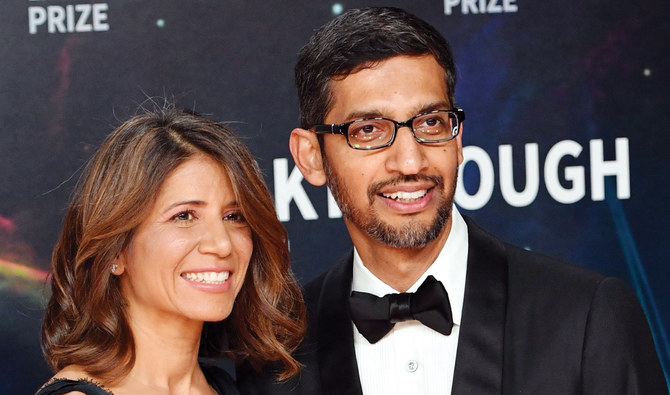
Google CEO Sundar Pichai with his wife Anjali Pichai. (AFP)
Updated 07 November 2019
Follow

Alphabet scrutinizing handling of misconduct claims

SAN FRANCISCO: Google’s parent company Alphabet has confirmed that its board is investigating how executives handled accusations of misconduct including sexual harassment.

“In early 2019, Alphabet’s board of directors formed a special litigation committee to consider claims made by shareholders in various lawsuits relating to past workplace conduct,” said an Alphabet spokesperson.

The board hired a law firm to help the committee, which was to contact those who filed complaints and scrutinize cases, including one involving the Alphabet chief legal officer, according to a CNBC report citing unspecified material it had seen.

Google in November outlined changes to its handling of sexual misconduct complaints, hoping to calm outrage that triggered a worldwide walkout of workers.

“We recognize that we have not always gotten everything right in the past and we are sincerely sorry for that,” Chief Executive Sundar Pichai said at the time in a message to employees, a copy of which was shared with AFP.

“It’s clear we need to make some changes.”

Pichai promised that Google would be more transparent with how concerns are dealt with, and provide better support and care to those who raise such issues with the company.

Google would provide “more granularity” regarding sexual harassment investigations and their outcomes, according to Pichai.

Google announced updates to its mandatory sexual harassment training and said it would require it annually instead of every two years, as had been the case.

Google also put the onus on team leaders to tighten the tap on booze at company events, on or off campus, to curtail the potential for drunken misbehavior.

HIGHLIGHTS

• Chief Executive Sundar Pichai promised that Google would be more transparent with how concerns are dealt with, and provide better support and care to those who raise such issues with the company.

• Google would provide ‘more granularity’ regarding sexual harassment investigations and their outcomes, according to Pichai.

Despite the assurances, shareholders filed lawsuits against Alphabet accusing it of covering up sexual misconduct.

Thousands of Google employees joined a coordinated worldwide walkout late last year to protest the US tech giant’s handling of sexual harassment.

A massive turnout at the “Googleplex” in Silicon Valley was the final stage of a global walkout that began in Asia and spread to Google offices in Europe.

Some 20,000 Google employees and contractors participated in the protest in 50 cities around the world, according to organizers.

The protest took shape after Google said it had fired 48 employees in the prior two years — including 13 senior executives — as a result of allegations of sexual misconduct.

Demands by protesters included putting employee representation on the board.


SABIC posts $31bn revenue, maintains $9bn dividend despite loss 

Updated 13 sec ago
Follow

SABIC posts $31bn revenue, maintains $9bn dividend despite loss 

RIYADH: Saudi Basic Industries Corp. swung to a net loss of SR25.78 billion ($6.87 billion) in 2025, as divestment-related charges and weaker petrochemical prices weighed on earnings, even as the company generated SR116.53 billion in revenue. 

The loss compares with a net profit of SR1.54 billion a year earlier, while revenue declined 1.03 percent from 2024 levels, according to a Tadawul filing  

In a statement, the company attributed the slight fall in revenue to lower average selling prices across key products, partially offset by higher sales volumes. 

The company’s operational profit stood at SR4.37 billion in 2025, while earnings before interest, tax, depreciation and amortization amounted to SR17.88 billion. 

In a statement, ‏Abdulrahman Al-Fageeh, CEO of SABIC, said: “2025 reflected a moderately improving macroeconomic landscape. Yet, production overcapacity persisted in the petrochemical industry, continuing to squeeze margins and depress utilization rates.”  

He added: “Amid these conditions, SABIC remained focused on meeting its 2025 priorities.”  

Al-Fageeh, who is set to step down as SABIC’s CEO at the end of March, said the company achieved a total recordable incident rate of 0.07, the lowest in SABIC’s history. “This represents a 22 percent year-over-year improvement in performance across the combined areas of environment, health, safety, and security.”  

According to SABIC, losses from discontinued operations increased by SR20.8 billion compared to the previous year.  

This was primarily attributed to reporting non-cash losses of SR15.2 billion related to the fair value assessment of the planned exit from petrochemical assets in Europe and thermoplastic engineering businesses in the Americas and Europe.  

In a separate Tadawul filing, SABIC said its board approved the distribution of interim cash dividends totaling SR4.5 billion for the second half of 2025, equivalent to SR1.5 per share. The dividend will be paid on March 31 to shareholders registered as of March 8. 

The second-half payout follows a similar SR4.5 billion dividend distributed for the first half of 2025, bringing the company’s total shareholder distributions for the year to SR9 billion. 

“We remain committed to delivering value to our shareholders, announcing the distribution of SR9 billion in dividends for the full year of 2025,” added Al-Fageeh. 

The CEO revealed that construction of the SABIC Fujian petrochemical complex remained on track, reaching 95.3 percent completion. 

He further said that SABIC’s innovation program provided market-driven solutions for customers through 148 new product introductions in 2025. 

“All these achievements helped to strengthen SABIC’s brand value, which surpassed $5 billion for the first time. Having grown 5.4 percent over the year, the SABIC brand is now valued at $5.19 billion,” he concluded. 

SABIC also announced the appointment of Faisal Mohammed Al-Faqeer as its new CEO, effective April 1, 2026, replacing Abdulrahman Saleh Al-Fageeh. 

“SABIC Board of Directors extends its sincere thanks and appreciation to  Abdulrahman Saleh Al-Fageeh, who has been an instrumental figure in guiding the company through a crucial period of strategic optimization designed to ensure its long-term success and reinforce its role at the forefront of the global petrochemical industry,” the company said in a Tadawul statement. 

Al-Faqeer has extensive experience in the petrochemicals and refining industries. He currently serves as senior vice president of liquids-to-chemicals at Saudi Aramco.