Saudi mining strategy in spotlight at IMARC

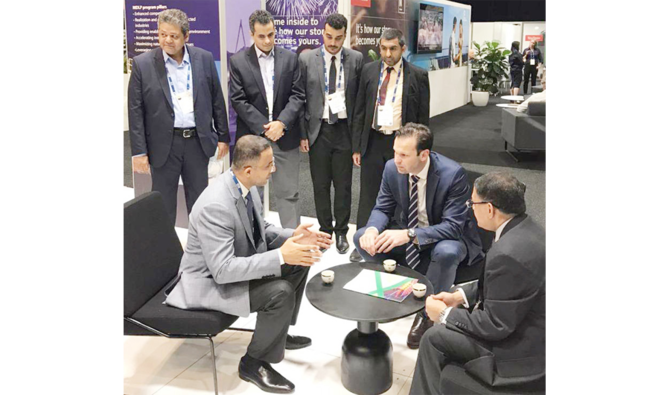
Saleh Alaqili, deputy minister for Mining Investment Development, was the leader of the Saudi delegation to the International Mining and Resources Conference and Expo in Australia.
Updated 07 November 2019
Follow

Saudi mining strategy in spotlight at IMARC

The Saudi Arabian Ministry of Industry and Mineral Resources has released details of its progress delivering its long-term global mining strategy, during the International Mining and Resources Conference and Expo (IMARC) held from Oct. 29 to 31 in Australia. The theme for the strategy is “Mining’s Vast Potential.”

Originally named one of the most promising new growth sectors in Vision 2030, the ministry has made great strides toward increased exploration and investment in the mining sector. The announcement provides details of the work already done and plans for how to accelerate economic growth in the future.

“The Arabian Peninsula has long been known for its mineral richness, and building on that unique strength, we see an even brighter future for mining in Saudi Arabia,” said Saleh Alaqili, deputy minister for Mining Investment Development and leader of the Saudi delegation to IMARC. “Our long-term mining strategy is focused on driving economic diversification and growth for the Kingdom, while offering exciting exploration and investment opportunities.”

Saudi Arabia’s mining strategy is built around the development of integrated mineral value chains that will elevate the sector to become the third pillar of Saudi industry. The ministry intends to deliver on the sector’s promise by:

• Leveraging the Kingdom’s unparalleled mineral endowment. 

• The “Arabian Shield” is estimated to house a potential $1.3 trillion worth of minerals, including phosphate, gold, copper, silver, zinc, rare earth minerals and others.

• Harnessing its strong domestic demand for minerals.

• Saudi Arabia is the fourth largest net importer of mineral and metal products, many of which can be produced domestically.

• Fostering a mining ecosystem that is attractive to Saudi and international explorers, investors and other stakeholders.

• Much of the ministry’s work during the last year has been focused on transforming the Kingdom’s mining ecosystem.

The ministry has identified four drivers of Saudi Arabia’s mining strategy and has committed nearly $4 billion to advancing them:

• Improving sector governance by establishing a new overarching mining law

• Digitizing critical processes and services

• Making the most accurate geological data accessible

•Sustainability.

The Saudi delegation included the key enablers involved in the transformation of the mining sector: Saudi Geological Survey (SGS), National Industrial Development and Logistics Program (NIDLP), Saudi Arabia General Investment Authority (SAGIA), and Saudi Industrial Development Fund (SIDF). 

“We have aggressive goals over the course of the next 10 years to deliver a valuable, sustainable mining sector for Saudi Arabia,” said Alaqili. “We welcome the world to work with us to deliver maximum value from our rich mineral resources.”


Schneider Electric to advance energy technology to power intelligence at Innovation Summit Middle East & Africa

Updated 01 March 2026
Follow

Schneider Electric to advance energy technology to power intelligence at Innovation Summit Middle East & Africa

Schneider Electric, a global energy technology leader, has announced that the second edition of the Innovation Summit Middle East & Africa will be held in Abu Dhabi on April 28–29. 

The summit will bring together global energy and technology leaders as well as government officials to advance the regional shift toward energy intelligence, as data center growth, AI adoption, and national visions place unprecedented demands on energy systems.

Schneider Electric is advancing its energy technology ambitions with the integration of electrification, automation and digital intelligence, deployed across buildings, data centers, industrial applications and power grids to unlock the full value of energy, and ensure efficiency and sustainability for all.

This year’s summit arrives at a pivotal moment for the Middle East and Africa, as the region experiences exponential growth driven by national visions, giga-projects, and rapid expansion in AI, data centers, and digital infrastructure. 

Saudi Arabia stands out within this landscape as one of the most dynamic markets in terms of investment in digital infrastructure and sustainable energy. 

With global electricity demand projected to grow at a strong compound annual growth rate of 3.6% over the 2026–2030 period and global AI workloads projected to lead a 160% increase in data center power demand, the imperative for intelligent, sustainable energy solutions has never been more critical.

“Energy today is the foundation of national resilience and competitiveness. With electricity consumption in the Middle East and North Africa having tripled since 2000 and on course to grow at an incremental 3-4% every year to register a whopping 50% by 2035 – driven by surging cooling, desalination, and urbanization demands, the region is at an inflection point,” said Walid Sheta, Zone president, Middle East and Africa, Schneider Electric. 

“Innovation Summit Middle East & Africa underscores our dedication to accelerating energy technology innovation and powering energy intelligence throughout the region. This edition will emphasize our emergence as the trusted energy technology partner guiding the region’s next phase of transformation. " 

This year’s summit will highlight regional benchmarks from 80+ countries, from the 100% elimination of SF6 and Carbon footprint reduction for fruit producers in South Africa to the savings that EcoStruxure Power & Grid is enabling for the National Electricity Company, Senegal – ensuring recovery times of 3 minutes versus 3 hours earlier.

Blending high-impact programming and latest product launches that position Schneider Electric at the center of MEA's energy transition story, key agenda items include:

CEO Forum in partnership with Forbes Middle East: An exclusive C-suite initiative bringing together 100 business leaders to address strategic imperatives in energy intelligence.

Keynote and Thought Leadership sessions: Featuring executive speakers from industry-leading companies and insights from strategic partners, including Bain & Company.

Innovation Hub experience: Guided tours and live demonstrations, as well as tailored customer experiences of Schneider Electric’s most innovative and integrated energy technology solutions addressing critical challenges in energy efficiency, grid modernization, and digital infrastructure across a 3,000 square feet immersive space.

Stakeholder recognition: Schneider Electric’s dedicated partners will be honored with 20 Cluster awards and five Middle East and Africa awards across four categories – Growth Award, Efficiency Award, Innovation Award, and Sustainability Award, on Day 2 of the Summit. 

"Across the Gulf, energy intelligence is becoming the operational reality as public and private sector enterprises race to align with national visions for a decarbonized and sustainable future,” said Amel Chadli, president, Gulf Cluster at Schneider Electric.

“As one of the most local of global companies, Schneider Electric is empowering customers to move beyond electrification and implement AI‑driven, software‑defined energy systems that deliver efficiency, resilience, and sustainability at a national scale. This summit offers a roadmap of what’s next as we continue to redefine the relationship between energy and digital capability.”

With AI, cloud, and high-performance computing becoming foundational to national competitiveness, energy technologies today must evolve and become resilient, sustainable and scalable to meet modern intelligence demands. 

Schneider Electric's refreshed positioning as an energy technology partner reflects the company's approach to supporting the region's transformation. 

Schneider Electric’s Innovation Summit Middle East & Africa highlights real-world applications across key sectors, including utilities, data centers, commercial buildings, industrial facilities, and critical infrastructure — demonstrating how intelligent energy management enables operational excellence, resilience, and sustainability across the region's most vital projects.