Saudi mining strategy in spotlight at IMARC

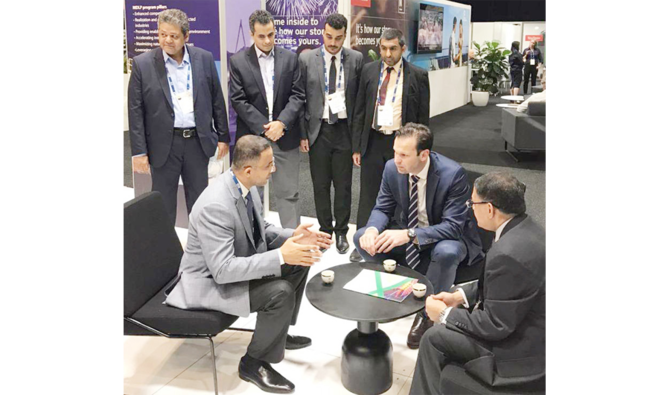
Saleh Alaqili, deputy minister for Mining Investment Development, was the leader of the Saudi delegation to the International Mining and Resources Conference and Expo in Australia.
Updated 07 November 2019
Follow

Saudi mining strategy in spotlight at IMARC

The Saudi Arabian Ministry of Industry and Mineral Resources has released details of its progress delivering its long-term global mining strategy, during the International Mining and Resources Conference and Expo (IMARC) held from Oct. 29 to 31 in Australia. The theme for the strategy is “Mining’s Vast Potential.”

Originally named one of the most promising new growth sectors in Vision 2030, the ministry has made great strides toward increased exploration and investment in the mining sector. The announcement provides details of the work already done and plans for how to accelerate economic growth in the future.

“The Arabian Peninsula has long been known for its mineral richness, and building on that unique strength, we see an even brighter future for mining in Saudi Arabia,” said Saleh Alaqili, deputy minister for Mining Investment Development and leader of the Saudi delegation to IMARC. “Our long-term mining strategy is focused on driving economic diversification and growth for the Kingdom, while offering exciting exploration and investment opportunities.”

Saudi Arabia’s mining strategy is built around the development of integrated mineral value chains that will elevate the sector to become the third pillar of Saudi industry. The ministry intends to deliver on the sector’s promise by:

• Leveraging the Kingdom’s unparalleled mineral endowment. 

• The “Arabian Shield” is estimated to house a potential $1.3 trillion worth of minerals, including phosphate, gold, copper, silver, zinc, rare earth minerals and others.

• Harnessing its strong domestic demand for minerals.

• Saudi Arabia is the fourth largest net importer of mineral and metal products, many of which can be produced domestically.

• Fostering a mining ecosystem that is attractive to Saudi and international explorers, investors and other stakeholders.

• Much of the ministry’s work during the last year has been focused on transforming the Kingdom’s mining ecosystem.

The ministry has identified four drivers of Saudi Arabia’s mining strategy and has committed nearly $4 billion to advancing them:

• Improving sector governance by establishing a new overarching mining law

• Digitizing critical processes and services

• Making the most accurate geological data accessible

•Sustainability.

The Saudi delegation included the key enablers involved in the transformation of the mining sector: Saudi Geological Survey (SGS), National Industrial Development and Logistics Program (NIDLP), Saudi Arabia General Investment Authority (SAGIA), and Saudi Industrial Development Fund (SIDF). 

“We have aggressive goals over the course of the next 10 years to deliver a valuable, sustainable mining sector for Saudi Arabia,” said Alaqili. “We welcome the world to work with us to deliver maximum value from our rich mineral resources.”


Schneider Electric launches academy in Saudi Arabia to build future-ready talent

Updated 04 February 2026
Follow

Schneider Electric launches academy in Saudi Arabia to build future-ready talent

Schneider Electric has announced the launch of the Energy Tech Academy Middle East and Africa in Saudi Arabia, a regional capability platform dedicated to skilling, upskilling, and knowledge sharing.

The launch comes at a critical moment as the Kingdom accelerates energy transition, industrial localization, and human capability development under Vision 2030. The academy reinforces the Kingdom’s leadership role in building future-ready talent while supporting industrial and energy transformation across the wider Middle East and Africa region.

The Energy Tech Academy Middle East and Africa is not a traditional training center; it is a regional platform translating Schneider Electric’s global energy technology expertise into applied capability for Saudi Arabia and the broader region. Anchored in Riyadh, the academy is designed to serve as a benchmark for skills development and enablement across the MEA.

The launch reflects Schneider Electric’s long-term commitment to investing in people and capabilities, and to supporting national priorities across energy, industry, and digital infrastructure.

Mohamed Shaheen, cluster president of Schneider Electric Saudi Arabia and Yemen, said: “This launch reflects our long-term commitment to Saudi Arabia and to building capability that lasts. After more than 40 years in the Kingdom, we continue to invest where impact matters most: in people. Launching the Energy Tech Academy Middle East and Africa from Riyadh underscores our belief that sustainable transformation is built on local capability and trusted partnerships.”

The academy directly supports Saudi Arabia’s focus on human capability development, localization, and Saudi-made outcomes by enabling the skills behind advanced energy systems, industrial automation, and digital infrastructure. Capabilities developed through the academy will support Saudi manufacturing, national projects, and resilient supply chains, while also strengthening regional industrial ecosystems.

“The Energy Tech Academy Middle East and Africa is designed to enable real outcomes,” said Walid Sheta, zone president for the MEA at Schneider Electric. “By equipping talent with future-ready skills across electrification, automation, and digital intelligence, we are strengthening Saudi and regional capability to design, operate, and lead the energy and industrial systems of the future.”

The launch event in Riyadh brought together senior government representatives, industry partners, customers, and Schneider Electric’s leadership, highlighting the importance of cross-sector collaboration in aligning education, skills development, and labor market needs.

Designed as a long-term platform, the Energy Tech Academy Middle East and Africa will continue to evolve through partnerships, programs, and continuous capability development, reinforcing Saudi Arabia’s role as a regional hub for skills, knowledge, and industrial enablement.