SHANGHAI: Tesla plans to double the number of repair and maintenance shops, add about 100 charging stations and revamp showrooms in China as the electric vehicle maker gears up to open its Shanghai plant.
The moves mark a departure from the approach chief executive Elon Musk announced in March, when he said the company would shut many of its retail stores worldwide to cut costs.
Tesla had already treated China, the world’s biggest electric vehicle market, differently than elsewhere. The company and Musk openly disdain marketing, but in China Tesla has offered racing events and showroom parties.
“Building cars from the Shanghai factory is just the first step,” Tesla vice president Tao Lin said at an industry conference last month in Beijing. “Next we must deliver cars very well to our customers and provide very good after-sales service.
Tesla plans to turn some of its showrooms in China into one-stop shops called “Tesla Centers” that also serve as delivery sites and offer maintenance support, two sources familiar with the matter said.
The sources, who spoke on condition of anonymity because they were not authorized to speak to the media, said the rollout would start in Shanghai and Guangzhou. In coming months, the company also plans to double its service centers to 63 from 29 and boost fast charging stations by 39% to 362, according to Tesla planning documents seen by Reuters.
“Expanding the service network is very important to boost customer confidence,” Tesla China general manager Wang Hao told Reuters, adding the firm would build more charging stations in China next year at a “faster pace.”
“There is growing sales potential from more inland cities, and a need to prepare for growing repair and maintenance demands to avoid complaints,” one of the sources said.
Tesla, most of whose service centers are in China’s coastal regions and big provincial capitals, will open new ones in the northwestern city of Urumqi, southwestern city of Kunming and “Ice City” Harbin in the north, the documents showed.
The sources cautioned that plans might change depending on the circumstances.
Tesla’s corporate headquarters in the United States did not respond to a Reuters request for comment.
Its efforts to boost its physical presence in China comes as the carmaker has started trial production at the $2 billion Shanghai plant, its first overseas factory, ahead of mass production by the end of December.
Tesla has said it should be able to build 3,000 Model 3 sedans a week in its initial phases. That is nearly four times the number of imported Model 3 vehicles sold in China per month this year, according to figures from research firm LMC Automotive.
The expansion plan is likely to increase financial strain on Tesla, which has been burning cash because of heavy losses and capital expenditure.
Tesla has had negative free cash flow every quarter but five over the past decade, but positive free cash flow of $371 million in the three months that ended in September, thanks to record deliveries and reduced costs.
It was not immediately clear how much Tesla would need to spend to expand its sales and after-sales network in China.
Tesla operates about 48 showrooms in mainland China. In contrast, BMW, Daimler’s Mercedes Benz, and Audi, which will have electric sport-utility vehicle models in China by the end of this year, all have more than 500 sales outlets there.


![]()

Tesla plans after-sales network expansion in China as Shanghai factory spins up
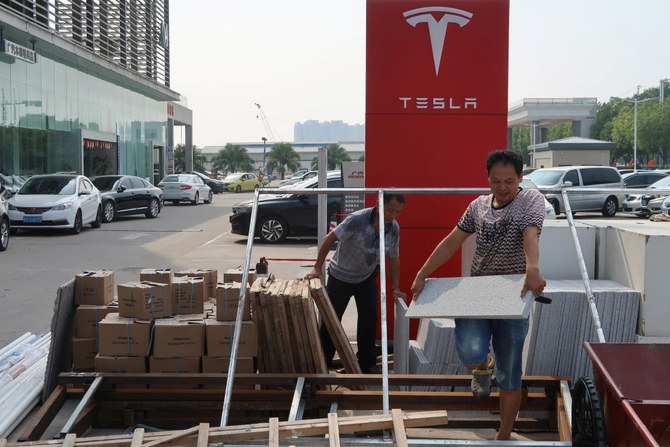
Tesla plans after-sales network expansion in China as Shanghai factory spins up
- Tesla had already treated China, the world’s biggest electric vehicle market, differently than elsewhere
- Tesla plans to turn some of its showrooms in China into one-stop shops called ‘Tesla Centers’


Latest updates


© 2026 SAUDI RESEARCH & PUBLISHING COMPANY, All Rights Reserved And subject to Terms of Use Agreement.