


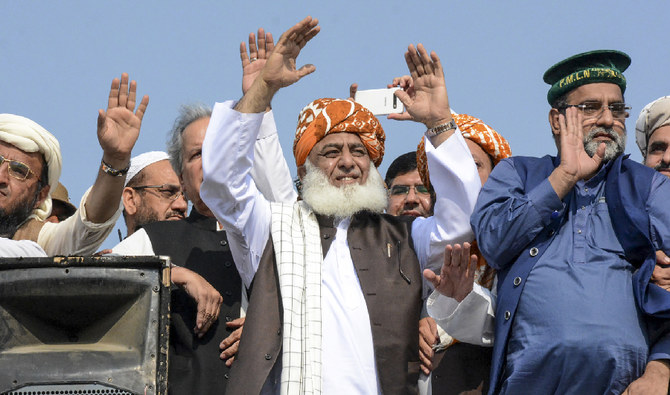
Anti-government marchers stand their ground as protest enters day five

1 / 3
Qamar Zaman Kaira (L) from Pakistan Peoples party (PPP), professor Sajid Mir (C), leader of Pakistan religious group Jamiat Ahal-i-Hadees and Chief of the Jamiat Ulema-e-Islam party Maulana Fazlur Rehman (R) raise their hands during an anti-government "Azadi March" towards Islamabad, in Lahore on October 30, 2019. (AFP)
2 / 3
Chief of Jamiat Ulema-e-Islam Maulana Fazlur Rehman, Opposition parties leader Shahbaz Sharif, and PPP leader Nayar Bukhari and others waving to activists during an anti-government march at H-9 Ground, Peshawar Morr in federal capital.(Photo Courtesy: Social Media)
3 / 3
Chief of the Jamiat Ulema-e-Islam party Maulana Fazlur Rehman (C) gestures to supporters on his arrival during an anti-government "Azadi March" march towards Islamabad, in Multan on October 27, 2019. Pakistani officials have ordered additional security forces be deployed to the capital Islamabad, authorities confirmed on October 29, days ahead of the expected arrival of thousands of Islamist protesters calling for the dissolution of the government. (AFP)
Updated 05 November 2019
Follow

Anti-government marchers stand their ground as protest enters day five

  • The government and opposition will meet again on Tuesday
  • The JUI-F chief says opposition leaders will unanimously decide when to call off the protest that has entered its fifth day

ISLAMABAD: Pakistani opposition parties on Monday refused to call off their anti-government protest after a meeting that lasted for several hours with the government representatives as tens of thousands of demonstrators remained camped for the fifth consecutive day in the federal capital.

The government and opposition representatives held talks in Islamabad for the first time since the protesters entered the city on Thursday, sought the resignation of Prime Minister Imran Khan and demanded fresh polls in the country.

“The talks are held in a cordial environment and we have decided to meet again tomorrow,” said Defense Minister Pervez Khattak, who is spearheading the government’s negotiating committee to hold talks with the joint opposition.

The protest leader and the Jamiat-e-Ulema-e-Islam (JUI-F) chief Maulana Fazal-ur-Rehman asked the participants of the “Azadi March” to continue the protest with “courage and perseverance.”

“All the opposition leaders will unanimously decide when to call off the protest,” Rehman said while addressing the charged crowd atop his shipping container. “The opposition leaders have expressed their full support to our anti-government protest.”

Earlier in the day, representatives of all opposition parties held a meeting in Islamabad to decide their future course of action.

The firebrand religious cleric on Friday gave the prime minister two days to resign, adding that the demonstrators would otherwise devise a workable future strategy to dislodge the government. The deadline for the ultimatum expired on Sunday, but Rehman refrained from announcing a new deadline or strategy to achieve his goal.

The opposition parties have built their anti-government campaign on the basis of alleged election irregularities and a fast deteriorating economy since the installation of the current government in August last year.

Prime Minister Khan had come into power, promising about ten million jobs for youth and five million low-cost homes for middle-class families.

However, the economy has nosedived in the last one year, with inflation touching double-digit numbers as the government opted for a $6 billion bailout package with tough taxation and economic reforms conditions to stave off a balance of payments crisis.

Criticizing the government’s economic policies, the JUI-F chief said that Pakistan’s economic decisions were handed over to the International Monetary Fund (IMF) which had resulted in historically high inflation and unemployment in the country.

“We cannot tolerate further decline of our economy,” he told the participants of the protest who were carrying placards inscribed with anti-government slogans and waving flags of their party.


Pakistan’s capital picks concrete over trees, angering residents

Updated 10 sec ago
Follow

Pakistan’s capital picks concrete over trees, angering residents

  • Between 2001 and 2024, Islamabad lost 14 hectares of tree cover, according to Global Forest Watch 
  • Officials justify removing trees to tackle seasonal pollen allergies that are especially acute in spring

ISLAMABAD: Pakistan’s capital Islamabad was once known for its lush greenery, but the felling of trees across the city for infrastructure and military monuments has prompted local anger and even lawsuits.

Built in the 1960s, Islamabad was planned as a green city, with wide avenues, parks and tree-lined sectors.

Many residents fear that vision is steadily being eroded, with concrete replacing green spaces.

Muhammad Naveed took the authorities to court this year over “large-scale tree cutting” for infrastructure projects, accusing them of felling “many mature trees” and leaving land “barren.”

The World Wide Fund for Nature (WWF) blamed major infrastructure development, including road construction and monuments, for the mass razing of trees and natural vegetation in Islamabad.

Between 2001 and 2024, the capital lost 14 hectares of tree cover, equal to 20 football pitches, according to Global Forest Watch, though the figure does not account for tree cover gains during the same period.

For Kamran Abbasi, a local trader and resident since the 1980s, it feels like “they are cutting trees everywhere.”

“It is not the same anymore,” he told AFP.

“Trees are life. Thousands are cut to build one bridge.”

SMOG AND POLLEN

Meanwhile, air quality in Islamabad continues to deteriorate.

Pollution is a longstanding problem, but plants can help by filtering dirty air, absorbing harmful gases and cooling cities.

“Forests act as powerful natural filters... cleaning the air and water, and reducing the overall impact of pollution,” Muhammad Ibrahim, director of WWF-Pakistan’s forest program told AFP.

There were no good air quality days in Islamabad last month, with all but two classed as “unhealthy” or “very unhealthy” by monitoring organization IQAir.

While some trees are felled for infrastructure, officials justify removing others to tackle seasonal pollen allergies that are especially acute in spring.

That problem is largely attributed to paper mulberry trees, which were planted extensively during the city’s early development.

“The main reason is pollen allergy,” said Abdul Razzaq, an official from the Capital Development Authority (CDA) in Islamabad.

“People suffer from chest infections, asthma and severe allergic reactions. I do too,” he told AFP.

The government plans to remove 29,000 pollen-producing trees and plants, according to a recent WWF report.

However, critics argue that pollen allergies are an excuse to justify broader tree-cutting, particularly linked to military and infrastructure projects.

The solution lies not in indiscriminate tree removal, but careful urban planning, experts say, replanting with non-allergenic species — and greater transparency around development projects in the capital.

CAPITAL UNDER AXE

In recent months, large bulldozers have been spotted levelling former green belts and wooded areas, including near major highways.

According to WWF and unnamed government officials, some of the cleared land is tapped for monuments commemorating the brief but intense armed conflict between Pakistan and neighboring India last May.

Other plots were razed to make way for military-linked infrastructure.

“We know that trees are being cut for military-related projects, but there is not much we can do,” a government source told AFP, requesting anonymity for security reasons.

“The people in power, the military, can do whatever they want.”

Pakistan’s powerful military has ruled the country for decades through coups and is deeply involved in the country’s politics and economy, analysts say.

At a proposed military monument site along the city’s express highway, WWF recorded more than six hectares of land clearing last year, with work continuing in 2026.

It saw “no active plantation... indicating that the clearing is infrastructure driven.”

The military did not respond to AFP’s request for comment.

Naveed’s court case seeking to halt the widespread felling, which is still being heard, argues there is “no excuse” for the tree loss.

“If a monument is deemed essential, why was it not placed in any existing park or public place?” he argues.

In reply to Naveed’s petition, authorities said roads and infrastructure projects were approved under regulations dating back to 1992.