DUBAI: Technology has become an essential part of our daily lives, including in the field of art and culture.
This was one of the main takeaways from the keynote speech of Noura bint Mohammed Al-Kaabi, the UAE’s minister of culture and knowledge development, on the first day of the EmTech MENA conference in Dubai.
The two-day conference began on Monday at Jumeirah Emirates Towers. It has lined up 500 professionals from throughout the Middle East and North Africa (MENA) to shed light on five themes: Artificial intelligence (AI) and the future of work; computer-created reality; the future of digital health; future cities; and the future of energy and sustainability.
With regard to the possibilities for combining art and technology and their potential impact on cultural expression, Al-Kaabi said technology and art have become “complementary.”
She added: “The way art is created, exhibited and experienced has changed through the use of digital technology, including AI and VR (virtual reality).”
Citing the works of Andy Warhol and Bahraini VR artist Najla Al-Khalifa as examples of new means of artistic expression, Al-Kaabi said: “The digital world has become the new ordinary.”
She described modern-day art galleries and exhibitions as “interactive spaces” that are no longer “passive buildings” where static art is viewed.
While many still prefer to view art in a more traditional form, the evolution of the field through technology can improve an audience’s overall experience, she said.
“For those who dare to imagine the benefits of pushing boundaries, innovating new concepts and venturing into new territories through technology, the possibilities are endless,” Al-Kaabi added.
Technology also plays a crucial role when it comes to expression of cultural identity, she said, adding that the integration of the two fields could go even further to eliminate language barriers, build on common values, and captivate and educate new consumers of art and heritage.
Al-Kaabi described the diffusion of cultural awareness through AI technology to the rest of the world as the concept of “intangible experiences.”
Immersive AI experiences can better reflect aspects of culture such as hospitality, and even simpler traditions such as the way Emiratis drink their coffee, she said.
Such experiences are also crucial in collecting data, building a museum, and even in an artist’s journey, Al-Kaabi added.
Alberto Levy, associate professor at the IE Business School in Spain, demonstrated the use of AI by creating a piece of “brain art” on the EmTech stage, through a device that shows how brainwaves react to emotions.
However, he said while AI has the ability to make everyone an artist, machines cannot replicate emotions.
“Machines are good for repetition. They can only emulate something that might resemble a feeling,” Levy added.
“We have to focus on the human part, the critical thinking, the creativity that machines can’t replicate.”
Saying the “music, the energy in the hall, and the essence of being on a Dubai stage” were elements that helped him create his piece of art, Levy questioned the need for copyright in a world of AI-made art.
“Why do we have to own the art?” he asked. “Why not produce it and see what emotions it’s generating? After all, it came out of a moment that’s priceless.”


Technology’s role in art and culture debated at EmTech MENA conference
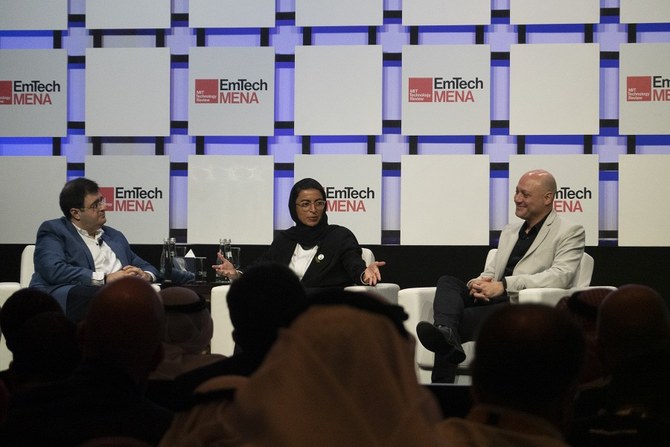
Technology’s role in art and culture debated at EmTech MENA conference

- ‘Technology has changed the way we create and consume art’
- Conference told how technology has become the ‘new normal’


US pump prices surge as Iran war upends global energy supply
- Fuel prices jump over 10 percent as oil prices surge
- Analysts predict further price rises due to market conditions
MARIETTA/NEW YORK : US retail gasoline and diesel prices are soaring as the US-Israel war with Iran constrains oil and fuel exports, which could be a political test for President Donald Trump’s Republican Party ahead of midterm elections in November.
Fuel prices jumped more than 10 percent this week as oil rose above $90 a barrel, its highest in years, adding pain at the pump for consumers already strained by inflation.
Trump on Thursday shrugged off higher gasoline prices in an interview with Reuters, saying “if they rise, they rise.”
The president had vowed to lower energy prices and unleash US oil and gas drilling during his second term, but much of his tenure has been marked by volatility and uncertainty amid shifts in policies like tariffs and geopolitical turmoil.
The US is the world’s largest oil producer. It is a major exporter but also imports millions of barrels a day since it is the world’s largest oil consumer.
As of Friday, the national average prices for regular gasoline stood at $3.32 a gallon, up 11 percent from a week ago and the highest since September 2024, according to data from the motorists association AAA. Diesel was at $4.33, up 15 percent from a week ago, surging to the highest since November 2023.
Midwest, south feel the pinch
US motorists in parts of the Midwest and the South, including states that supported Trump, have seen some of the steepest increases in fuel costs since the conflict in Iran started.
In Georgia, a swing state, average retail gasoline prices rose 40.1 cents a gallon over the past week, according to fuel tracking site GasBuddy.
Andrenna McDaniel, a health care insurance worker in South Fulton, Georgia, said she was surprised to see prices skyrocket overnight.
“They jumped up so quickly,” she said on Friday, adding that she does not agree with the war at all.
McDaniel, a Democrat, said that for now she is only driving for the most important things, and feels lucky that she works from home so she does not have to drive as much as other people do. Georgia voted for Donald Trump in the 2024 election.
Trump voter Richard Soule, 69, a US Air Force veteran and a retired firefighter, said a little pain at the pump is worth Trump’s efforts to protect America.
“When President Trump went in there and bombed out their nuclear, and they just thumbed their nose at it, I believe he did the right thing at the right time,” Soule said on Friday as he filled up his Ford F-150 truck in Marietta, Georgia.
Other states, including Indiana and West Virginia have seen prices rise by 44.3 cents and 43.9 cents, respectively.
Prices may rise further
More pain may be on the way, analysts said, as oil prices continue to trend upward. On Friday, US oil futures settled at $90.90 a barrel, up nearly $10 and the biggest single-day rise since April 2020.
“Given current market conditions, the national average price of gasoline could climb toward $3.50 to $3.70 per gallon in the coming days if oil continues rising and supply disruptions persist,” GasBuddy analyst Patrick De Haan said.
The disruptions in the Middle East and the Strait of Hormuz, a key trade conduit, have boosted demand for US oil abroad, which in turn has driven up prices for domestic refiners too.
“The US has weaned itself off of its dependence on Middle Eastern crude, but obviously Asian refineries, and to a lesser extent, European refineries have not,” Denton Cinquegrana, chief oil analyst with OPIS. “That’s what you’re seeing happen in the spot market, because the demand for US exports rise, and so the price rise.”
Seasonal factors could add further pressure. Gasoline prices typically go up in the spring and peak in the summer due to higher gasoline demand and production of summer-blend gasoline, which is more costly to produce. Diesel fuel saw an even more aggressive jump since Iran began retaliating against US and Israeli strikes, significantly disrupting shipping in the Strait of Hormuz.
Global diesel inventories have remained in tight supply due to heavy demand for heating and power generation during a prolonged winter in the US and other parts of the world and a structural tightness of refining capacity. Sticker prices of everything from food to furniture go up when the cost of diesel goes up, as the fuel is mainly used in freight transportation, manufacturing, agriculture, and global shipping, analysts said.
“In a world where buzzword seems to be ‘affordability’, that is certainly not going to help,” Cinquegrana said.