European powers condemn Iran over new centrifuges move

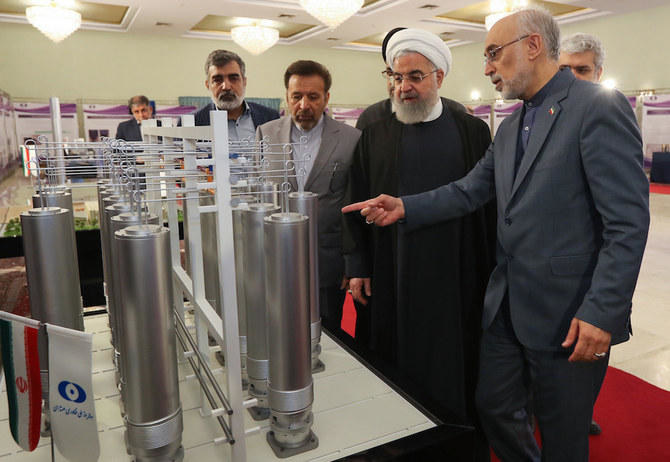
Iran responded to US sanctions by gradually scaling back its commitments under the nuclear agreement and has said it could take further steps in November. (File/AFP)
Updated 04 November 2019
Follow

European powers condemn Iran over new centrifuges move

  • Atomic Energy Organization of Iran says enriched uranium production increased tenfold
  • German Foreign Minister Heiko Maas said Iran's latest step was 'unacceptable'

TEHRAN: Iran announced Monday a more than tenfold increase in enriched uranium production following a series of steps back from commitments under a 2015 nuclear deal abandoned by the United States.
Tehran has also developed two new advanced centrifuges, one of which is undergoing testing, Ali Akbar Salehi, the head of the Atomic Energy Organization of Iran, announced.
Enriched uranium production has reached five kilogrammes per day, Salehi told reporters at the Natanz facility in central Iran in remarks broadcast by state television.
That compares with the level of 450 grams two months ago.
Tehran decided in May to suspend certain nuclear commitments, a year after US President Donald Trump withdrew from the deal between world powers and Iran and reimposed sanctions on the country.
Tehran has so far hit back with three packages of countermeasures and threatened to go even further if the remaining partners to the deal — Britain, China, France, Germany and Russia — fail to help it circumvent US sanctions.
After the latest announcement, the European Union warned that its support for the nuclear deal depends on Tehran fulfilling its commitments.

German Foreign Minister Heiko Maas said Iran's latest step was "unacceptable" risks completely breaking the entire agreement.
Maja Kocijancic, spokeswoman for EU diplomatic chief Federica Mogherini, said: “We have continued to urge Iran to reverse such steps without delay and to refrain from other measures that would undermine the nuclear deal."
Although the EU “remained committed” to the accord, “we have also been consistent in saying that our commitment to the nuclear deal depends on full compliance by Iran,” she told reporters in Brussels.
On July 1, Iran said it had increased its stockpile of enriched uranium to beyond a 300-kilo maximum set by the deal, and a week later, it announced it had exceeded a 3.67-percent cap on the purity of its uranium stocks.
It fired up advanced centrifuges to boost its enriched uranium stockpiles on Sept. 7.
Salehi said Iranian engineers “have successfully built a prototype of IR-9, which is our newest machine, and also a model of a new machine called IR-s ... all these in two months.”
Iran has removed all of its IR-1 centrifuges — the sole deal-approved machines — and is now using advanced models, leading to the sharp increase in enriched uranium production, he added.
“We must thank the enemy for bringing about this opportunity to show the might of the Islamic republic of Iran, especially in the nuclear industry,” Salehi said.
“This is while some say (Iran’s) nuclear industry was destroyed!” he said, laughing.
Iran will take the fourth step of walking back on the nuclear accord on Tuesday, semi-official news agency ISNA reported without specifying details.
The announcement came as Iranians held mass rallies four decades to the day after revolutionary students stormed the US embassy in the capital and took dozens of American diplomats and staff hostage.
It took a full 444 days for the crisis to end with the release of 52 Americans, but the US broke off diplomatic relations with Iran in 1980 and ties have been frozen ever since.
Monday also marked the end of the 60-day deadline Iran gave to Europe to either provide it with the economic benefits of the nuclear agreement or see even more commitments abandoned.
The European parties to the Vienna deal have repeatedly called on Iran to stay within the accord’s framework but their efforts to skirt unilateral US sanctions have so far borne no fruit.
Iran’s supreme leader Ayatollah Ali Khamenei called French President Emmanuel Macron’s efforts to set up talks between Iran and the US to break the impasse “naive.”
Macron’s efforts to initiate a phone call between US President Donald Trump and his Iranian counterpart Hassan Rouhani on the sidelines of the UN General Assembly in September ended in failure.
Rouhani stressed he would only hold talks with the US if sanctions were lifted first.


Hamas to hold leadership elections in coming months: sources

Updated 4 sec ago
Follow

Hamas to hold leadership elections in coming months: sources

  • A Hamas member in Gaza said Hayya is a strong contender due to his relations with other Palestinian factions, including rival Fatah, which dominates the Palestinian Authority, as well as his regional standing

GAZA CITY, Palestinian Territories: Hamas is preparing to hold internal elections to rebuild its leadership following Israel’s killing of several of the group’s top figures during the war in Gaza, sources in the movement said on Monday.
“Internal preparations are still ongoing in order to hold the elections at the appropriate time in areas where conditions on the ground allow it,” a Hamas leader told AFP.
The vote is expected to take place “in the first months of 2026.”
Much of the group’s top leadership has been decimated during the war, which was sparked by Hamas’s unprecedented attack on Israel in October 2023.
The war has also devastated the Gaza Strip, leaving its more than two million residents in dire humanitarian conditions.
The leadership renewal process includes the formation of a new 50-member Shoura Council, a consultative body dominated by religious figures.
Its members are selected every four years by Hamas’ three branches: the Gaza Strip, the occupied West Bank and the movement’s external leadership.
Hamas prisoners in Israeli prisons are also eligible to vote.
During previous elections, held before the war, members across Gaza and the West Bank used to gather at different locations including mosques to choose the Shoura Council.
That council is responsible, every four years, for electing the 18-member political bureau and its chief, who serves as Hamas’s overall leader.
Another Hamas source close to the process said the timing of the political bureau elections remains uncertain “given the circumstances our people are going through.”
After Israel killed former Hamas chief Ismail Haniyeh in Tehran in July 2024, the group chose its then-Gaza chief Yahya Sinwar as his successor.
Israel accused Sinwar of masterminding the October 7 attack.
He too was killed by Israeli forces in the southern Gaza city of Rafah, three months after Haniyeh’s assassination.
Hamas then opted for an interim five-member leadership committee based in Qatar, postponing the appointment of a single leader until elections are held and given the risk of being targeted by Israel.
According to sources, two figures have now emerged as frontrunners to be the head of the political bureau: Khalil Al-Hayya and Khaled Meshaal.
Hayya, 65, a Gaza native and Hamas’s chief negotiator in ceasefire talks, has held senior roles since at least 2006, according to the US-based NGO the Counter-Extremism Project (CEP).
Meshaal, who led the Political Bureau from 2004 to 2017, has never lived in Gaza. He was born in the West Bank in 1956.
He joined Hamas in Kuwait and later lived in Jordan, Syria and Qatar. The CEP says he oversaw Hamas’s evolution into a political-military hybrid.
He currently heads the movement’s diaspora office.
A Hamas member in Gaza said Hayya is a strong contender due to his relations with other Palestinian factions, including rival Fatah, which dominates the Palestinian Authority, as well as his regional standing.
Hayya also enjoys backing from both the Shoura Council and Hamas’s military wing, the Ezzedine Al-Qassam Brigades.
Another source said other potential candidates include West Bank Hamas leader Zaher Jabarin and Shoura Council head Nizar Awadallah.