Pakistan embassy in Kabul closes visa section amid tensions

1 / 2
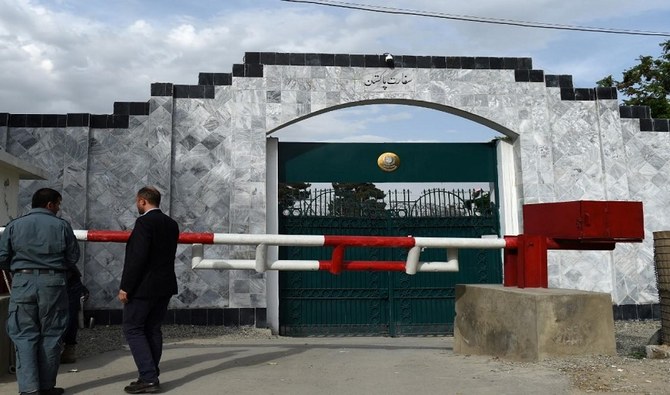
Afghan security personnel stand guard in front of the Pakistan embassy in Kabul on May 10, 2016. (AFP/ File photo)
2 / 2
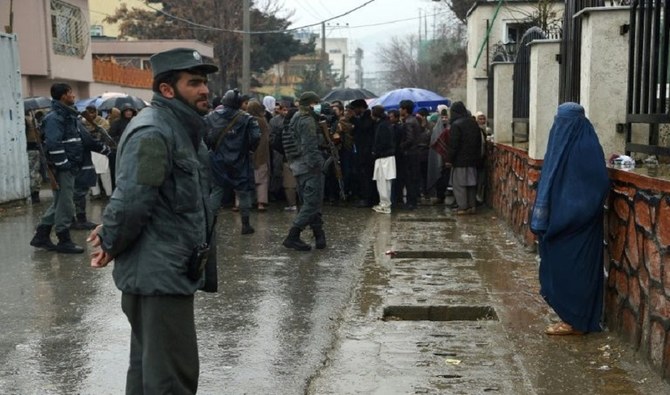
Afghan policemen stand guard as people with visa issues queue up outside Pakistan's embassy in Kabul in March 2019 -- the consular office has been closed until further notice for security reasons (AFP)
Updated 04 November 2019
Follow

Pakistan embassy in Kabul closes visa section amid tensions

  • Consular office was closed citing security reasons amid mounting tensions between the two countries
  • Consular section typically processes 1,500 visas a day, spokesman says

KABUL: Pakistan’s embassy in Kabul said Sunday it was indefinitely closing its consular office in the Afghan capital due to security reasons, amid mounting tensions between the neighboring countries.
Closure of the visa section will come as a huge blow for many Afghans, hundreds of whom apply daily for permits to travel to Pakistan where they seek medical treatment, goods and university educations.
A message shared on WhatsApp by an embassy spokesman said the consular section would be closed as of Monday “until further intimation.”
The spokesman told AFP that the consular section typically processes about 1,500 visa applications a day.
In Islamabad, Pakistan’s foreign ministry said the Afghan charge d’affaires had been summoned to “convey serious concerns over the safety and security of the diplomatic personnel of the embassy of Pakistan, Kabul, and its sub-missions.”
In a statement, the ministry said embassy staff were being harassed.
“They were obstructed on the road and the embassy vehicles were also hit by motorcycles while going toward the embassy,” the statement read.
Protests outside the Pakistani embassy are common, sometimes triggered by people unhappy about visa wait times or security while standing in long queues.
Relations between Afghanistan and Pakistan, both Islamic republics, have long been fraught, with Afghans blaming Islamabad for any number of woes including allegedly supporting the Taliban.
Pakistan denies it helps the insurgent group.
Tensions have soured further in recent days amid clashes along the border in Afghanistan’s eastern province of Kunar.
Both sides have accused each other’s troops of cross-border shelling.
The Pakistani foreign ministry has said six Pakistani troops were wounded October 27 and 28 in “unprovoked mortar and heavy weapon firing” by Afghan soldiers.
Pakistani consular services remain open in Herat, Jalalabad and Mazar-i-Sharif, according to the embassy spokesman, who recommended that applicants travel to Jalalabad if they needed a visa urgently.


Pakistan Supreme Court halts trial of prominent lawyer over alleged anti-military tweets

Updated 7 sec ago
Follow

Pakistan Supreme Court halts trial of prominent lawyer over alleged anti-military tweets

  • Top court orders lower court to pause proceedings after lawyers allege due-process breaches
  • Mazari-Hazir, husband face charges under cybercrime law that carry up to 14 years in prison

ISLAMABAD: Pakistan’s Supreme Court on Thursday halted the cybercrime trial of prominent human rights lawyer Imaan Mazari-Hazir and her husband, Hadi Ali Chattha, after their lawyers argued that a lower court had recorded witness testimony in their absence, violating due-process rules.

Mazari-Hazir, one of Pakistan’s most outspoken civil liberties lawyers, and Chattha are being prosecuted under the Prevention of Electronic Crimes Act (PECA) over posts on X that authorities say incited ethnic divisions and portrayed the military as involved in “terrorism.” Both reject the allegations. If convicted under the relevant PECA provision, they face a prison term of up to 14 years.

The case has drawn broad attention in Pakistan’s legal community because Mazari-Hazir, who has been repeatedly detained over her criticism of the security establishment, argues that the trial court ignored basic procedural guarantees despite her medical leave request. The case also comes as Pakistan faces sustained scrutiny over the use of PECA against activists, journalists and political dissenters, with lawyers arguing that lower courts often move ahead without meeting minimum fair-trial standards.

The couple’s lawyer, Riasat Ali Azad, said his clients filed a petition in the Supreme Court because the lower court had moved ahead improperly.

“Today, the Supreme Court of Pakistan has stayed the lower court proceedings, the trial court proceedings and has said that the [Islamabad] High Court should decide our pending revision petition for which a date has already been fixed,” he told reporters.

Azad said the violation was clear under Pakistan’s Code of Criminal Procedure, which requires evidence to be recorded in the presence of the accused.

“Yet, on that very day, evidence of four witnesses was recorded in their absence, and a state counsel was appointed to conduct cross-examination on their behalf,” he said. “All these things are against the right to a fair trial under Articles 10 and 10-A.”

A three-judge bench led by Justice Muhammad Hashim Khan Kakar ordered the trial court to pause proceedings and instructed the Islamabad High Court to hear the couple’s pending criminal revision petition first.

The trial had been scheduled to resume on Dec.15, but the Supreme Court’s stay now freezes proceedings before both the additional sessions judge and the special PECA court. 

The Islamabad High Court is expected to hear the criminal revision petition next week.

Chattha, who is also a lawyer, said the SC ruling underscored the need for procedural safeguards.

“It is a victory for the constitution and the law,” he said, arguing that the trial court had ignored their request to re-record witness statements in their presence.