

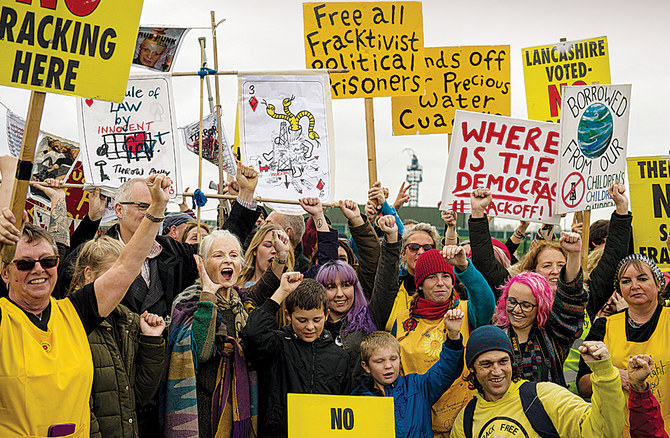

LONDON: The British government called a halt on Saturday to the controversial process of “fracking” due to fears it could trigger earthquakes in a surprise U-turn just weeks before a general election.
Until now, Britain had hoped that fracking — banned in many countries, but booming in the US — could help secure its future energy independence.
But with just a few weeks to go before Britain goes to the polls — where environmental issues are expected to feature prominently — Business and Energy Secretary Andrea Leadsom announced a “moratorium” at what is currently the UK’s only operational shale gas well in Lancashire, northwest England.
“I have concluded that we should put a moratorium on fracking in England with immediate effect,” Leadsom said.
“It is clear that we cannot rule out future unacceptable impacts on the local community.”
The U-turn follows a report by Britain’s Oil and Gas Authority into recent seismic activity at Preston New Road, a site operated by exploration and production company Cuadrilla.
The OGA report found that it was not currently possible to accurately predict the technology’s potential for triggering earthquakes.
Prime Minister Boris Johnson said he had “very considerable anxieties” about the extraction of shale gas.
But Labour leader Jeremy Corbyn dismissed the government’s about-turn as merely a PR stunt ahead of the general election.
“The Conservatives’ temporary pause of fracking is an election stunt to try and win a few votes,” he tweeted.
“Boris Johnson described fracking as ‘glorious news for humanity’. We cannot trust him.”
Fracking or hydraulic fracturing is used to release oil and gas locked deep underground.
It is carried out by blasting a mixture of water, sand and chemicals underground to release shale oil and gas.
Environmentalists argue that the process contaminates water supplies, hurts wildlife, causes earthquakes and contributes to global climate change.
It is banned in many countries, including France and Germany, and the UK’s other constituent members — Scotland, Wales and Northern Ireland — are opposed to it.
Nevertheless, eyeing the boom in fracking in the US, the British government still views the technology as a potential opportunity to reduce its dependence on gas from Norway and Qatar.
When asked on BBC radio on Saturday why the government was not banning it altogether, Leadsom insisted that fracking represented “a huge opportunity for the United Kingdom.”
The British Geological Survey estimates that the Cuadrilla site holds up to 2,300 trillion cubic feet (90 trillion cubic meters) of shale gas, which could theoretically fill Britain’s natural gas needs for more than a thousand years.
In 2016, the Conservative government estimated that some 20 shale wells could be opened by the middle of next year, but only three wells have been drilled to date. Public mistrust of shale gas extraction is rising sharply.
According to the National Audit Office, opposition among Britons has risen to 40 percent from 21 percent since 2013.
“Public concern has centered on the risks to the environment and public health, from fracking-induced earthquakes, and the adequacy of the environmental regulations in place,” it said.


