

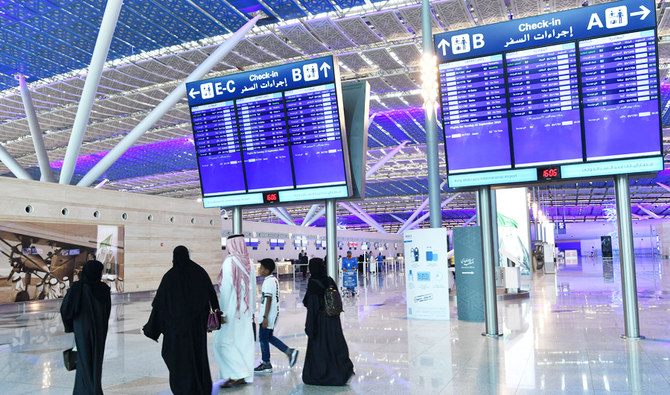
Saudi civil aviation authority to impose new airport charge
The decision will take effect on Jan. 1, 2020
Updated 03 November 2019
Fatima Muhammad
JEDDAH: The General Authority of Civil Aviation (GACA) has issued a circular that it will start imposing an Airport Building Charge on domestic flights from Jan. 1, 2020, Arab News has learned. The aim is to provide funding for airport infrastructure development projects and to enhance airport services.
The charge will be SR21 ($5.60) for a one-way trip (SR10 for departure airport, SR10 for arrival airport and SR1 value-added tax).
The charge will be SR42 for a round trip, and SR87 when a passenger books a domestic air carrier at a local international departure terminal.
Airlines will collect the charge from passengers by adding it to the ticket price, then pass on the amount charged by coordinating with airport administration and finance departments.
FASTFACTS
SR21 will be charged for a one-way trip.
SR42 The charge will be doubled for a round trip.
SR87 when a passenger books a domestic air carrier at a local international departure terminal.
Four groups will be exempt: Infants, passengers staying on board and not using airport facilities, members of crew on duty, and members of aircraft registered on the list of airline pilots who have IDs.
In case of payment delays by airlines, airports will have the right to launch legal proceedings. The new charge will be subject to decrease or increase every three years.
Heritage Commission discovers 20 ancient rock art sites in Soudah Peaks v
Discovery of carvings 4,000–5,000 years old in Soudah Peaks highlights the Kingdom’s rich cultural heritage
Updated 4 sec ago
Arab News
RIYADH: The Heritage Commission, in collaboration with Soudah Development, a Public Investment Fund company, has announced the discovery of 20 ancient rock art sites in the Soudah Peaks area of southwest Saudi Arabia.
The find adds to the Kingdom’s growing record of archeological and cultural heritage sites, the Saudi Press Agency reported recently.
The Soudah Peaks region, in Asir province, is more than 636.5 sq. km, and includes the highlands of Soudah and parts of the historic Rijal Almaa area.
Known for its mountains, cool climate, and scenic views, the region is part of a major development plan to create a luxury tourism destination that respects local culture and history.
The newly discovered rock art, spread across several sites, is estimated to be 4,000 to 5,000 years old, making it among the oldest cultural remains in the area. (SPA)
The newly discovered rock art, spread across several sites, is estimated to be 4,000 to 5,000 years old, making it among the oldest cultural remains in the area.
The engravings include Thamudic inscriptions, an early form of writing in the Arabian Peninsula, as well as carvings of animals such as ibex, hyenas, and ostriches.
Other scenes depict hunters, dancers, palm trees, and weapons, providing insight into the daily life, environment, and beliefs of ancient communities.
The archeological survey followed a four-phase scientific approach, based on a memorandum of understanding between the Heritage Commission and Soudah Development.
The newly discovered rock art, spread across several sites, is estimated to be 4,000 to 5,000 years old, making it among the oldest cultural remains in the area. (SPA)
The work included data collection, site analysis, field documentation, and classification of archeologically significant locations, ensuring accurate recording and supporting future research and conservation.
Experts say the discovery is important for archeological research and cultural understanding. The variety of images and inscriptions sheds light on early human settlement and how ancient societies expressed themselves and interacted with their environment.
The Soudah Peaks project, part of the Kingdom’s Vision 2030, aims to combine high-end tourism with environmental and cultural protection. Soudah Development has emphasized its commitment to safeguarding the area’s natural beauty and historical sites.
The initiative aligns with the Heritage Commission’s mission to document and protect archeological sites across the Kingdom. In recent years, Saudi Arabia has stepped up efforts to register and preserve heritage locations.
As research continues, the rock engravings at Soudah Peaks are expected to become key reference points for researchers and visitors, offering a tangible link to the cultural roots of southwest Saudi Arabia.