

Pakistan protest leader calls on PM to resign in 48 hours

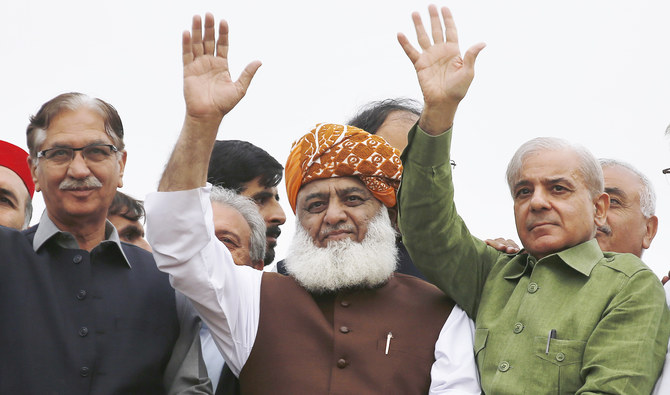
Rehman is leading tens of thousands of opposition supporters to demand the resignation of the government. (AP)
Updated 02 November 2019
Follow

Pakistan protest leader calls on PM to resign in 48 hours

  • Fazlur Rehman claims ‘sea of public’ has the power to ‘arrest’ Imran Khan

ISLAMABAD: The leader of one of Pakistan’s largest religious parties, Fazlur Rehman, gave Prime Minister Imran Khan two days to resign in an address to supporters on Thursday, or face thousands of protesters gathered in Islamabad.

Rehman is leading tens of thousands of opposition supporters to demand the resignation of the government, warning of chaos if their demands are not met. “You have two days time. You should tender your resignation. Otherwise the next day, we have to decide our future course of action,” Rehman said.

Khan has dismissed the opposition’s calls to step down and warned he would not tolerate chaos on the streets.

“We are peaceful people, that’s why we want to stay peaceful,” Rehman told protesters, flanked by the leaders of major opposition parties. “Otherwise this sea of Pakistan’s public that has arrived in Islamabad has the power to go inside the prime minister’s house and arrest him.”

Rehman said protesters did not want a confrontation with “institutions.” “We want to see institutions powerful but we also want institutions to act with neutrality,” he said.

However, he warned: “If we feel that this illegitimate ruler (Khan) is being protected by our institutions, then there is a deadline of two days. After that we should not be stopped from having an opinion about these institutions.”

Speaking at the protest rally, opposition leader Shehbaz Sharif, president of the PMLN party of jailed former Prime Minister Nawaz Sharif, said Khan’s government had failed to deliver since it had come to power, as was visible from protests by all segments of society.

“We have to move this movement forward ... and if given just six months, we will put this country back on track,” he said.

Bilawal Bhutto Zardari, the chairman of the opposition PPP party, said the government had burdened the poor through double-digit inflation, and that the country was plagued by increasing unemployment.

“I want to assure you on behalf of my party that we will stand by you in every democratic step you take,” he told the protesters. “Together we will send this puppet home.”

Security is tight in Islamabad with the government and diplomatic sector — just a few miles from the rally site — sealed off. Media outlets reported that schools were closed on Friday, public transport suspended and internet services interrupted in some areas.

Khan won the 2018 election on promises of pulling 100 million people out of poverty. But an economic crisis has since forced his government, like many of its predecessors, to turn to the International Monetary Fund for a $6 billion bailout.

The government is trying to correct an unsustainable current account deficit and cut debt while trying to expand the tax base in the country of 208 million people, of whom few file returns. 

Inflation is squeezing household budgets and traders this week protested against new tax measures.


India accelerates free trade agreements against backdrop of US tariffs

Updated 21 December 2025
Follow

India accelerates free trade agreements against backdrop of US tariffs

  • India signed a CEPA with Oman on Thursday and a CETA with the UK in July 
  • Delhi is also in advanced talks for trade pacts with the EU, New Zealand, Chile 

NEW DELHI: India has accelerated discussions to finalize free trade agreements with several nations, as New Delhi seeks to offset the impact of steep US import tariffs and widen export destinations amid uncertainties in global trade. 

India signed a Comprehensive Economic Partnership Agreement with Oman on Thursday, which allows India to export most of its goods without paying tariffs, covering 98 percent of the total value of India’s exports to the Gulf nation. 

The deal comes less than five months after a multibillion-dollar trade agreement with the UK, which cut tariffs on goods from cars to alcohol, and as Indian trade negotiators are in advanced talks with New Zealand, the EU and Chile for similar partnerships. 

They are part of India’s “ongoing efforts to expand its trade network and liberalize its trade,” said Anupam Manur, professor of economics at the Takshashila Institution. 

“The renewed efforts to sign bilateral FTAs are partly an after-effect of New Delhi realizing the importance of diversifying trade partners, especially after India’s biggest export market, the US, levied tariff rates of up to 50 percent on India.” 

Indian exporters have been hit hard by the hefty tariffs that went into effect in August. 

Months of negotiations with Washington have not clarified when a trade deal to bring down the tariffs would be signed, while the levies have weighed on sectors such as textiles, auto components, metals and labor-intensive manufacturing. 

The FTAs with other nations will “help partially in mitigating the effects of US tariffs,” Manur said. 

In particular, Oman can “act as a gateway to other Gulf countries and even parts of Eastern Europe, Central Asia, and Africa,” and the free trade deal will most likely benefit “labor-intensive sectors in India,” he added. 

The chances of concluding a deal with Washington “will prove to be difficult,” said Arun Kumar, a retired economics professor at the Jawaharlal Nehru University.

“With the US, the chances of coming to (an agreement) are a bit difficult, because they want to get our agriculture market open, which we cannot do. They want us to reduce trade with Russia. That’s also difficult for India to do,” he told Arab News.  

US President Donald Trump has threatened sanctions over India’s historic ties with Moscow and its imports of Russian oil, which Washington says help fund Moscow’s ongoing war with Ukraine.

“President Trump is constantly creating new problems, like with H-1B visa and so on now. So some difficulty or the other is expected. That’s why India is trying to build relationships with other nations,” Kumar said, referring to increased vetting and delays under the Trump administration for foreign workers, who include a large number of Indian nationals. 

“Substituting for the US market is going to be tough. So certainly, I think India should do what it can do in terms of promoting trade with other countries.” 

India has free trade agreements with more than 10 countries, including comprehensive economic partnership agreements with South Korea, Japan, and the UAE.

It is in talks with the EU to conclude an FTA, amid new negotiations launched this year for trade agreements, including with New Zealand and Chile.  

India’s approach to trade partnerships has been “totally transformed,” Commerce and Industry Minister Piyush Goyal said in a press briefing following the signing of the CEPA with Oman, which Indian officials aim to enter into force in three months. 

“Now we don’t do FTAs with other developing nations; our focus is on the developed world, with whom we don’t compete,” he said. “We complement and therefore open up huge opportunities for our industry, for our manufactured goods, for our services.”