

JUI-F, opposition leaders to address mass anti-government rally in Islamabad

1 / 11
Maulana Fazlur Rehman (C), chief of the Jamiat Ulema-e-Islam party steps down from his container during an anti-government "Azadi March" towards Islamabad, in Lahore on October 30, 2019. Pakistan Prime Minister Imran Khan faces the first major challenge to his leadership as a grey-bearded, orange-turbaned rival he calls "Maulana Diesel" marches to Islamabad with thousands of Islamists hoping to bring down the government. (AFP)
2 / 11
People cross the walkthrough gates on October 31, 2019, to enter the ground where the country's opposition parties will hold a joint political rally in Islamabad upon reaching the city. (AN Photo)
3 / 11
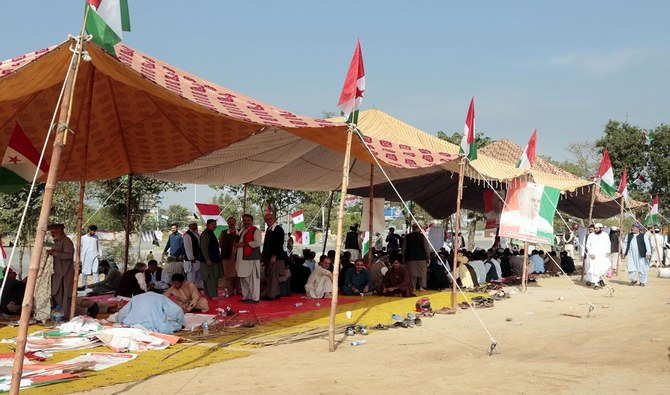
Workers of various opposition parties relax under a tent on October 31, 2019, in Islamabad's H9 sector where the "Azadi March" will culminate and anti-government political factions will hold a joint public rally. (AN Photo)
4 / 11
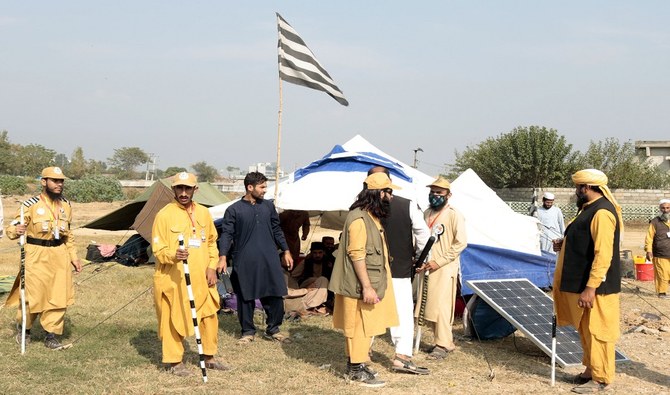
Members of Jamiat-e-Ulama-e-Islam's volunteer force, Ansar-ul-Islam, gather at the venue of the opposition's public rally in Islamabad's H9 sector on October 31, 2019. (AN Photo)
5 / 11
Activists of Islamic political party Jamiat Ulema-e-Islam (JUI-F) sit on a street near a roadblock before the start of anti-government "Azadi (Freedom) March" in Islamabad on November 1, 2019. (AFP)
6 / 11
A caravan of supporters of Maulana Fazlur Rehman, head of the Jamiat Ulema-e-Islam party, enter Islamabad on Oct. 31, 2019. (AP)
7 / 11
People cross the walkthrough gates on October 31, 2019, to enter the ground where the country's opposition parties will hold a joint political rally in Islamabad upon reaching the city. (AN Photo)
8 / 11
Members of Pashtunkhwa Milli Awami Party, an opposition faction led by Mahmood Khan Achakzai, set up their tents in Islamabad's H9 sector on October 31, 2019. The anti-government "Azadi March," which has brought Jamiat-e-Ulama-e-Islam (JUI-F) and other opposition parties together, will ultimately convene here upon entering the federal capital. (AN Photo)
9 / 11
Workers of various opposition parties relax under a tent on October 31, 2019, in Islamabad's H9 sector where the "Azadi March" will culminate and anti-government political factions will hold a joint public rally. (AN Photo)
10 / 11
Members of Jamiat-e-Ulama-e-Islam's volunteer force, Ansar-ul-Islam, gather at the venue of the opposition's public rally in Islamabad's H9 sector on October 31, 2019. (AN Photo)
11 / 11
Members of Pashtunkhwa Milli Awami Party, an opposition faction led by Mahmood Khan Achakzai, set up their tents in Islamabad's H9 sector on October 31, 2019. The anti-government "Azadi March," which has brought Jamiat-e-Ulama-e-Islam (JUI-F) and other opposition parties together, will ultimately convene here upon entering the federal capital. (AN Photo)
Updated 01 November 2019
Follow

JUI-F, opposition leaders to address mass anti-government rally in Islamabad

  • Protesters from all over Pakistan are expected to reach Islamabad on Thursday evening 
  • It’s the government’s responsibility to provide security to general public,” says defacto Information Minister

ISLAMABAD: Pakistan opposition party Jamiat Ulema-e-Islam’s (JUI-F) protest caravan reached Islamabad on Thursday night to hold a mass anti-government demonstration on Friday. 

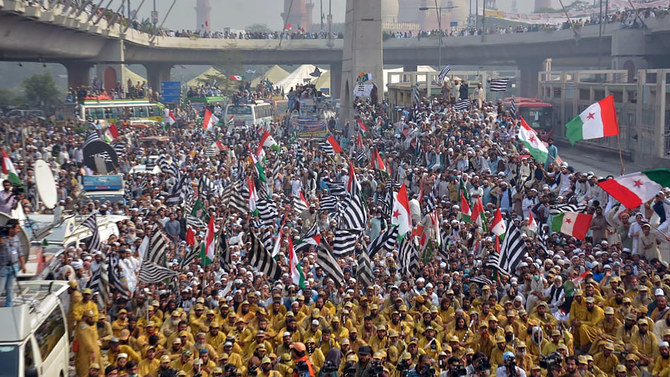
The protesters seek Prime Minister Imran Khan’s resignation and demand fresh elections in the country. Maulana Fazal-ur-Rehman, Chief of the JUI-F, will address a huge public gathering at the venue provided by Islamabad administration which desperately seeks to secure sensitive government installations and diplomatic enclave.
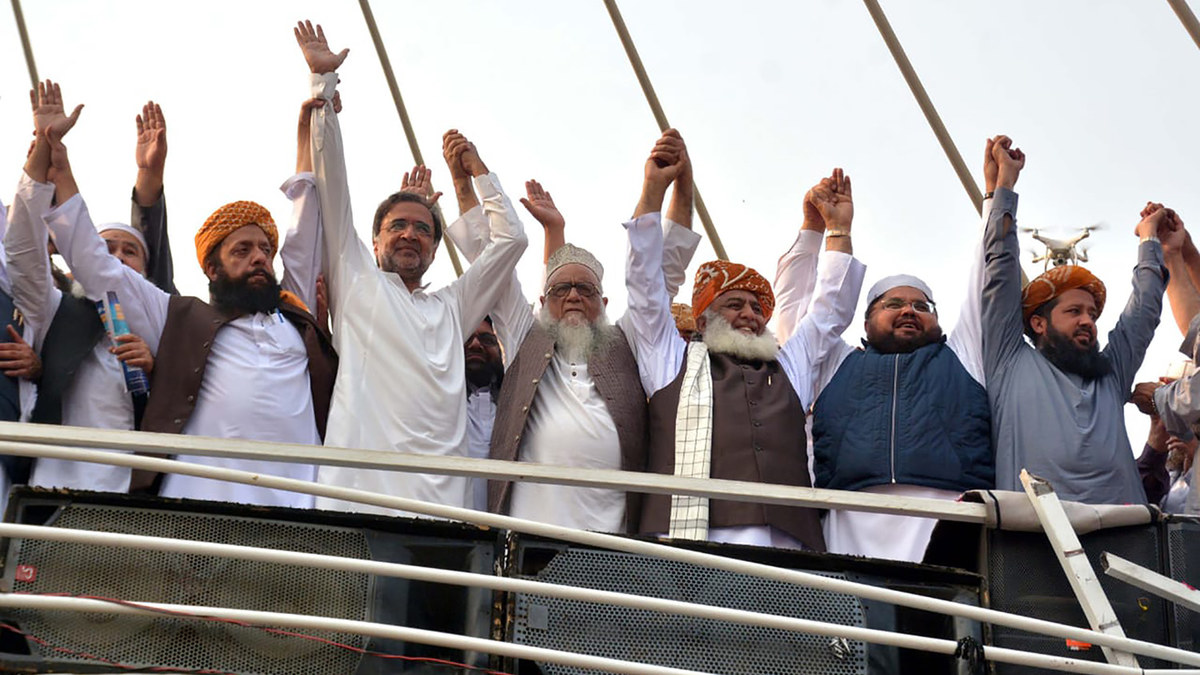


Leaders of opposition parties – Qamar Zaman Kaira of Pakistan People’s Party and Sajid Mir of Jamiat Ahle Hadith – share the stage with JUI-F leaders in Lahore on Oct. 30, 2019. (AN Photo by Shafiq Malik)

The JUI-F chief Maulana Fazal-ur-Rehman’s caravan set off from Karachi in southern Pakistan on Sunday while party activists and demonstrators from other parts of the country, including Khyber Pakhtunkhwa and Balochistan provinces, have also reached Islamabad to participate in the anti-government rally.
The firebrand religious leader has been mobilizing the general public and his party activists since July last year against the Pakistan Tehreek-e-Insaf (PTI) government that he believes is a “product of rigging in last year’s general elections.” The government and the Election Commission of Pakistan deny the charge.
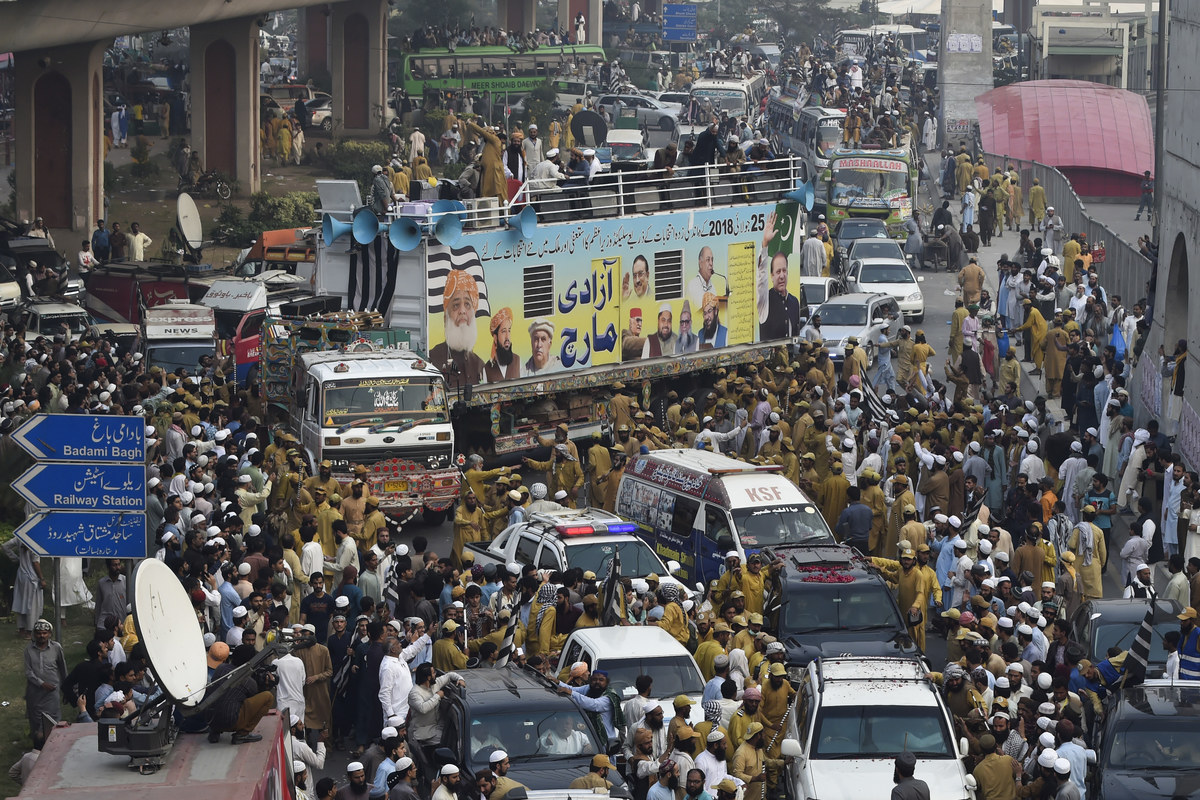


Activists and supporters of the Jamiat Ulema-e-Islam party gather during an anti-government "Azadi March" towards Islamabad, in Lahore on October 30, 2019. Pakistan Prime Minister Imran Khan faces the first major challenge to his leadership as a grey-bearded, orange-turbaned rival he calls "Maulana Diesel" marches to Islamabad with thousands of Islamists hoping to bring down the government. (AFP)

Earlier in the day, the government said that it would provide security and utilities to demonstrators led by Jamiat Ulema-e-Islam (JUI-F) on the protest venue in Islamabad, but would not allow them to disrupt public life, damage national security, and image of the country.
“We are making all-out efforts to provide complete security and utilities [water and electricity] to protesters and expect them to remain within limits of law and constitution,” said Minister for Interior Brig. (retd) Ejaz Shah while addressing a press conference in Islamabad along with Firdous Ashiq Awan, a special assistant to Prime Minister Imran Khan on information and broadcasting.


Participants of the JUI-F-led Azadi March can be seen chanting slogans at a public gathering in Lahore on Oct. 30, 2019. (AN Photo by Shafiq Malik)

Islamabad has already been put on high-alert as anti-government protesters led by JUI-F chief Maulana Fazal-ur-Rehman are scheduled to enter the federal capital by Thursday evening to seek the resignation of Prime Minister Imran Khan through a show of strength.
“All those who wanted to create unrest in Islamabad [under the garb of the march] were disappointed after the government allowed JUI-F to hold its peaceful protest,” the interior minister said.

Fazal-ur-Rehman is a veteran politician who heads an alliance with several seats in the National Assembly and provincial assemblies. But his real influence comes from his ability to mobilize support, particularly in numerous religious schools, or madrasas, across the country. He has labeled Prime Minister Khan’s government as “illegitimate” and sought fresh elections in the country.
“We have allowed a peaceful protest … and it is our responsibility to ensure the security of public and at least 7,000 members of diplomatic corps in Islamabad,” Awan said while warning protesters against crossing the red lines.
She said the diplomatic corps in Islamabad “reflects an image of Pakistan in the world,” therefore the government would not allow any unrest in the federal capital.
The United Nations declared Islamabad to be a “non-family station” in 2008 after a terrorist attack, but this was recently reversed due to the prime minister’s international image building efforts, she said.
Khan won last year’s election on a promise to end corruption, generate at least ten million new jobs to help middle-class families but the economy is running into headwinds and inflation jumped to the highest level in decades after his government signed off a $6 billion bailout package with the International Monetary Fund in July this year to stave off a balance of payments crisis.
JUI-F chief and other opposition leaders have been trying to capitalize on anger and frustration of the general public against Khan’s government, though the prime minister has recently been quoted by media saying that he would neither resign nor be “blackmailed” by the protesters.


Kazakh president meets Pakistan PM to discuss bilateral trade, regional connectivity

Updated 15 sec ago
Follow

Kazakh president meets Pakistan PM to discuss bilateral trade, regional connectivity

  • Kazakhstan seeks access to Arabian Sea ports as Pakistan pushes role as regional transit hub
  • Commerce ministers discuss connectivity challenges as Pakistan-Kazakhstan trade push grows

KARACHI: Kazakhstan President Kassym-Jomart Tokayev arrived at Prime Minister Shehbaz Sharif’s official residence in Islamabad on Wednesday for talks with Pakistan’s top political leadership on bilateral trade, cooperation and regional connectivity, with both sides expected to sign several memoranda of understanding (MoUs).

Tokayev arrived in Pakistan a day earlier on a two-day official visit as landlocked Kazakhstan seeks access to maritime trade routes through Pakistan’s southern ports on the Arabian Sea. Islamabad, meanwhile, has been positioning itself as a regional transit hub, with an emphasis on improving physical connectivity with Central Asian states.

Pakistan’s Deputy Prime Minister (DPM) and Foreign Minister (FM) Ishaq Dar called on the Kazakh president earlier in the day to welcome him to the country.

“Welcoming him to Pakistan, DPM/FM extended warm greetings from the President, Prime Minister, Government and people of Pakistan,” the foreign office said in a social media post.

It said Dar underscored Pakistan’s appreciation for the growing momentum of high-level political exchanges and reaffirmed a shared commitment to expand bilateral cooperation across political, economic and people-to-people domains, while working together for durable peace, stability and development in the region.

According to the Kazakh government, bilateral trade between the two countries stood at $53.7 million in 2024. Pakistan’s main exports to Kazakhstan include citrus fruits, pharmaceutical products, garments, soap and sports equipment, while imports largely comprise onions and garlic, dried legumes, oats, buckwheat, seeds and fruits.

Pakistan’s foreign office said a day earlier that Tokayev’s visit would offer an important opportunity to explore new avenues for cooperation, with MoUs expected in areas of mutual interest.

Federal Minister for Commerce Jam Kamal Khan separately held talks on Wednesday with Kazakhstan’s Minister of Trade and Integration Arman Shaqqaliev to review bilateral trade and connectivity.

“The meeting focused extensively on addressing connectivity challenges between Pakistan and Central Asia and identifying practical solutions to unlock the full trade potential between the two countries,” the commerce ministry said.

“Both sides agreed that improved rail, road and multimodal connectivity is fundamental to strengthening Pakistan–Kazakhstan trade and enabling sustainable, long-term economic engagement,” it added.

Shaqqaliev highlighted the strategic importance of major infrastructure projects, particularly rail and road corridors, saying such initiatives could generate trade and investment flows of about $5 billion, create jobs and strengthen regional supply chains.

Khan said Pakistan was keen to enhance direct connectivity with Central Asia through Turkmenistan and Afghanistan, while acknowledging regional and geopolitical challenges.

“Improved transit routes would not only benefit Pakistan and Kazakhstan but also open broader opportunities for regional and global trade, including access to African and ASEAN markets through Pakistan’s ports,” he was quoted as saying.

The two sides discussed cooperation in sectors including agriculture and food security, pharmaceuticals, textiles, sports goods, leather, mining, energy and infrastructure development.

Kazakhstan expressed interest in joint ventures in food processing, agriculture value chains and pharmaceuticals, while Pakistan invited Kazakh investment in mining, minerals and agri-based industries under its investment facilitation framework.

Both ministers also stressed the need for structured business-to-business engagement, agreeing that trade promotion bodies should focus on linking firms, sharing market intelligence and facilitating matchmaking without adding regulatory hurdles.

“They reaffirmed their shared commitment to transforming Pakistan–Kazakhstan economic relations from potential to performance, with a strong focus on connectivity, investment-led growth and regional integration,” the commerce ministry said, adding that sustained coordination and private-sector engagement could significantly boost trade and investment in coming years.