LAHORE: Pakistan’s federal capital is on alert as anti-government demonstrators belonging to Jamiat-e-Ulama-e-Islam (JUI-F) and other opposition parties march toward the city with the stated objective of toppling the government.
Authorities have sealed off diplomatic enclave, placing shipping containers in different parts of the city to block main thoroughfares and entrance routes to manage the incoming protestors who are likely to arrive in Islamabad today.
The country’s interior ministry held a meeting here on Wednesday to discuss the protest rally and devise a strategy to deal with it.
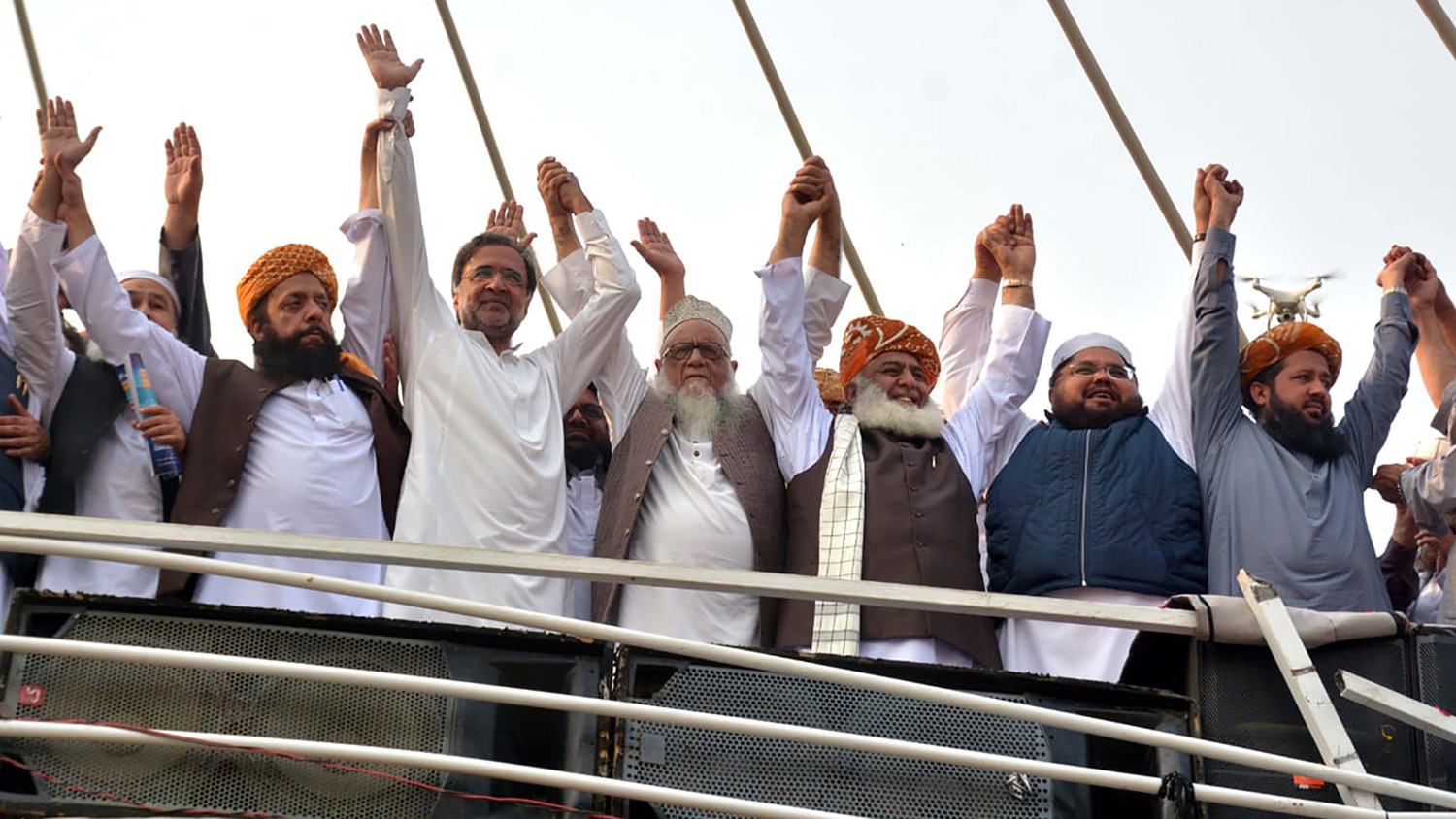
Leaders of opposition parties – Qamar Zaman Kaira of Pakistan People’s Party and Sajid Mir of Jamiat Ahle Hadith – share the stage with JUI-F leaders in Lahore on Oct. 30, 2019. (AN Photo by Shafiq Malik)
The official gathering, which brought together representatives of various law enforcement agencies and security forces, decided to use the police as the first line of defense while adding that it would get requisite support from the Rangers, if required.
The meeting also made it clear that the city’s Red Zone that houses Diplomatic Enclave and various government installations would constitute a no-go area for the protestors.
The Islamabad Traffic Police also released route maps for the residents of the federal capital, hoping to make it somewhat convenient for them to move around the heavily barricaded city.
Earlier in the day, JUI-F Chief Maulana Fazlur Rehman addressed a big gathering in Pakistan’s second largest city, Lahore, before resuming his march to Islamabad.

Maulana Fazlur Rehman addressing Azadi March at Minar-e-Pakistan Lahore before leaving for Islamabad on Oct. 30, 2019. (AN Photo by Shafiq Malik)
Rehman claimed every Pakistani was concerned about the government’s policies, adding that doctors, traders and teachers were out on the streets to protest against the current administration. He continued that people were suffering due to enduring price hikes, adding that Pakistan’s economic graph had nose-dived and its financial situation looked bleak.
“It is not a protest, it is not a march, and it is not a sit-in,” he said while explaining the anti-government agitation. “It is a movement: A movement for the rights of the masses and to get rid of the IMF [International Monetary Fund] agents … Every Pakistani supports this movement.”
“Azadi [freedom] March is the voice of every oppressed soul in Pakistan,” he continued.
Lahore is considered to be the stronghold of the Pakistan Muslim League-Nawaz (PML-N) party, one of the biggest opposition factions in the country whose top leader, Nawaz Sharif, is currently undergoing a medical treatment in one of the hospitals in the city and had instructed his party workers to join the JUI-F agitation.
Rehman announced a protest campaign earlier this month aimed at ousting Khan, raising the prospect of political turmoil as the government struggles to stabilize the economy.
Protesters set off out on Sunday from the southern port city of Karachi and plan to undertake a 1,440-kilometer-long journey to the country’s capital, passing through major Pakistani cities.
As the caravan moves toward Islamabad, analysts predict the show will be the biggest public gathering in the federal capital since a 2014 sit-in by Khan, then an opposition leader, against the government of former PM Nawaz Sharif.
Khan won last year’s election on a promise to end corruption and help middle-class families but the economy is running into headwinds and the government in July agreed to a $6 billion bailout from the International Monetary Fund.
Election authorities rejected opposition complaints of rigging in the 2018 vote, and Khan said in statements reported by media recently that he would not resign or be “blackmailed” by protesters.
Rehman is a veteran politician who heads an alliance with several seats in the National Assembly and provincial assemblies. But his real influence comes from his ability to mobilize support, particularly in numerous religious schools, or madrasas, across the country.
The main opposition parties of former prime ministers Nawaz Sharif and Benazir Bhutto have both said they would back Rehman’s campaign against Khan, though have also said they would not support any unconstitutional action.