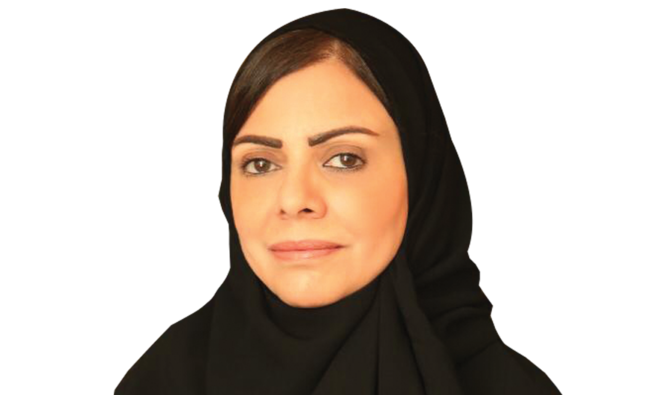
Fatmah Baothman, the first woman in the Middle East with a PhD in AI

Fatmah Baothman
Updated 30 October 2019
Follow

Fatmah Baothman, the first woman in the Middle East with a PhD in AI

  • Dr. Fatmah Baothman played a vital role in establishing King Abdul Aziz University’s computer science department for women, and became the first appointed teaching assistant in the department

Jeddah-born Dr. Fatmah Baothman is the first woman in the Middle East with a Ph.D. in modern artificial intelligence (AI).
Her AI journey started when she was a student at the University of Arizona studying English. She was introduced to computer systems that help non-native English speakers. The level of machine communication and interaction fascinated her.
In 2003, she graduated from the School of Computing and Engineering at the University of Huddersfield in the UK, where she obtained a Ph.D. in phonology-based automatic speech recognition for Arabic. Her work primarily focused on AI, and she was exposed to forecasting, pattern recognition, phonology and phonetics, acoustics, machine learning and mathematics.
She is the first Middle Eastern woman to have won two international awards in AI from the US and the UK.  She has been a guest speaker and moderator at many regional and global technology forums. She has authored several books on AI, and her articles have been published in magazines and scientific journals.
Baothman has also translated a book on modern AI to help Arabic speakers gain a better understanding of the subject.
Baothman has held several positions, among them Apple center manager, director of the education sector at King Abdullah Economic City, director of the E-learning Researcher Program in Dubai, deputy director of the information technology (IT) center at King Abdul Aziz University (KAU), and president of the Women Engineers Committee at the Saudi Council of Engineering.
She has worked at KAU for more than 25 years as an assistant professor in computing and IT. She has recently been appointed as the board president of the Artificial Intelligence Society.
She played a vital role in establishing KAU’s computer science department for women, and became the first appointed teaching assistant in the department.


Automatic defense systems ‘hugely important’ in dealing with threats

Updated 9 sec ago
Follow

Automatic defense systems ‘hugely important’ in dealing with threats

RIYADH: Automatic defensive systems that respond to threats in real time without human intervention are “hugely important” in modern air defense, a senior executive at Lockheed Martin told Arab News at the World Defense Show in Riyadh on Thursday.

Joseph Rank, chief executive and vice president at Lockheed Martin Saudi Arabia and Africa, said the ability to connect detection systems directly to interceptors without delay is critical when responding to fast-moving threats such as missiles and drones.

“Integration is hugely important today. There’s so many threats, and the way you deal with threats in a real-time basis is by having everything integrated,” Rank said.

He described systems in which sensors identify incoming projectiles and automatically communicate with defensive assets.

“Your sensors or your radars have to see the incoming missiles or drones, but you don’t want to wait and have a human in loop … The sensors communicate automatically to the missiles that are going to knock those out of the air,” he said.

Rank said latency must be minimal to ensure an effective response.

“The latency has to be almost like nothing there, like a nanosecond, so that immediately, when you pick up that incoming missile or drone, it’s automatically communicated, no human in the loop that’s there,” he said.

He spoke about how the company uses a system called Command IQ to support this interconnectivity, linking sensors and interceptors in real time and incorporating artificial intelligence to assess response options.

The system works by “connecting everything together, sensors to shooters in real time, and it also integrates artificial intelligence. So, it gives you the best options.

“You might have three or four options to shoot or eliminate that drone. It gives you what’s the most cost-effective, what has the most probability of kill. And so, it helps you protect your citizens here, the citizens of the Kingdom.”

Beyond system integration, Rank also addressed the company’s operations in Saudi Arabia, describing a shift from supplying equipment to carrying out manufacturing and maintenance activities locally.

“We used to sell things to the Kingdom. Now we actually make things here in the Kingdom,” he said.

The company is meeting or exceeding the country’s 60 percent localization requirement and is investing in workforce development, he added.

Rank said that the company, which has operated in Saudi Arabia for 60 years, intends to continue expanding its role, including through future co-development of systems in Saudi Arabia.

“We’re going to build new things here in the Kingdom that will be for the Kingdom’s use, and we will export abroad.”

The company also announced in a statement on Thursday that it signed a memorandum of understanding with the Arabian International Co. for Steel Structures to expand localized production of components for the advanced Terminal High Altitude Area Defense weapon system.