

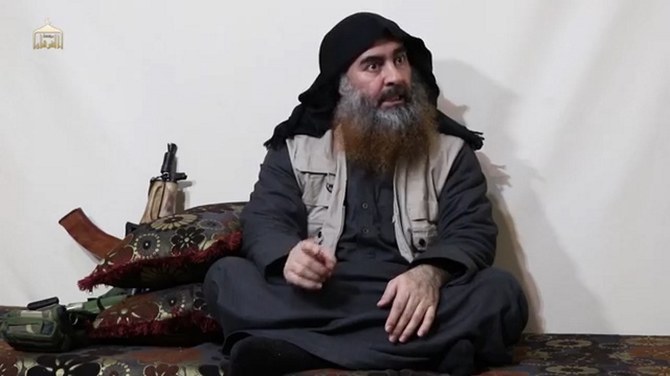
Daesh chief Baghdadi buried at sea by US military

The US Army reportedly targeted Daesh group leader Abu Bakr Al-Baghdadi. (AFP)
Updated 29 October 2019
Follow

Daesh chief Baghdadi buried at sea by US military

  • His death marks a devastating blow to the Daesh, says US Defense Secretary
  • Saudi Crown Prince Mohammad bin Salman offered US President Donald Trump his congratulations on the raid 

WASHINGTON: US officials have said the body of Daesh chief Abu Bakr Al-Baghdadi was buried at sea, as fresh details surfaced about the US special forces operation that led to his death over the weekend.
Syrian Kurds claimed to be a key source of the intelligence that led Americans to Baghdadi after years of tracking the man behind a five-year reign of terror across much of Iraq and Syria.
And an unnamed US military dog became an unlikely hero of the raid, incurring injuries as it chased Baghdadi down a dead-end tunnel underneath his northwestern Syria hideout, where the jihadist blew himself and three children up with a suicide vest.
The US military basked in success Monday after eliminating the founder and spiritual guide of the Islamic State (IS) group, capping a years-long campaign to crush the Sunni Muslim extremist organization that had at one point created a “caliphate” the size of England.
“His death marks a devastating blow to the remnants of (IS),” said Defense Secretary Mark Esper.

He praised the nearly hundred-strong force that helicoptered to the rural compound in the Idlib region of Syria in a complex mission that required coordination with Russians, Kurds, Turks and President Bashar Assad’s regime to prevent US aircraft from being fired upon.
“They executed the raid in all of its facets brilliantly,” Esper said.
Joint Chiefs of Staff Chairman General Mark Milley said no one was injured in the operation, despite the US team taking fire when they arrived.
They took two men prisoner, and Baghdadi’s body was taken to a secure facility for a DNA test that would confirm his identity, Milley said.
“The disposal of his remains has been done, is complete and was handled appropriately,” he added, saying it was handled “in accordance with the law of armed conflict.”
Another Pentagon official confirmed that Baghdadi’s body was put into the sea at an unnamed location, similar to the 2011 sea burial of Al-Qaeda leader Osama bin Laden after his death in a US special forces raid in Pakistan.

A Kurdish official said an inside source the group oversaw was responsible for leading US forces to Baghdadi’s hideout, helping to map out the interior of the compound, its staffing, as well as making it possible for them to identify Baghdadi.
“Since 15 May, we have been working together with the CIA to track Al-Baghdadi and monitor him closely,” said Polat Can, a senior adviser to the Kurdish-led Syrian Democratic Forces.
The group had an informant who was able to infiltrate Baghdadi’s house.
“Al-Baghdadi changed his places of residence very often,” he said on Twitter.
“Our intelligence source was involved in sending co-ordinates, directing the airdrop, participating in and making the operation a success until the last minute,” Polat Can said.
The source also “brought Al-Baghdadi’s underwear to conduct a DNA test and make sure (100%) that the person in question was Al-Baghdadi himself,” he said.

Attention focused as well on the unnamed dog — likely a Belgian Malinois, a breed favored by the military, which chased Baghdadi into a tunnel under the complex and cornered him before he detonated his suicide vest.
Trump praised the dog on Sunday as “beautiful,” but military officials said any information about it, including its name, was secret.
“It’s classified, we’re protecting the dog’s identity,” said Milley.
The dog had been “slightly wounded and is fully recovering,” he said.

On Monday, Saudi Crown Prince Mohammad bin Salman offered US President Donald Trump his congratulations on the raid.
“The Crown Prince congratulated the President on the United States successful mission to bring Daesh founder and leader Abu Bakr Al-Baghdadi to justice,” the White House said in a statement.
US officials said Baghdadi’s death would not end the conflict in Syria, but warned Washington could not be relied on to bring peace to the region.
“Baghdadi’s death will not rid the world of terrorism or end the ongoing conflict in Syria,” said Esper.
“The security situation in Syria remains complex,” he said, adding: “Acting as a police force out to solve every dispute is not our mission.”
But he said the death of Baghdadi “will certainly send a message to those who would question America’s resolve and provide a warning to terrorists who think they can hide.”


India’s wealthy embrace a new luxury symbol: water

Updated 2 sec ago
Follow

India’s wealthy embrace a new luxury symbol: water

  • Tap water in India is not fit for human consumption
  • Wealthy opt for premium water as wellness craze boosts industry
NEW DELHI: At an Indian gourmet food store, Avanti Mehta is organizing a blind tasting of drinks sourced from France, Italy and India. No, ​this isn’t wine, it’s water.
Participants use tiny shot glasses to check the minerality, carbonation and salinity in samples of Evian from the French Alps, Perrier from southern France, San Pellegrino from Italy and India’s Aava from the foothills of the Aravalli mountains.
“They will all taste different ... you should be choosing a water that can give you some sort of nutritional value,” said Mehta, who is 32 and calls herself India’s youngest water sommelier, a term usually associated with premium wine. Her family owns the Aava mineral water brand. Premium water is a $400 million business in the world’s most populous nation and is growing bigger as its wealthy see it as a new status symbol that fits in with a spreading wellness craze.
Premium Indian mineral water costs around $1 for a one-liter bottle, while imported brands are upwards of $3, or 15 times the price of the country’s lowest-priced basic bottled water.
Clean water is a privilege in the country of 1.4 billion people where ‌researchers say 70 percent of ‌the groundwater is contaminated. Tap water remains unfit to drink, and 16 people died in Indore city ‌after ⁠consuming contaminated ​tap water ‌in December.
Many in India see bottled water as a necessity and standard 20 US-cent bottles are available widely at convenience stores, restaurants and hotels. The market is worth nearly $5 billion annually and is set to grow 24 percent a year — among the fastest in the world.
Bottled water demand in United States or China is driven by convenience, making it a $30 billion-plus market in each country which will grow just 4-5 percent each year, Euromonitor says.
In India, the premium water segment is leading the surge in demand, accounting for 8 percent of the bottled water market last year compared to just 1 percent in 2021, Euromonitor said.
“Distrust of municipal water in some areas has escalated the demand for bottled water. Now, people understand how mineral water has more health benefits. It’s expensive, but the category will boom,” said Amulya Pandit, a senior consultant at Euromonitor specializing in the drinks ⁠market.
Among its consumers are New Delhi-based real estate developer B.S. Batra, who says his family uses only premium water at home to get more minerals and safeguard health.
“You feel different, more energetic during the day,” ‌said Batra, 49, an avid badminton player.
“I consume mineral water even with whisky at home, and ‍kids use it for their smoothies.”

WATER LURES BOLLYWOOD STAR, WEALTHY
The popular 20-cent plastic ‍bottled water is mainly made by Pepsi, Coca-Cola and Indian market leader Bisleri. In addition, Indians who can afford it, install purifiers in their homes which ‍clean the water but also remove most minerals.
Imported and local premium waters are luring wealthy consumers and businesses alike.
Bollywood star Bhumi Pednekar and her sister have launched Backbay — selling 750 ml cartons of mineral water for $2.2; Indian conglomerate Tata is expanding its premium water portfolio, and retailers and businesses are reporting higher sales.
Tata Consumer Products, also Starbucks’ partner in India, sells 20-cent bottled water, but premium water is its priority as it sees affluent, health-focused consumers willing to spend on the drink without worrying about the price, CEO Sunil D’Souza said in ​an interview.
“I don’t have to push water uphill...I see a long, long, long runway for the business,” he said.
Tata’s premium “Himalayan” mineral water factory — which a Reuters photographer visited — is located in the foothills of the Himalayan range in Himachal Pradesh state. Workers there largely ⁠keep a hands-free watch on machines filling plastic and glass bottles with water sourced from a natural underground aquifer.

LOOKING FOR SPRINGS
Most Indians prefer still water, and the sparkling variant remains niche. Tata said it plans to launch a sparkling Himalayan water, and is also scouting for natural springs for expanding its other offerings. At three Foodstories Indian gourmet stores, sales of premium waters tripled in 2025. Customer demand prompted the chain to import “light and creamy” Saratoga Spring Water from New York, which costs 799 rupees ($9) for a 355-milliliter (12-fluid-ounce) bottle, and stocks sold out within days, said co-founder Avni Biyani.
Indian mineral water brand Aava’s sales touched a record 805 million rupees ($9 million) last year, growing 40 percent a year since 2021. Tata said its basic and premium water portfolio will grow 30 percent a year, after growing tenfold to $65 million in six years.
Imported waters, which attract an over 30 percent tax, are pricier than Indian brands. Nestle’s Perrier and San Pellegrino, and Danone’s Evian retail for over 300 rupees, or $3.20, for a 750 ml bottle.
Nestle declined to comment, while Danone said the Indian bottled water market was growing at a “robust” pace but imported waters “tend to be niche and boutique.”
“When you open your tap, you’re not getting an Aava, Evian ... And that is what you’re essentially paying for,” said water sommelier Mehta.
At the water tasting session, some participants said they enjoyed the experience ‌but many found the price hard to swallow.
“To be honest, it is kind of expensive,” said executive Hoshini Vallabhaneni, one of 14 people at the event. “For everyday use — it will burn a hole in the pocket.” (Reporting by Aditya Kalra in New Delhi and Rishika Sadam in Hyderabad; Additional reporting by Alexander Marrow in London and Anushree Fadnavis ‌in Himachal Pradesh; Editing by Raju Gopalakrishnan)