

Afghan rival camps concerned over further delay in poll results

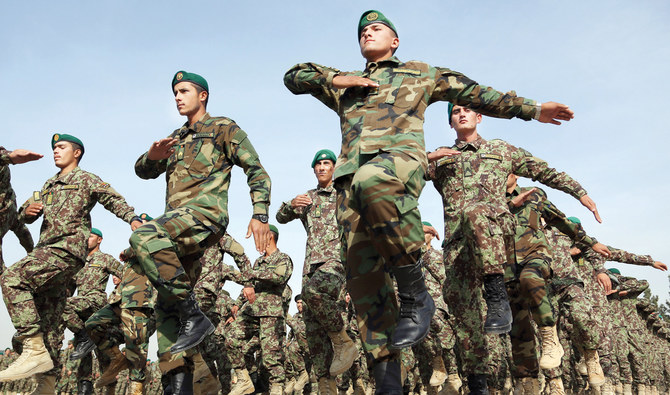
Newly graduated Afghan National Army soldiers march during a ceremony at the Afghan Military Academy in Kabul after a three-month training program. (AP)
Updated 29 October 2019
Follow

Afghan rival camps concerned over further delay in poll results

  • Independent Election Commission says outcome will be published on Nov. 14

KABUL: The camps of the two frontrunners in Afghanistan’s presidential election voiced concern on Monday about a further delay in the announcement of last month’s poll results.

On the basis of the timeline of the election, which was already delayed twice and saw the lowest turnout of any ballot held in Afghanistan since the Taliban’s ouster, the Independent Election Commission (IEC) failed to release the preliminary results on Oct. 19.

Officials of the government-appointed body said at the time that the IEC would announce the results within a week. 

But on Sunday the head of the IEC, Hawa Alam Nuristani, said the outcome would be published on Nov. 14, which will push back the declaration of the final results too.

The IEC cited technical issues and hacking of its server as the main reasons for the delay. 

This has created skepticism that the process will create a crisis similar to the 2014 polls, which progressed to the second round and led to — based on a deal brokered by Washington — Ashraf Ghani becoming president and his arch rival Abdullah Abdullah becoming chief executive.

FASTFACT

Afghanistan welcomed the killing of Daesh leader Abu Bakr Al-Baghdadi as a major blow to terrorism that is expected to weaken the South Asian branch of the Middle Eastern militant group.

“Despite the fact that we’re concerned about any delay (in the announcement of the poll results), if that aids the transparency of the election then it’s bearable,” Fazl Ahmad Manawi, a chief manager for Abdullah, told Arab News.

Harun Mir, an official representing Ghani’s side, said: “We see no legal or moral justification for delaying the results. People expect the IEC to explain with transparency the reasons for it.”

Officials of the two camps said divisions between IEC commissioners, the partiality of some of the nominees and poor management were the causes for the postponement.

Asked if the delay was part of a compromise to allow the resumption of US talks with the Taliban so the group is given a share in the future setup, Manawi said: “I don’t see any political plot, but anything is possible in Afghanistan.”

The US special envoy for Afghanistan, Zalmay Khalilzad, is currently in Kabul, where he has met with Ghani, Abdullah and other influential Afghan politicians to discuss resuming talks with Taliban.

The Taliban wants the withdrawal of US-led troops from Afghanistan, considers Ghani’s administration a US “puppet,” and says it will not accept elections under occupation.

Speaking at the Council of Ministers meeting on Monday, Abdullah said both the talks and election process were very important for Afghanistan.

“We must act on opportunities for peace, but at the same time we mustn’t forget a transparent election result,” he added.

“A transparent election will rescue democracy and the democratic process, and will bring stability to the country. We’re asking the IEC to keep its independence for the remainder of the process.”


US allows oil majors to broadly operate in Venezuela, new energy investments

Updated 14 February 2026
Follow

US allows oil majors to broadly operate in Venezuela, new energy investments

  • Treasury Department issues general license allowing Chevron, BP, Eni, Shell and Repsol to operate oil and gas operations in Venezuela
  • Move is the most significant relaxation of sanctions on Venezuela since US forces captured and removed President Nicolas Maduro

WASHINGTON: The US ​eased sanctions on Venezuela’s energy sector on Friday, issuing two general licenses that allow global energy companies to operate oil and gas projects in the OPEC member and for other companies to negotiate contracts to bring in fresh investments. The move was the most significant relaxation of sanctions on Venezuela since US forces captured and removed President Nicolas Maduro last month.
The Treasury Department’s Office of Foreign Assets Control issued a general license allowing Chevron, BP, Eni, Shell and Repsol to operate oil and gas operations in Venezuela. Those companies still have offices in the country and stakes in projects, and are among the main partners of state-run ‌company PDVSA.
The authorization ‌for the oil majors’ operations requires payments for royalties and Venezuelan ​taxes ‌to ⁠go through ​the US-controlled ⁠Foreign Government Deposit Fund.
The other license allows companies around the world to enter contracts with PDVSA for new investments in Venezuelan oil and gas. The contracts are contingent on separate permits from OFAC.
The authorization does not allow transactions with companies in Russia, Iran, or China or entities owned or controlled by joint ventures with people in those countries.
The licenses “invite American and other aligned companies to play a constructive role in supporting economic recovery and responsible investment, ” the US State Department said in a release. Additional authorizations may be issued “as necessary,” it said.
A spokesperson for Chevron, ⁠the only US oil firm currently operating in Venezuela, said the company welcomed ‌the new licenses.
“The new General Licenses, coupled with recent changes ‌in Venezuela’s Hydrocarbons Law, are important steps toward enabling the further development ​of Venezuela’s resources for its people and for advancing ‌regional energy security,” the spokesperson said in a statement.
Eni said it is assessing the opportunities in ‌Venezuela that the authorization opens up.

Oil law reform

The US licenses follow a sweeping reform of Venezuela’s main oil law approved last month, which grants autonomy for foreign oil and gas producers to operate, export and cash sale proceeds under existing joint ventures with PDVSA or through a new production-sharing contract model.
The US has had sanctions on Venezuela since ‌2019 when President Donald Trump imposed them during his first administration. Trump is now seeking $100 billion in investments by energy companies in Venezuela’s oil and gas sector. ⁠US Energy Secretary Chris Wright ⁠said on Thursday, during his second day of a trip to Venezuela, that oil sales from the country since Maduro’s capture have hit $1 billion and would hit another $5 billion in months.
Wright said the US will control the proceeds from the sales until Venezuela stands up a “representative government.” Since last month, the Treasury issued several other general licenses to facilitate oil exports, storage, imports and sales from Venezuela. It also authorized the provision of US goods, technology, software or services for the exploration, development or production of oil and gas in Venezuela.
The Venezuelan government expropriated assets of Exxon Mobil and ConocoPhillips in 2007 under then-President Hugo Chavez. The Trump administration is trying to get those companies to invest in Venezuela as well. At a meeting at the White House with Trump last month, Exxon Mobil CEO Darren Woods said Venezuela was “uninvestable” at ​the moment.
Wright said on Thursday that Exxon, ​which no longer has an office in Venezuela, is in talks with the government there and gathering data about the oil sector. Exxon did not immediately comment.